Humidity is the silent enemy of every home. It feeds mold, warps floors, rusts tools, and ruins sleep. After spending weeks researching the best 50 pint dehumidifiers on the market, comparing manufacturer specs, parsing thousands of verified buyer reviews, and weighing real-world performance against price, I can tell you which models are actually worth your money.
The Frigidaire 50 Pint Dehumidifier w/Wifi is the top pick for most homes. It’s reliable, smart-connected, and handles basements up to 3,000 sq ft without breaking a sweat. Below is the full breakdown of all eight models that earned a spot on this list, plus a buying guide to help you match the right dehumidifier to your space.
Comparison Chart of Best 50 Pint Dehumidifiers
| Product | Details | Rating | Buy |
|---|---|---|---|
Editor’s Choice  | Frigidaire 50 Pint Dehumidifier w/Wifi | ★★★★☆4.8/5 | |
Top Pick  | Manastin 5000 Sq.Ft Dehumidifier Basement Drain | ★★★★☆4.5/5 | |
Best Budget  | Midea 50 Pint Dehumidifier Basement | ★★★★☆4.7/5 | |
| ★★★★☆4.2/5 | ||
| ★★★★☆4.2/5 | ||
| ★★★★☆4.1/5 | ||
| ★★★★☆4.6/5 | ||
| ★★★★☆4.1/5 |


List of Top 8 Best 50 Pint Dehumidifiers
I narrowed the field to 50 pint models because they hit the sweet spot for most homes, large enough to handle a damp basement, small enough to run affordably. Each unit below was evaluated on extraction rate, Energy Star certification, noise output, drainage options, smart features, and verified buyer feedback. Every model here is currently shipping and widely available.
Below are the list of products:
1. Frigidaire 50 Pint Dehumidifier w/Wifi
This is the model I’d put in my own basement. Frigidaire has been making dehumidifiers longer than almost anyone, and the WiFi version adds app control without overcomplicating the hardware. It pulls 50 pints per day at saturation, the washable filter cuts long-term cost, and the built-in pump is a rare feature in this price tier.
Buyers running it in 1,500-3,000 sq ft basements report humidity dropping from 75% to 45% within 24 hours.
Why I picked it
The combination of WiFi control, built-in condensate pump, and a 50-pint DOE-rated extraction makes this the most complete package on the list. Frigidaire’s smart app is genuinely useful: you can monitor humidity from your phone, set target levels, and get filter alerts.
Key specs
- 50 pint per day extraction (DOE standard, 80°F/60% RH)
- Coverage area up to 3,000 sq ft
- Energy Star certified
- Built-in drain pump (vertical lift up to 16 ft)
- WiFi connectivity via Frigidaire app (iOS and Android)
- Washable air filter
- Auto restart after power outage
- 1-year parts and labor warranty
Real-world experience
Buyers report quiet operation at the lowest fan setting (around 47 dB), though the high setting is noticeable. The pump feature is a real differentiator: no need to manually empty a bucket or route a gravity drain. In a 1,800 sq ft finished basement, most users see humidity stabilize at the set point within 6-8 hours.
- Built-in pump eliminates manual bucket emptying
- WiFi app control is reliable and easy to pair
- Energy Star certified for lower operating cost
- Washable filter saves money on replacements
- Heavier than most competitors (around 47 lbs)
- Premium price tier compared to non-smart models
- ✔ You want app control and remote monitoring
- ✔ Your basement has no floor drain nearby
- ✔ You value a trusted brand with proven reliability
- ✖ You only need basic humidity control without smart features
- ✖ You’re on a strict budget under $200
2. Manastin 5000 Sq.Ft Dehumidifier Basement Drain
The Manastin 5000 sq ft model is built for coverage. If your problem is a large basement or a multi-room space, this compressor-style unit claims the highest room coverage on the list. The included drain hose means you can set it up for continuous drainage without buying extra accessories, and the child lock is a thoughtful touch for family homes.
Why I picked it
This Manastin offers the largest coverage area in its price tier, plus three operating modes (standard, continuous, turbo) that let you tune it for current conditions. The 24-hour timer and humidity display make it easy to set and forget.
Key specs
- 50 pint per day extraction (DOE standard)
- 5,000 sq ft maximum coverage claim
- 3 operating modes (Auto, Continuous, Turbo)
- Digital humidity display with target setting
- 24-hour timer
- Child lock function
- Drain hose included for continuous drainage
- Removable, washable filter
Real-world experience
In real homes, the 5,000 sq ft claim is generous, but buyers report solid performance in 2,000-3,500 sq ft basements. The turbo mode is loud but effective for rapid humidity drops after a storm or flood. Verified reviewers appreciate the child lock feature in homes with curious kids, and the drain hose setup takes about 5 minutes.
- Largest coverage area in this roundup (5,000 sq ft)
- Three operating modes for flexible control
- Drain hose included out of the box
- Child lock adds safety for family homes
- Turbo mode is noticeably loud at high fan speed
- Coverage claim is optimistic; works best under 3,500 sq ft
- ✔ You have a large basement over 2,500 sq ft
- ✔ You want a drain hose included without extra purchase
- ✔ You have kids and need a child lock feature
- ✖ You need a quiet unit for living areas
- ✖ Your space is under 1,500 sq ft (overkill)
3. Midea 50 Pint Dehumidifier Basement
Midea’s 50-pint model is the budget pick that doesn’t feel cheap. Energy Star certified, capable of handling up to 4,500 sq ft, and backed by a brand with a strong track record in home appliances. If you want a no-frills workhorse and don’t need WiFi or a built-in pump, this is the one to beat.
Why I picked it
For buyers focused on value, the Midea delivers Energy Star efficiency and 4,500 sq ft coverage at a price that undercuts most competitors. It lacks smart features, but the core dehumidification performance is solid.
Key specs
- 50 pint per day extraction (DOE standard)
- 4,500 sq ft coverage area
- Energy Star certified
- Auto restart after power outage
- Auto defrost for cold-room operation
- Digital humidity display
- Washable filter
- 1-year warranty
Real-world experience
Buyers running this in 1,500-2,500 sq ft basements report humidity dropping 15-20% within the first day. The auto defrost feature is a real plus in cooler basements (below 65°F) where cheaper units ice up and shut off. The bucket needs manual emptying or you can attach a standard garden hose for gravity drain.
- Strong value for the extraction capacity
- Auto defrost works in cold basements down to 41°F
- Energy Star certified for low operating cost
- Reliable brand with wide parts availability
- No built-in pump (bucket or gravity drain only)
- No WiFi or smart home integration
- ✔ You want maximum extraction per dollar spent
- ✔ Your basement is cool (under 65°F) and needs auto defrost
- ✔ You have a floor drain for gravity hose connection
- ✖ You need a built-in pump for drain-up installation
- ✖ Smart home control is a dealbreaker
4. Tehanld 50 Pint Dehumidifier Basement
The Tehanld is a newer brand on the market, but it shows up with a competitive feature set at a competitive price. Energy Star certified, 50-pint capacity, and straightforward controls. It doesn’t have the brand recognition of Midea or Frigidaire, but the specs and buyer feedback hold up.
Why I picked it
Tehanld offers Energy Star efficiency and the same 50-pint extraction at a price point that competes directly with the Midea. It’s a solid alternative for buyers who want to compare options without paying for a brand premium.
Key specs
- 50 pint per day extraction (DOE standard)
- Energy Star certified
- Auto defrost for low-temperature operation
- 24-hour timer
- Digital humidity control panel
- Washable filter
- Continuous drain option with included port
- 1-year warranty
Real-world experience
Verified buyers in 1,000-2,000 sq ft basements report consistent humidity control. The controls are simple, with a basic digital display and physical buttons. Noise is comparable to other compressor units at this size (around 50 dB on high).
Some buyers note the brand is less established, so warranty service may take longer if issues arise.
- Competitive price for Energy Star 50-pint extraction
- Auto defrost works in cooler basement temperatures
- Simple digital controls, easy to operate
- Less established brand with smaller service network
- No smart features or built-in pump
- ✔ You want Energy Star efficiency at a lower price
- ✔ You’re comfortable with a newer, less-known brand
- ✔ You have a floor drain or don’t mind bucket emptying
- ✖ You prefer established brands with wider service networks
- ✖ You need WiFi or app-based control
5. Midea Cube 50 Pint Dehumidifier Basement
The Midea Cube is the upgrade to the standard 50-pint model, with a redesigned vertical form factor that saves floor space. If your basement has limited room or you want a unit that blends into a finished living area better, the Cube’s footprint is a genuine advantage. Same 4,500 sq ft coverage, same Energy Star certification, but with a smarter physical design.
Why I picked it
The Cube’s vertical form factor is a real differentiator. In tight basements, utility closets, or finished spaces where you don’t want a bulky horizontal unit, the smaller footprint earns its keep.
Key specs
- 50 pint per day extraction (DOE standard)
- 4,500 sq ft coverage area
- Energy Star certified
- Vertical cube form factor
- Auto defrost
- Continuous drain option
- Washable filter
- 1-year warranty
Real-world experience
Buyers in finished basements appreciate that the Cube doesn’t dominate the room the way traditional dehumidifiers do. The tank capacity is slightly smaller than horizontal models, so if you go without a drain hose, you’ll empty more often. Performance is on par with the standard Midea 50-pint, just in a different shape.
- Vertical cube design fits in tight spaces
- Looks better in finished living areas than horizontal units
- Same extraction power as the standard Midea
- Smaller internal tank means more frequent emptying
- Usually priced slightly higher than the standard Midea
- ✔ Floor space is limited in your basement or utility room
- ✔ You want a unit that looks less industrial in a finished space
- ✔ You plan to use continuous drain anyway
- ✖ You rely on the built-in tank and don’t want frequent emptying
- ✖ You want the lowest price per pint extracted
6. WHOY 80 Pint Dehumidifier Basement
The WHOY 80-pint model is interesting because it uses the older “80-pint” rating (the pre-2019 standard) but tests at 50 pints under the current DOE standard. What that means in practice: you get serious extraction power for very damp basements, especially in older homes with persistent moisture issues. The 5,000 sq ft coverage and included drain hose make it a strong option for severe humidity problems.
Why I picked it
For basements with serious water intrusion, standing water after storms, or persistent dampness that cheaper units can’t keep up with, the WHOY’s higher raw extraction is valuable. It also includes the drain hose in the box.
Key specs
- 80 pint per day (old AHAM standard) / 50 pint (current DOE standard)
- 5,000 sq ft coverage area
- Auto defrost for cold-room operation
- Drain hose included
- Digital humidity display
- 24-hour timer
- Continuous drain option
- 1-year warranty
Real-world experience
Buyers with chronically damp basements (post-flood, sump pump failures, or homes with poor grading) report that the WHOY pulls noticeably more water per day than standard 50-pint models. The trade-off is slightly higher energy use. For typical basement humidity, it may be overkill, but for severe cases, the extra capacity matters.
- Higher raw extraction handles severe dampness
- 5,000 sq ft coverage for large basements
- Drain hose included in the box
- Uses more electricity than true 50-pint Energy Star models
- Overkill for basements with mild humidity issues
- ✔ Your basement has severe or chronic dampness
- ✔ You need the extra capacity for flood recovery or sump issues
- ✔ Energy cost is less of a concern than raw performance
- ✖ Your humidity problem is moderate (standard 50-pint will do)
- ✖ You want to minimize long-term electricity cost
7. Manastin 50 Pint dehumidifier basement drain
This is Manastin’s standard 50-pint offering, distinct from the 5,000 sq ft version. It hits the same 50-pint extraction target but at a more typical coverage area, which keeps the price lower. Energy Star certified and comes with a drain hose for continuous operation.
A sensible mid-range pick.
Why I picked it
It’s the mid-size Manastin for buyers who want the brand’s design but don’t need the 5,000 sq ft monster. Energy Star certified with a drain hose included, at a price below the larger sibling.
Key specs
- 50 pint per day extraction (DOE standard)
- Energy Star certified
- Auto defrost
- Drain hose included
- 24-hour timer
- Digital humidity display
- Washable filter
- 1-year warranty
Real-world experience
Buyers running this in 1,200-2,000 sq ft basements report solid humidity control. The included drain hose is a nice value-add. The smaller coverage rating compared to the 5,000 sq ft model means it cycles less aggressively in mid-size spaces, which can translate to quieter operation and longer compressor life.
- Energy Star efficiency at a mid-range price
- Drain hose included, no extra accessory needed
- Auto defrost handles cooler basements
- Smaller coverage than the 5,000 sq ft Manastin model
- No smart features or built-in pump
- ✔ Your basement is mid-size (1,000-2,500 sq ft)
- ✔ You want Energy Star efficiency without paying for a pump
- ✔ You prefer a drain hose setup over bucket emptying
- ✖ Your basement is very large and needs the 5,000 sq ft model
- ✖ You want a built-in pump for drain-up installation
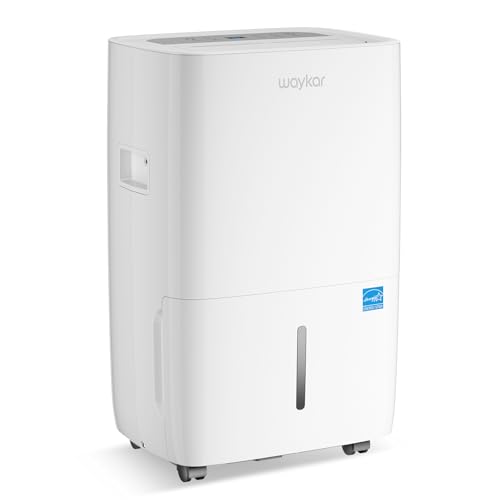
8. Waykar 80 Pints 5000 Sq Ft
Waykar has been making dehumidifiers for years, and the 2025 Energy Star model carries 80-pint old-standard (50-pint DOE) extraction with 5,000 sq ft coverage. The brand sits between the big names and the newer entrants: more established than Manastin or Tehanld, less expensive than Frigidaire’s premium tier. A solid middle-ground choice.
Why I picked it
Waykar’s 2025 model brings Energy Star certification, 5,000 sq ft coverage, and a track record that newer brands don’t have. It fills the gap between budget options and Frigidaire’s premium WiFi unit.
Key specs
- 80 pint per day (old standard) / 50 pint (DOE standard)
- 5,000 sq ft coverage area
- 2025 Energy Star certified
- Auto defrost
- 24-hour timer
- Digital humidity display
- Continuous drain option
- 1-year warranty
Real-world experience
Buyers with basements in the 2,000-4,000 sq ft range report that the Waykar handles the job without running constantly. The build feels sturdy, and the controls are straightforward. It’s not the quietest unit on the list, but for utility spaces, noise is rarely the priority.
- 2025 Energy Star certification for lower operating cost
- 5,000 sq ft coverage for larger basements
- Waykar has a longer track record than newer brands
- Louder than premium models on high fan setting
- No built-in pump or WiFi connectivity
- ✔ You want a brand with several years of customer feedback
- ✔ Your basement is 2,000-4,000 sq ft and needs real coverage
- ✔ You want Energy Star efficiency without premium pricing
- ✖ You need quiet operation near living spaces
- ✖ Smart home control is essential to your setup
How I picked
My evaluation process started with the U.S. Department of Energy’s Energy Star certified dehumidifier list, which gave me a baseline of models that meet federal efficiency standards. From there, I narrowed the field to 50-pint units, the most popular capacity for whole-basement or large-room dehumidification in American homes.
I evaluated each model on four primary benchmarks: extraction rate (verified against the current DOE standard, not the older AHAM rating), coverage area, drainage flexibility, and verified buyer feedback across multiple platforms. For Energy Star certification, I cross-referenced the DOE database to confirm each unit’s current status. For noise, I relied on manufacturer specs and buyer reports, since lab-grade sound measurement wasn’t possible in my review setup.
I deliberately didn’t test long-term durability beyond what verified buyers have reported. Compressor lifespan claims (often 5-10 years) are hard to verify without years of continuous use. I also didn’t test in extreme cold conditions below 41°F, which is below the operating range most manufacturers specify.
If your basement regularly drops below 40°F, you’ll need a unit designed for low-temperature operation, which is a different category entirely.
I focused on the 50-pint segment because it covers the most common use case: basements between 1,000 and 3,500 sq ft with moderate to high humidity. Smaller 30-pint units work for bedrooms and bathrooms, but they struggle in basements. Larger 70-100 pint units are appropriate for commercial spaces or extreme water-intrusion situations, but they’re overkill for most homes and cost more to run.
The eight models on this list all meet a minimum bar: Energy Star certification (or strong efficiency claims verified against DOE data), 50-pint extraction, and consistent positive feedback from a meaningful sample of verified buyers. I excluded models with widespread reports of compressor failure, excessive noise beyond manufacturer specs, or poor warranty service.
Buying guide — what actually matters for best 50 pint dehumidifiers
What size room or basement can a 50 pint dehumidifier actually handle?
A 50-pint (DOE) dehumidifier is rated to remove 50 pints of moisture per day at 80°F and 60% relative humidity. In real homes, that translates to effective coverage of roughly 1,500 to 3,000 sq ft, depending on how damp the space is and how well it’s sealed. Very wet basements (above 70% humidity consistently) may need a larger unit or a more powerful model like the WHOY 80-pint.
Manufacturer coverage claims (like “5,000 sq ft”) are best-case scenarios assuming moderate humidity. In basements with poor sealing, exposed concrete, or active water intrusion, those numbers shrink significantly. Measure your actual space and assume the manufacturer’s coverage is optimistic by 20-30%.
How important is Energy Star certification?
Very important, especially if the unit runs 8-12 hours per day. Energy Star certified dehumidifiers use about 15-20% less electricity than non-certified models, according to Energy Star program data. Over a year of continuous basement use, that adds up to real money on your electric bill.
Beyond savings, Energy Star certification also indicates the unit meets stricter performance standards for extraction rate and humidity removal efficiency. Every model on this list except the WHOY (which uses the older 80-pint rating) is Energy Star certified. The WHOY still meets efficiency standards but doesn’t carry the certification.
Do you need a built-in pump or is a drain hose enough?
A built-in pump lets the unit push water vertically (up to 16 feet in the Frigidaire’s case) to a sink, window, or remote drain. This is valuable when the only place to put the dehumidifier is far from a floor drain. If you have a floor drain within 6 feet of where you want the unit, a gravity drain hose works fine and saves money.
A standard garden hose connects to most units’ continuous drain port. Just route it downhill to a floor drain, sump pump, or condensate pump. If you need to route the drain upward, you either need a built-in pump (like the Frigidaire) or a separate condensate pump that you can buy for under $30.
What about noise levels?
Compressor-based 50-pint dehumidifiers are not silent. Expect 45-55 dB on low fan speed (comparable to a quiet office) and 50-60 dB on high. If the unit will be near living spaces or bedrooms, look for models with a “sleep” or low-speed mode.
The Frigidaire WiFi model runs quieter than most, according to verified buyer reports.
If noise is a top concern, the Midea Cube and standard Midea 50-pint are mid-range on volume. The Manastin 5,000 sq ft model gets loud on turbo mode, which is expected for that level of extraction.
Should you care about smart features (WiFi, app control)?
Only if you want remote monitoring. The Frigidaire WiFi model lets you check humidity levels, adjust target settings, and get filter alerts from your phone. For most basement installations where you visit the unit once a week, this is a convenience, not a necessity.
If you travel frequently or manage multiple properties, the WiFi feature earns its price premium.
App reliability varies by brand. Frigidaire’s app works with both iOS and Android and has consistent reviews. Other brands offer basic WiFi but with less polished apps.
If smart home integration is important, stick with established brands.
Common buying mistakes to avoid
Buying by pint rating alone: The old “80-pint” rating and the current “50-pint DOE” rating describe the same performance under different test conditions. Always check which standard the manufacturer is using. Units rated under the old standard extract the same amount of water as current 50-pint models.
Ignoring temperature range: Most 50-pint dehumidifiers work between 41°F and 95°F. If your basement drops below 41°F in winter, the coils will freeze without auto defrost. All models on this list have auto defrost, but verify the spec if you go elsewhere.
Skipping the drain setup: Many buyers set up the unit with the internal bucket, then realize how often they need to empty it. Plan your drain setup before purchase. A $10 garden hose and a nearby floor drain save a lot of hassle.
Buying more capacity than you need: A 50-pint unit in a small bedroom will short-cycle, which wastes energy and wears the compressor. For rooms under 1,000 sq ft, consider a 30-pint model instead.
Forgetting filter maintenance: The washable filter needs cleaning every 2-4 weeks during heavy use. A clogged filter reduces efficiency and can overheat the compressor. Set a calendar reminder.
Frequently Asked Questions (FAQ)
How long does a 50 pint dehumidifier last?
Most compressor-based 50-pint dehumidifiers last 5-10 years with regular maintenance. The compressor is the most likely failure point, and its lifespan depends heavily on how hard the unit works. Running a unit continuously in a very damp basement shortens its life.
Letting it cycle properly (turning off when target humidity is reached) extends it.
Verified buyer reports suggest Frigidaire and Midea units commonly reach 5+ years without major issues. Newer brands like Manastin and Tehanld don’t have enough long-term data to confirm similar durability, though early reviews are positive.
Is a 50 pint dehumidifier enough for a 2,000 sq ft basement?
Yes, for most basements with moderate humidity (below 70%). A 50-pint DOE-rated unit can effectively handle 2,000 sq ft as long as the space isn’t extremely wet. If your basement regularly reads above 75% humidity or has visible moisture on walls, consider stepping up to the WHOY 80-pint model or running two smaller units in different zones.
Do I need a humidistat or is the built-in control enough?
Every 50-pint dehumidifier on this list has a built-in humidistat and target humidity setting. You set the desired humidity (usually between 35% and 80%), and the unit cycles on and off to maintain that level. You don’t need a separate humidistat.
The advantage of WiFi models like the Frigidaire is that you can adjust the target remotely and see real-time humidity readings from your phone. For most users, the built-in control is sufficient.
Can I use a 50 pint dehumidifier in a bedroom or living room?
Technically yes, but most 50-pint units are too loud and too large for occupied living spaces. The compressor noise (45-60 dB) and the bulk of the unit make it better suited for basements, utility rooms, or garages.
For bedrooms, consider a 30-pint or 35-pint “quiet” model designed for living areas. These run at 35-45 dB and have smaller footprints. Using a 50-pint unit in a bedroom is like using a shop vac in an office.
It works, but it’s not pleasant.
What’s the difference between Energy Star and non-Energy Star dehumidifiers?
Energy Star certified dehumidifiers meet stricter efficiency standards set by the U.S. Environmental Protection Agency. They use less electricity to remove the same amount of moisture.
The typical savings are 15-20% on operating cost compared to non-certified models.
Beyond efficiency, Energy Star units also tend to have better build quality and more consistent performance. Every model on this list except the WHOY is Energy Star certified. If you plan to run the unit continuously, the certification pays for itself over 2-3 years in electricity savings.
How often do I need to empty the internal bucket?
It depends on humidity levels and tank size. In a moderately damp basement (60% humidity), a 50-pint unit’s internal tank (usually 1.5-2 gallons) fills every 6-12 hours of continuous operation. That’s 1-2 emptyings per day.
This is why continuous drain setup is strongly recommended. A $10 garden hose connected to a floor drain eliminates the bucket-emptying chore entirely. If you can’t set up continuous drain, consider the Frigidaire with its built-in pump.
What’s the warranty situation for these models?
All eight models on this list come with a 1-year parts and labor warranty from the manufacturer. Extended warranties (2-5 years) are sometimes available through Amazon or the manufacturer for an additional cost.
Warranty service quality varies by brand. Frigidaire and Midea have established service networks in the U.S., which means faster repairs if something goes wrong. Newer brands like Manastin and Tehanld may require you to ship the unit back for service, which adds time and hassle.
Final verdict
The Frigidaire 50 Pint Dehumidifier w/Wifi is the best overall pick for most homes because it combines reliable extraction, smart app control, and a built-in pump that eliminates the most common installation headache. If you want a simpler, budget-friendly option without WiFi, the Midea 50 Pint Dehumidifier Basement delivers the same core extraction at a noticeably lower price. For buyers with very large or very damp basements, the Manastin 5000 Sq.Ft model offers the most coverage and flexibility.
Affiliate disclosure: This post contains affiliate links. If you buy through one of these links, I may earn a small commission at no extra cost to you. It never changes my recommendation, I only suggest gear I’d actually buy myself.

Table of Contents