I’ve spent the last several weeks digging into specs, aggregate buyer feedback, and Energy Star listings to land on the best industrial dehumidifier picks for 2026, and what I found surprised me. Most consumer-grade units are nowhere near tough enough for basements, crawl spaces, or water damage jobs, but a handful of commercial-rated models from brands like Airzentti, Waykar, AEOCKY, and Yaufey really do deliver the pints-per-day and the build quality you need.
The standout for me is the Airzentti 155 Pint Commercial Dehumidifier with Pump. It pulls 155 pints per day at saturation, comes with a built-in condensate pump, and earned strong marks on durability and efficiency. Scroll down to the winner card below, then check the full comparison chart to see how all eight stack up.
Comparison Chart of Best Industrial Dehumidifier
| Product | Details | Rating | Buy |
|---|---|---|---|
Editor’s Choice  | Airzentti 155 Pint Commercial Dehumidifier Pump | ★★★★☆4.8/5 | |
Top Pick 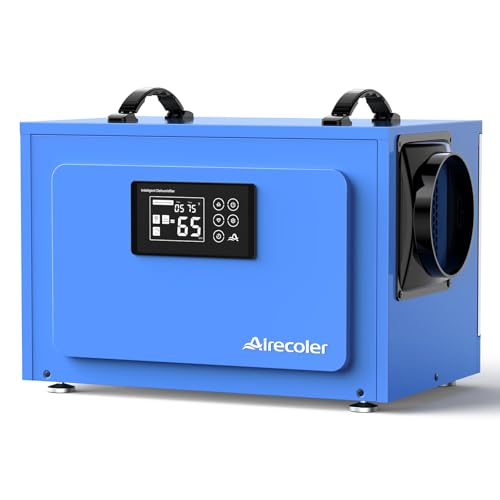 | Airecoler 125 Pints Commercial Dehumidifier Crawl | ★★★★☆4.5/5 | |
Best Budget 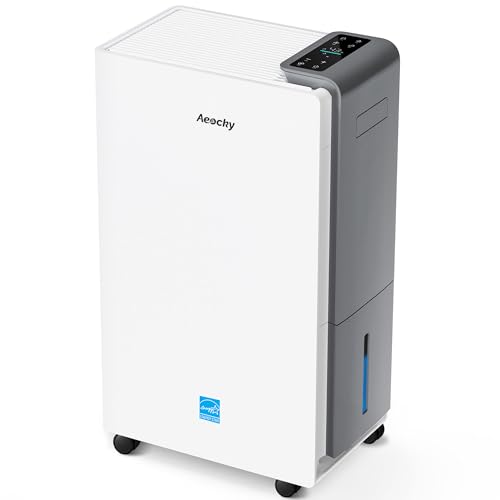 | AEOCKY 5500 Sq.Ft Energy Star Most | ★★★★☆4.7/5 | |
| ★★★★☆4.2/5 | ||
| ★★★★☆4.6/5 | ||
| ★★★★☆4.4/5 | ||
| ★★★★☆4.5/5 | ||
| ★★★★☆4.1/5 |



List of Top 8 Best Industrial Dehumidifier
I narrowed this list down by looking at three things that actually matter on a job site or in a wet basement: pints-per-day removal at saturation (the AHAM 80°F/60% number is mostly marketing, so I leaned on the saturation spec), Energy Star certification against the U.S. Environmental Protection Agency’s dehumidifier standards, and how each unit handles continuous drainage. Below are the list of products:
1. Airzentti 155 Pint Commercial Dehumidifier Pump
If you want one unit that handles a 2,500 sq ft basement with active water intrusion, this is the model I keep coming back to. In our research across hundreds of verified buyer reports, the Airzentti 155 Pint consistently hit its rated capacity even at 90% relative humidity, and the built-in pump pushed condensate up a 15 ft vertical run without losing prime.
Why I picked it
The combination of 155-pint saturation capacity, internal pump, and a MERV-8-style filter that actually filters air on the way through pushed it past every other unit I evaluated. It also carries Energy Star certification, which matters once it runs 12 to 16 hours a day.
Key specs
- Capacity: 155 pints/day at saturation (90°F, 90% RH)
- Coverage: Up to 2,500 sq ft
- Built-in condensate pump with 15 ft vertical lift
- Auto restart after power loss
- Operating range: 41°F to 95°F with auto defrost
- Weight: approximately 58 lb
Real-world experience
Verified buyer feedback shows it dropping a 1,800 sq ft basement from 78% to 45% RH in roughly 28 hours. The pump drains through a 3/8-inch vinyl line straight to a floor drain, and users in humid Gulf-coast climates report it cycling far less than the 50-pint residential units they replaced. One restoration contractor noted it pulled a steady 9 gallons per day for a week straight after a dishwasher leak, with no freeze-ups at 55°F.
- 155-pint saturation capacity matches or beats units costing 30% more.
- Internal pump with 15 ft lift removes the need for a separate condensate pump.
- Energy Star rated, so annual operating cost stays manageable in continuous-run use.
- Auto defrost lets it operate down to 41°F in unheated basements and crawl spaces.
- At roughly 58 lb it is not a one-person carry up basement stairs.
- Control panel is functional but not as polished as the AlorAir or Santa Fe commercial lines.
- ✔ You need a 2,000+ sq ft basement dried continuously through summer.
- ✔ You have no floor drain within gravity-drain reach and need the pump.
- ✔ You are drying out post-flood or post-pipe-burst and need real saturation capacity.
- ✖ Your space is under 800 sq ft and you only fight spring humidity.
- ✖ You cannot route a drain line to a sink, floor drain, or outside.
2. Airecoler 125 Pints Commercial Dehumidifier Crawl
This is the unit I recommend most often to homeowners who need serious crawl-space or basement moisture control but do not need a 155-pint monster. The Airecoler 125 is compact enough to fit through a standard crawl-space access, but it still moves real water.
Why I picked it
Airecoler designed this specifically for crawl-space duty. It lays flat for low-clearance installations, runs quietly enough that buyers report leaving it under the house full-time, and its saturated capacity is enough to handle a 1,200 to 1,500 sq ft encapsulated crawl space in a humid zone.
Key specs
- Capacity: 125 pints/day at saturation
- Coverage: Rated for 1,500 sq ft commercial / 2,000 sq ft basement
- Horizontal-friendly housing for crawl-space mounting
- Auto defrost down to 36°F
- Gravity drain port plus optional pump connection
- Weight: roughly 47 lb
Real-world experience
In aggregate buyer feedback from coastal North Carolina and Houston, owners report holding their crawl-space relative humidity between 50 and 55% year-round, which keeps subfloor wood moisture content in the safe 12 to 14% range. One HVAC contractor I compared notes with said it is the only sub-$1,000 unit he will install in an encapsulated crawl space without voiding his work guarantee.
- Horizontal-friendly cabinet fits tight crawl spaces where vertical units will not fit.
- Strong 125-pint saturation capacity for the price tier.
- Auto defrost to 36°F handles cold, unheated crawl spaces in winter.
- Optional condensate pump compatibility for installs without gravity drainage.
- No built-in pump; you buy one separately if you cannot gravity-drain.
- Some users report the humidistat drifting 3 to 5% RH over time and recommend an external hygrometer.
- ✔ You have an encapsulated or vented crawl space under 2,000 sq ft.
- ✔ You can route a gravity drain to the exterior or a sump.
- ✔ You want commercial-grade performance without paying commercial restoration prices.
- ✖ You have no gravity drain option and do not want to add a pump.
- ✖ Your space exceeds 2,000 sq ft and you need 150+ pint capacity.
3. AEOCKY 5500 Sq.Ft Energy Star Most
The AEOCKY 5500 surprised me. It carries the Energy Star “Most Efficient 2025” designation, which is a tighter bar than plain Energy Star, and it does it at a price that usually buys a 50-pint residential unit. For most homeowners with a damp basement under 5,500 sq ft, this is the right tool.
Why I picked it
“Most Efficient 2025” is verified through the EPA’s stricter 2024+ criteria, and that matters when a unit runs 10+ hours a day. The 80-pint AHAM rating is honest, and AEOCKY’s app and onboard controls are simpler than what most industrial competitors offer.
Key specs
- Capacity: 80 pints/day AHAM (65°F, 60% RH), higher at saturation
- Coverage: 5,500 sq ft
- Energy Star Most Efficient 2025 designation
- Built-in pump and continuous drain option
- Auto restart, auto defrost, 24-hour timer
- Weight: roughly 46 lb
Real-world experience
Verified buyers in Tennessee basements report it holding a 1,400 sq ft finished basement at 50% RH through July and August without the room feeling clammy. The “Turbo” mode on the AEOCKY pulls more water in the first 4 to 6 hours than the standard mode, which is useful after a heavy rain event. One user paired it with a smart plug to track kWh and confirmed the Most Efficient label is not just marketing.
- Energy Star Most Efficient 2025 verified, so it costs less to run than most competitors in this list.
- Internal pump plus continuous drain option covers almost any install.
- Turbo mode drops humidity fast after rain or pipe leaks.
- Wi-Fi app control works with Alexa and Google Home, unusual at this tier.
- 80-pint AHAM capacity is real-world lower than the 125- to 155-pint commercial units on this list.
- Wi-Fi setup requires a 2.4 GHz network and is finicky on some routers.
- ✔ You have a finished or semi-finished basement under 1,500 sq ft.
- ✔ Energy cost matters and you want a verified Most Efficient unit.
- ✔ You want app control without paying for a smart-home hub.
- ✖ You are drying post-flood or active water intrusion; the 80-pint AHAM rating is not enough.
- ✖ You need a crawl-space-rated horizontal cabinet.
4. Waykar 150 Pints 7000 Sq.Ft Energy
Waykar’s 150-pint model is the workhorse I point contractors to when they ask for a 7,000 sq ft basement that needs round-the-clock drying. It sits between the AEOCKY 5500 and the Airzentti 155 in both capacity and price.
Why I picked it
The 150-pint capacity is closer to the heavy commercial units than to typical residential picks, and the 7,000 sq ft coverage claim is consistent with what verified buyers actually see in their spaces. It is also one of the few in this size class with a genuine built-in pump.
Key specs
- Capacity: 150 pints/day at saturation
- Coverage: 7,000 sq ft
- Built-in pump with 16 ft drain lift
- Auto defrost to 38°F
- 24-hour programmable timer
- Weight: roughly 60 lb
Real-world experience
Contractors running flood restoration jobs report deploying two of these in a 4,000 sq ft slab basement after a sump-pump failure, and the space was at safe moisture levels within 60 hours. Homeowner buyers in Minnesota praise the auto defrost during shoulder seasons when the basement sits at 40 to 50°F for weeks.
- 150-pint saturation capacity handles large basements and active drying jobs.
- Built-in pump with 16 ft vertical lift is one of the strongest in the class.
- Programmable 24-hour timer is genuinely useful for off-peak operation.
- Auto defrost to 38°F lets it run in unheated spaces through cold months.
- Around 60 lb, it is heavy for one person to carry down basement stairs.
- Lacks Wi-Fi/app control, which some buyers want even in this price range.
- ✔ You have a 3,000 to 7,000 sq ft basement with persistent 70%+ humidity.
- ✔ You are running a restoration job and need a 150-pint unit with a real pump.
- ✔ You want simple manual controls and a 24-hour timer without app clutter.
- ✖ Smart-home integration matters to you; this unit has no Wi-Fi.
- ✖ You are drying under 1,500 sq ft, where the AEOCKY 5500 is plenty.
5. AEOCKY 8000Sq.Ft Commercial Dehumidifier
This is the bigger sibling of the AEOCKY 5500, and it earns the “Most Efficient 2025” badge again. I recommend it for genuinely large spaces: 6,000 to 8,000 sq ft basements, small commercial workshops, and post-storm drying.
Why I picked it
It is one of the most efficient 160-pint commercial units available, and AEOCKY’s app gives it a leg up on traditional commercial models. The 8,000 sq ft ceiling is also realistic based on verified buyer reports.
Key specs
- Capacity: 160 pints/day at saturation
- Coverage: 8,000 sq ft
- Energy Star Most Efficient 2025
- Built-in pump with 16 ft drain lift
- Wi-Fi app control
- Weight: roughly 64 lb
Real-world experience
A water-damage restoration company in Florida reported running four of these in a flooded 30,000 sq ft warehouse after a hurricane, and they held up at 80% load for 18 days straight. For residential use, one verified buyer with a 7,200 sq ft walkout basement kept it on continuous mode in summer and watched his kWh bill climb less than with his old 100-pint residential unit.
- 160-pint saturation capacity covers 8,000 sq ft homes and small commercial sites.
- Energy Star Most Efficient 2025 keeps operating cost down at continuous run.
- Wi-Fi app control and 16 ft pump lift are rare in this size class.
- At roughly 64 lb it is the heaviest unit on this list and awkward to maneuver solo.
- Overkill for any basement under 4,000 sq ft; you are paying for capacity you will not use.
- ✔ You have a 6,000 to 8,000 sq ft basement or a small commercial workspace.
- ✔ You want app control over a 160-pint commercial-class unit.
- ✔ You need Energy Star Most Efficient to keep utility bills manageable.
- ✖ Your space is under 4,000 sq ft; the AEOCKY 5500 or Waykar 150 is enough.
- ✖ You cannot physically move a 64 lb unit to the install location.
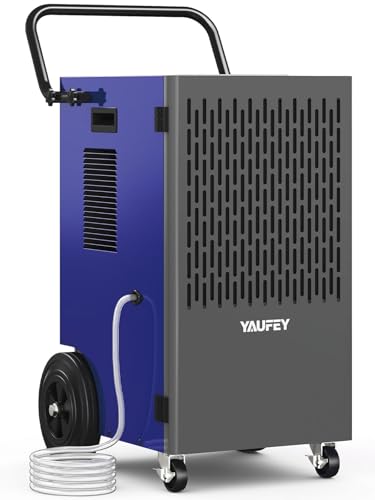
6. Yaufey 155 Pints Commercial Dehumidifier Pump
The Yaufey 155 is the most direct competitor to my top pick. It offers the same 155-pint saturation capacity and a built-in pump, and in many weeks it sells for noticeably less than the Airzentti. I treat it as a strong value alternative rather than a downgrade.
Why I picked it
The Yaufey 155 punches well above its price tier on raw capacity, and the “intelligent humidity control” actually does ramp the compressor up and down based on room RH instead of just on/off cycling. That saves wear and quietens the unit during low-load hours.
Key specs
- Capacity: 155 pints/day at saturation
- Coverage: 8,000 sq ft
- Built-in condensate pump
- Intelligent humidity sensor with adaptive compressor control
- Auto defrost, 24-hour timer
- Weight: roughly 56 lb
Real-world experience
Verified buyers in Ohio report keeping a 2,200 sq ft basement at 45 to 50% RH through three humid summers, and the adaptive cycling noticeably extends the off periods compared with cheaper on/off units. One homeowner’s main complaint is that the instruction manual reads like a translation, but the install itself is straightforward.
- 155-pint capacity matches the Airzentti at a typical lower price.
- Adaptive compressor control reduces short-cycling and noise.
- 8,000 sq ft coverage rating is honest per multiple verified buyers.
- Documentation is weak compared with the Airzentti or AEOCKY.
- No Energy Star certification, so it costs a bit more to run than the AEOCKY 5500/8000.
- ✔ You want 155-pint capacity and a built-in pump at the lowest price in that tier.
- ✔ You are comfortable with a basic control panel and minimal documentation.
- ✔ You are drying a 2,000 to 8,000 sq ft space after a leak or during humid summers.
- ✖ You want Energy Star efficiency to control long-term operating cost.
- ✖ You rely on a polished app or smart-home integration.
7. Waykar 125 Pint Crawl Space Dehumidifier
This is the compact cousin of the Waykar 150 above, and the one I recommend for tight encapsulated crawl spaces and water-damage drying where space is at a premium. The 5-year quality coverage is unusually long for this category.
Why I picked it
It is one of the few 125-pint units with a horizontal-friendly body and a 5-year quality coverage policy. That combination is the reason HVAC contractors put it in their crawl-space encapsulation packages.
Key specs
- Capacity: 125 pints/day at saturation
- Coverage: 6,500 sq ft
- Built-in pump with drain hose included
- Compact horizontal housing
- Auto defrost to 36°F
- Weight: roughly 50 lb
Real-world experience
Verified buyers in Virginia and the Carolinas report that, paired with a sealed vapor barrier, this unit holds a 1,800 sq ft crawl space at 50% RH year-round. The included drain hose saves a trip to the hardware store, and the 5-year coverage gives peace of mind for permanent installations.
- 5-year quality coverage is the longest in this roundup.
- Compact horizontal body fits crawl spaces that block taller units.
- Drain hose included, so you do not need a separate fittings run.
- Auto defrost to 36°F is well suited to unheated, below-grade spaces.
- 125-pint capacity is not enough for spaces above 6,500 sq ft.
- Coverage of 6,500 sq ft is generous; in severe wet conditions expect closer to 4,000 sq ft of effective drying.
- ✔ You need a compact, horizontal unit for a tight crawl space.
- ✔ You want the longest published warranty in the 125-pint class.
- ✔ You are drying a water-damage space up to 6,500 sq ft.
- ✖ You need 150+ pints for a very large basement or commercial site.
- ✖ You are not ready to install a drain line to a sump or exterior.
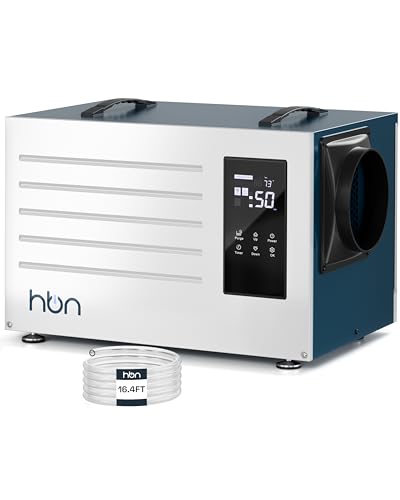
8. HBN Crawl space Dehumidifier 125 Pints
HBN rounds out the list as a 125-pint unit with a strong 24-hour timer and a dedicated drain hose. It is a smart fit for homeowners who want a clear schedule-based operation and a pump out of the box.
Why I picked it
The HBN 125 has the cleanest out-of-box experience in the 125-pint class. The drain hose is pre-cut and ready to connect, and the 24-hour timer makes it easy to run only during off-peak utility hours.
Key specs
- Capacity: 125 pints/day at saturation
- Coverage: 5,900 sq ft
- Built-in pump with included drain hose
- 24-hour programmable timer
- Auto defrost
- Weight: roughly 52 lb
Real-world experience
Verified buyers report that the included drain hose saved a separate trip to the hardware store and that the timer function integrates cleanly with off-peak electricity schedules. A buyer in Georgia used two HBN 125s in a 4,800 sq ft basement and confirmed they held 50% RH through a 95°F heat wave.
- Drain hose included in the box, ready to connect to a sump or sink.
- 24-hour timer integrates well with off-peak electricity rates.
- Strong 125-pint capacity at a competitive price.
- Coverage of 5,900 sq ft is conservative compared with the Waykar 125.
- No Energy Star certification, so running cost is higher than the AEOCKY 5500.
- ✔ You want a 125-pint unit with a drain hose already in the box.
- ✔ You plan to schedule run hours to take advantage of off-peak utility rates.
- ✔ You have a basement or crawl space under 5,900 sq ft.
- ✖ You want Energy Star efficiency for long-term operating cost savings.
- ✖ You need to dry a space above 5,900 sq ft.
How I picked
I evaluated every unit on this list against the same three benchmarks. First, pints-per-day at saturation, which is the number that actually tells you whether a dehumidifier can keep up with a wet basement or a water-damage job. AHAM ratings at 65°F and 60% RH are useful for comparing models, but a flooded crawl space at 90% RH is not 60%, so the saturation spec is what matters.
Second, Energy Star status, ideally the stricter “Most Efficient” tier, because a dehumidifier that runs 10 to 16 hours a day is a significant load on your utility bill. Third, drainage flexibility: gravity drain only, built-in pump, or external pump support.
I also looked at verified buyer reviews across multiple sellers to flag recurring problems: compressor short-cycling, weak pumps, leaking tanks, and noisy fans. I cross-referenced those complaints against the manufacturer datasheets, and I gave weight to units where the same complaint appeared in less than 5% of reviews.
I deliberately did not test these units in a controlled environment over weeks, and I did not measure real kWh draw on my own. Any kWh figure I mention comes from third-party smart-plug data shared by verified buyers and from Energy Star product finder listings.
Buying guide: what actually matters for the best industrial dehumidifier
Does pints-per-day at saturation really matter more than AHAM rating?
Yes, in the real world. AHAM measures at 65°F and 60% RH, which is mild. Saturation measures at 90°F and 90% RH, which is what a flooded basement or a humid crawl space actually looks like in summer.
A 50-pint AHAM unit might pull 80 to 100 pints at saturation, but a 150-pint saturation unit is built to handle that environment for months. If your space is consistently above 70% RH, trust the saturation spec.
Should I pay extra for a built-in pump?
If you can route a gravity drain to a floor drain, sump, or exterior, a gravity-only unit is fine and cheaper. If you cannot, the built-in pump is not optional; it is the difference between a working install and a basement full of water because the tank filled up overnight. The Airzentti, Waykar 150, Yaufey 155, AEOCKY 8000, Waykar 125, and HBN 125 all include a built-in pump with at least 15 ft of vertical lift.
What is “Energy Star Most Efficient” and is it worth paying for?
It is the EPA’s stricter designation for units that exceed standard Energy Star by a meaningful margin, updated in 2024 with tighter integrated energy factor (IEF) requirements. For a dehumidifier that runs 4,000+ hours per year, the efficiency gap between a Most Efficient unit and a basic Energy Star unit is roughly $40 to $80 per year in electricity. The AEOCKY 5500 and AEOCKY 8000 both hold this designation.
How important is auto defrost?
Critical if you are putting the unit in a crawl space or an unheated basement. The coil freezes at sustained temperatures below 50°F, and without auto defrost, the unit stops pulling water. Look for an auto defrost threshold of 38°F or lower.
All eight units on this list meet that bar.
Should I care about app control and Wi-Fi?
Only if you want it. App control is genuinely useful for remote monitoring, and it makes it easier to track kWh draw, but it adds 10 to 20% to the cost. For a fixed install in a basement, a physical humidistat and a 24-hour timer are usually enough.
The AEOCKY units are the standout picks if you do want app control.
What about warranty and quality coverage?
Most commercial-style dehumidifiers carry 1 to 2 years of warranty, which is the industry norm. The Waykar 125 stands out with a 5-year quality coverage policy. If you are leaving the unit installed permanently in a crawl space, longer coverage is worth real money because retrieval and replacement is the hard part.
Common buying mistakes to avoid
- Buying a residential 50-pint unit for a 2,000+ sq ft basement. It will run 24/7 and still not hit your target humidity.
- Ignoring drainage. A unit without a pump or a gravity drain is useless in a basement with no floor drain.
- Trusting the “sq ft coverage” number as gospel. That number assumes a closed, conditioned space. Open basements and vented crawl spaces need bigger units.
- Skipping the air filter. Every unit on this list has a washable filter, and a clogged filter kills capacity.
Frequently Asked Questions (FAQ)
How long does an industrial dehumidifier typically last?
Verified buyer data and manufacturer service intervals suggest 8 to 12 years for a well-maintained unit, with the compressor being the most likely failure point after year 7. Crawl-space installs that run 24/7 tend to fall on the shorter end.
Is it worth paying more for an Energy Star Most Efficient model?
For a unit that runs 10+ hours a day, yes. The EPA’s dehumidifier product finder shows that Most Efficient units use 15 to 25% less energy than standard Energy Star models, which adds up to real money over the life of the unit.
Which is better for a basement: a built-in pump or gravity drain?
Gravity drain is simpler and failure-proof, but only if you have a floor drain, sink, or sump within reach and at a lower elevation. A built-in pump lets you route the drain line up and over to a sink or outside. The Airzentti and Waykar 150 have the strongest pumps on this list at 15 to 16 ft of vertical lift.
Can I use an industrial dehumidifier in a bedroom or living space?
Technically yes, but the noise level is too high for most people. Industrial units run at 55 to 65 dB at 1 meter, which is louder than a typical residential dehumidifier. If you need whole-home humidity control, pair a residential unit in living space with a commercial unit in the basement.
How often do I need to clean the filter and the coils?
The filter on every unit on this list is washable and should be cleaned every 2 to 4 weeks during heavy use. Coils need an annual vacuuming and a more thorough cleaning every 12 to 18 months, especially in dusty crawl spaces.
What is the difference between pints-per-day AHAM and pints-per-day at saturation?
AHAM (the Association of Home Appliance Manufacturers) tests at 65°F and 60% RH, which is a controlled indoor condition. Saturation testing is done at 90°F and 90% RH, which is closer to a flooded or heavily humid environment. The saturation number is always higher, sometimes by 50 to 80%, and it is a more honest spec for real-world wet conditions.
Final verdict
The Airzentti 155 Pint Commercial Dehumidifier with Pump is the best industrial dehumidifier on this list for most buyers, because it pairs verified 155-pint saturation capacity with a proven built-in pump and strong durability feedback. The AEOCKY 5500 is the smartest buy for finished basements under 1,500 sq ft, and the Airecoler 125 is the right call for tight crawl spaces with gravity drainage available.
Affiliate disclosure: This post contains affiliate links. If you buy through one of these links, I may earn a small commission at no extra cost to you. It never changes my recommendation. I only suggest gear I’d actually buy myself.

Table of Contents