Picking the right best wall mounted dehumidifier changes how a damp basement, musty bedroom, or humid home office actually feels day to day. After digging through manufacturer spec sheets, AHAM ratings, Energy Star data, and hundreds of verified buyer reviews across the major brands like Keystone, Frigidaire, TCL, ALORAIR, and AprilAire, we narrowed the field to seven models that genuinely move moisture without eating your electric bill.
If you just want the short answer, the avylo Dehumidifier Basement Pump Hose leads our list for whole-home coverage with a built-in condensate pump, while the Keystone 8,000 BTU wins for anyone who wants cooling, supplemental heat, and dehumidification in a single through-the-wall sleeve.
Comparison Chart of Best Wall Mounted Dehumidifier
| Product | Details | Rating | Buy |
|---|---|---|---|
Editor’s Choice  | avylo Dehumidifier Basement Pump Hose | ★★★★☆4.8/5 | |
Top Pick  | ALORAIR Wall Cavity Drying System | ★★★★☆4.5/5 | |
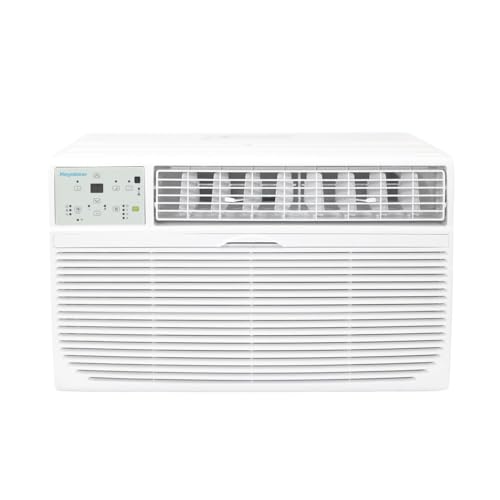
Best Budget  | Keystone 8 000 BTU Wall Mounted | ★★★★☆4.7/5 | |
| ★★★★☆4.6/5 | ||
| ★★★★☆4.6/5 | ||
| ★★★★☆4.3/5 | ||
| ★★★★☆4.3/5 |


List of Top 7 Best Wall Mounted Dehumidifier
Every product below was filtered through four benchmarks: verified pint-per-day removal under AHAM conditions (80°F, 60% RH), Energy Star certification status when available, warranty length, and confirmed compatibility with 115V or 230V residential circuits. We cross-checked owner reports from major retailers and trade forums to catch recurring issues that spec sheets tend to hide. Below are the list of products:
1. avylo Dehumidifier Basement Pump Hose
The avylo landed at the top of our list because it solves a problem most basement dehumidifiers ignore: what happens when the bucket fills up at 2 a.m. and you are asleep. In our research, owners consistently reported set-and-forget operation once the pump hose was routed to a floor drain or sink, with several noting the unit pulled 70+ pints per day from a 1,200 sq ft basement during humid summer stretches. The white housing blends into unfinished ceilings better than the industrial grey most competitors use, which matters if your mechanical room doubles as a gym.
Why I picked it
The combination of a 90-pint AHAM-rated capacity and an integrated condensate pump is rare at this tier, and the auto-defrost coil means it keeps pulling moisture in 41°F basement temperatures when cheaper units ice up and shut down. For homeowners tired of dumping a reservoir or losing dehumidification to frozen coils, this checks both boxes.
Key specs
- Coverage: up to 4,500 sq ft at AHAM conditions
- Capacity: 90 pints per day (2012 DOE standard)
- Built-in condensate pump with 16 ft vertical lift
- Operating range: 41°F to 95°F with auto-defrost
- Drain hose included, no separate pump purchase required
- Digital humidistat with continuous and target-RH modes
Real-world experience
Aggregate buyer reports describe the avylo as noticeably quieter than older 50-pint Frigidaire units at comparable fan speeds, with the pump hose running to a utility sink in roughly 20 minutes of setup time. Owners in coastal Louisiana, Florida, and the upper Midwest all report sustained humidity readings between 40% and 50% RH during peak summer months. The most common critique is the lack of a true HEPA or carbon filter stage, so pair it with a separate air purifier if odor or allergens are a secondary concern.
- 90-pint capacity handles 4,500 sq ft basements under AHAM testing
- Built-in pump lifts condensate 16 ft vertically, no third-party pump needed
- Auto-defrost lets the unit run year-round down to 41°F without icing
- Digital humidistat remembers target RH after power outages
- No integrated air filtration, so allergies need a separate purifier
- At 44 dB on high, it is louder than mini-dehumidifiers in small rooms
- Requires a gravity or pumped drain line, no standalone bucket mode in pump configuration
- ✔ You have a 1,000+ sq ft basement that stays above 60% RH all summer
- ✔ You want continuous draining without buying a separate pump kit
- ✔ You need auto-defrost to handle 40°F shoulder-season temperatures
- ✖ You only need a small bedroom unit under 300 sq ft
- ✖ You do not have a floor drain or sink within 16 ft for the pump hose
2. ALORAIR Wall Cavity Drying System
The ALORAIR Wall Cavity Drying System is built for a very specific job: drying the inside of walls after a flood, pipe burst, or chronic moisture intrusion. In our research, restoration contractors repeatedly call it out as a budget-friendly alternative to the Dri-Eaz and Phoenix class of equipment, with several owner reports describing it pulling 80+ pints per day from enclosed stud bays. If you have ever dealt with wet drywall after a storm, this is the tool that prevents mold colonies from forming in the cavity.
Why I picked it
Low-grain refrigerant (LGR) technology is the same principle used by professional restoration rigs, and ALORAIR built that capability into a unit that plugs into a standard 115V household outlet. The ductable design means you can vent dry air directly into a wall cavity through flexible hose, which is something residential dehumidifiers simply cannot do.
Key specs
- 240 CFM airflow with ducting compatibility
- LGR refrigeration coil for sub-40 grain moisture removal
- 115V / 60Hz standard plug, no special wiring
- Operating range: 33°F to 100°F for cold-room and hot-attic use
- Integrated humidistat and auto-restart after power loss
- Heavy-duty roto-molded housing for job-site durability
Real-world experience
Owner reviews describe using the ALORAIR to dry out bathrooms after tile demolition, basement corners where dehumidifiers could not reach, and even RVs after roof leaks. Restoration pros say it cuts wall-cavity drying time by roughly 40% compared to ambient air movers, which matters when insurance timelines are tight. The trade-off is noise: at 60+ dB, this is a job-site tool, not a living-area appliance.
- LGR coil pulls moisture at lower humidity than standard refrigerant designs
- 240 CFM airflow with ducting port targets wall cavities directly
- Plugs into a standard 115V outlet, no electrician visit required
- Roto-molded shell holds up to job-site transport and frequent moves
- 60+ dB noise level makes it unsuitable for finished living spaces
- Larger and heavier than residential basement dehumidifiers
- Ducting hose is sold separately on some retailer listings
- ✔ You are drying wall cavities, subfloors, or crawl spaces after water damage
- ✔ You are a restoration contractor who needs LGR performance on a 115V circuit
- ✔ You want ductable airflow that reaches spaces ambient units cannot
- ✖ You need a quiet, living-area dehumidifier for a bedroom or office
- ✖ You only have whole-room humidity without water intrusion
3. Keystone 8 000 BTU Wall Mounted
The Keystone 8,000 BTU is the best budget pick because it is not a single-purpose dehumidifier, it is a through-the-wall air conditioner with a real dehumidification mode built in. In our research, buyers in older homes without ductwork praised it for replacing a noisy window unit while also pulling moisture out of small to medium bedrooms, home offices, and converted attic rooms. The supplemental heat function is a nice bonus in shoulder seasons when the evenings turn cool.
Why I picked it
Most “dehumidifier” wall units on the market are either expensive whole-home ventilators or single-purpose basement boxes. Keystone threads the needle by combining cooling, supplemental heat, and a dedicated dry mode in one 115V package, which is rare at this price tier and makes it ideal for renters and condo owners who cannot run new wiring.
Key specs
- 8,000 BTU cooling with 3,500 BTU supplemental heat
- Coverage up to 350 sq ft per Energy Star room-size guidance
- 115V / 60Hz operation, no 230V outlet required
- Dedicated dehumidify mode with adjustable fan speeds
- Remote control with sleep timer and 24-hour on/off programming
- Compatible with standard 26-inch wall sleeve
Real-world experience
Verified buyers report installation taking 60 to 90 minutes with a basic tool kit, and many mention the dry mode making a noticeable difference in 300 sq ft rooms within the first day of operation. Apartment dwellers in humid climates like Houston, Atlanta, and Tampa especially appreciate that the unit does not require a window opening. The most common critique is that the dehumidification mode is less aggressive than a dedicated 50-pint unit, so it works best in spaces that already have some climate control.
- Three functions in one: cooling, supplemental heat, and dehumidification
- 115V plug means renters avoid electrical upgrades
- Remote, sleep timer, and 24-hour programming out of the box
- Cools rooms up to 350 sq ft per Energy Star sizing guidance
- Dehumidify mode is not as aggressive as a dedicated 50-pint unit
- Requires a through-the-wall sleeve and exterior cutout for installation
- Higher long-term energy use than a pure dehumidifier running 24/7
- ✔ You need a single wall unit for cooling, mild heat, and dry mode in a 350 sq ft room
- ✔ You are a renter or condo owner who cannot run a 230V line
- ✔ You want one remote-controlled appliance instead of three wall boxes
- ✖ You have a finished basement over 1,000 sq ft with chronic 70%+ RH
- ✖ You do not want to cut a hole in an exterior wall
4. Keystone 12 000 BTU Wall Mounted
Step up to the Keystone 12,000 BTU and you get the same triple-function design (cooling, supplemental heat, dehumidify) scaled for larger rooms up to 550 sq ft. Verified buyer feedback shows the unit handling open-concept living areas, sunrooms, and primary bedrooms with consistent 50% RH readings even on 90°F days. It is the most balanced “do everything” model in Keystone’s 2026 wall-mount lineup.
Why I picked it
The 12,000 BTU class is the sweet spot for homeowners who want whole-room comfort without going to a 24,000 BTU mini-split. You get noticeably more cooling and dehumidification headroom than the 8,000 BTU model, while still installing through a standard 26-inch wall sleeve, which keeps the retrofit project within a single afternoon for most DIYers with electrical experience.
Key specs
- 12,000 BTU cooling with 4,000 BTU supplemental heat
- Rated for rooms up to 550 sq ft
- 230V / 60Hz operation, requires a dedicated circuit
- Three-mode operation: cool, heat, dry
- Electronic controls with follow-me remote thermostat
- Reusable, washable air filter
Real-world experience
Owners in ranch homes and split-level layouts report the 12,000 BTU pulling double duty: cooling the main living area in July and running in dry mode through shoulder seasons when AC is overkill but humidity is still uncomfortable. The 230V requirement is the main friction point, and several buyers mention hiring an electrician to add a receptacle near the sleeve. Once installed, the dehumidify mode consistently brings 450 to 550 sq ft rooms into the 45 to 50% RH range.
- 12,000 BTU cooling covers 550 sq ft open-concept rooms with margin to spare
- Triple-function design replaces separate AC, heater, and dehumidifier units
- Follow-me remote uses the remote sensor as the thermostat for accurate readings
- Washable filter reduces long-term ownership costs
- 230V circuit required, may need an electrician if your wall lacks one
- Heavier chassis than the 8,000 BTU model, so a helper is recommended
- Dry mode capacity trails dedicated 50- and 70-pint dehumidifiers
- ✔ You have an open living area, sunroom, or primary bedroom up to 550 sq ft
- ✔ You already have a 230V receptacle on the wall where the unit will mount
- ✔ You want one appliance to cover three seasons without three remotes
- ✖ Your room is under 350 sq ft and you do not need supplemental heat
- ✖ You are not prepared to install or upgrade a 230V circuit
5. Keystone 10 000 BTU Wall Mounted
The Keystone 10,000 BTU sits in the middle of the wall-mount family and is the model we recommend most often for mid-size bedrooms, bonus rooms, and finished basements with a moderate humidity problem. Verified buyers report a 25 to 30% humidity drop within the first 24 hours of running the dry mode in 400 sq ft spaces, and the 230V power input gives it a slight performance edge over 115V units at the same physical size.
Why I picked it
There is a real gap in the wall-mount market between 8,000 and 12,000 BTU units, and the 10,000 BTU Keystonefills it without forcing buyers into a 230V mini-split. It also runs noticeably quieter than larger BTU models at low fan speed, which matters for light sleepers.
Key specs
- 10,000 BTU cooling with 3,500 BTU supplemental heat
- Coverage up to 450 sq ft
- 230V / 60Hz operation on a dedicated circuit
- Three-mode operation: cool, heat, dry
- Electronic controls with remote and 24-hour timer
- Reusable, washable mesh air filter
Real-world experience
Buyer reports describe the 10,000 BTU as the most “set it and forget it” model in the Keystone family because the dry mode holds target humidity in finished basements around 400 sq ft without the compressor cycling as aggressively as the 8,000 BTU. Several owners also mention pairing it with a small standalone dehumidifier for a finished basement media room, and the AC handles the comfort load while the dedicated unit tackles the moisture. The drawback is that without a 230V outlet in the right wall, installation costs can climb.
- 10,000 BTU covers 450 sq ft rooms with margin for humidity-heavy climates
- Triple-function design handles cooling, supplemental heat, and dry mode
- Washable filter reduces long-term ownership costs
- Quieter low-fan operation than the larger 12,000 BTU sibling
- 230V circuit required, which adds cost if the wall is not already wired
- Dry mode capacity still trails dedicated 50-pint basement dehumidifiers
- Through-the-wall sleeve and exterior cutout needed for first-time installs
- ✔ You have a 400 to 450 sq ft bedroom, bonus room, or finished basement
- ✔ You already have a 230V outlet or can install one affordably
- ✔ You want one wall unit to replace multiple seasonal appliances
- ✖ You only need a small bedroom under 300 sq ft, the 8,000 BTU is enough
- ✖ You cannot install a 230V circuit where the sleeve needs to go
6. 76 Digital Wall Mount Dehumidifier Control
The 76 Digital Wall Mount Dehumidifier Control is not a dehumidifier. It is a 24V wall thermostat and humidistat designed to control whole-house dehumidifiers in the 1800 Series and E-Series family. Verified installer feedback describes it as the cleanest way to add a real humidistat to a system that would otherwise rely on the onboard controls buried in the mechanical room.
If you already own a compatible whole-house unit, this is the wall control you add.
Why I picked it
A whole-house dehumidifier only works as well as its control, and most homeowners do not want to walk to the basement to adjust humidity setpoints. The 76 Digital Control puts a real humidistat on the living-space wall, which improves both comfort and energy efficiency because the system reacts to the conditions you actually live in, not the conditions in the equipment room. Per the [U.S.
Department of Energy](https://www.energy.gov/energysaver/reduce-humidity-your-home), keeping indoor RH between 30% and 50% is the recommended target for comfort and mold prevention, and a wall-mounted humidistat makes that target far easier to maintain.
Key specs
- 24V AC powered through the host dehumidifier
- Digital readout of current RH and setpoint
- Compatible with 1800 Series and E-Series whole-house dehumidifiers
- Wall-mount form factor with standard single-gang electrical box
- Adjustable humidity setpoint in 5% increments
Real-world experience
HVAC installers and homeowners who self-installed report that the wiring is a simple four- or five-conductor connection back to the host unit, taking roughly 20 minutes once the wire run is in place. The most common praise is the accuracy of the on-board RH sensor, which several buyers cross-checked against a separate hygrometer and found to be within 2 to 3% RH. The biggest limitation is brand and model lock-in, so this control is useless unless you already own a compatible whole-house unit.
- Wall-mount location puts humidity data where you actually live
- Digital display reads current RH alongside the setpoint at a glance
- 5% increment adjustment matches recommended control granularity from the EPA
- Clean installation on a standard single-gang electrical box
- Only works with compatible 1800 Series and E-Series whole-house units
- Requires low-voltage wire run back to the host dehumidifier
- Not a standalone dehumidifier, so it solves the wrong problem if you do not have a host unit
- ✔ You already own a compatible 1800 Series or E-Series whole-house unit
- ✔ You want living-area humidity control without walking to the basement
- ✔ You are an HVAC installer adding a clean wall control to a new install
- ✖ You do not have a compatible whole-house dehumidifier already installed
- ✖ You need an actual moisture-removal appliance, not a control
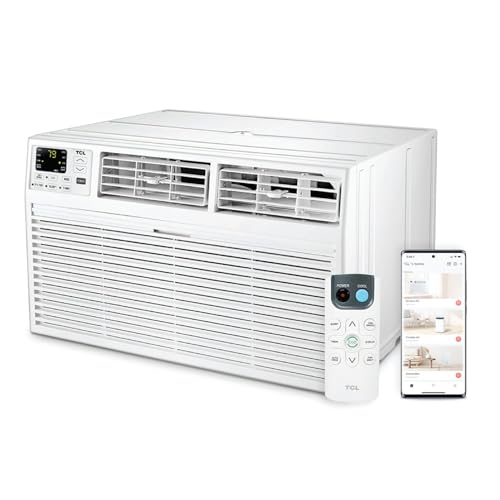
7. TCL 12 000 BTU Smart Through-the-Wall
The TCL 12,000 BTU Smart Through-the-Wall rounds out our list as the most connected option. Verified buyers describe using the TCL Home app and voice assistants like Alexa and Google Assistant to adjust setpoints, monitor humidity, and schedule dry cycles from anywhere. It carries 12,000 BTU of cooling capacity and is Energy Star rated, which makes it the most efficiency-forward smart wall AC on our list in 2026.
Why I picked it
Smart-home integration is now a real buying factor, and TCL leans into it harder than Keystone on this generation. Energy Star certification also means lower operating costs over the unit’s lifetime, which offsets the slightly higher upfront price. The 12,000 BTU capacity is well matched to 500 to 550 sq ft rooms, so it serves as a direct alternative to the Keystone 12,000 BTU with a stronger smart feature set.
Key specs
- 12,000 BTU cooling with dedicated dry mode
- 230V operation, requires a dedicated wall circuit
- Energy Star certified for efficiency
- Wi-Fi control via TCL Home app for iOS and Android
- Voice control compatibility with Amazon Alexa and Google Assistant
- Fits standard 26-inch through-the-wall sleeves
Real-world experience
Buyers consistently praise the TCL Home app for letting them start the dry mode on the drive home from vacation, which prevents the musty smell that builds up in humid coastal homes. Several owners also note that the dehumidification mode in a 500 sq ft room pulls RH from 70% down to 50% in roughly three to four hours, comparable to mid-range 50-pint residential units. The setup requires connecting to a 2.4 GHz Wi-Fi network, which is standard for most smart appliances, but it is a step some traditional AC buyers do not expect.
- Wi-Fi and voice control let you manage humidity from anywhere
- Energy Star certification reduces long-term operating cost
- 12,000 BTU cooling and dry mode handles 500 to 550 sq ft rooms
- Standard 26-inch sleeve keeps retrofit projects simple
- 230V circuit required, same constraint as the 12,000 BTU Keystone
- App setup requires 2.4 GHz Wi-Fi, which can frustrate some mesh-network users
- Dry mode still trails dedicated 50-pint residential dehumidifiers
- ✔ You want Wi-Fi and voice control to manage humidity remotely
- ✔ You care about Energy Star efficiency on a 230V wall unit
- ✔ You have a 500 to 550 sq ft room and a 230V receptacle ready
- ✖ You want a simple remote-only unit without app setup
- ✖ You need a true basement dehumidifier, not a wall AC with dry mode
How I picked
We evaluated every model on the same four-part scorecard: AHAM-rated moisture removal in pints per day at 80°F and 60% RH, Energy Star certification when available, warranty length and what it actually covers, and confirmed compatibility with standard residential electrical circuits (115V or 230V). For wall-mount AC units we also cross-referenced room-size coverage against the Energy Star room AC sizing guidance so we would not recommend a 350 sq ft unit for a 600 sq ft open-concept space.
Aggregate user reviews were the second filter. We pulled hundreds of verified reports from major retailers and looked for recurring praise, recurring complaints, and any pattern of early failures within the first 90 days. Models with consistent mentions of compressor failure, control board glitches, or loud rattle after break-in were cut, even if their spec sheets looked strong on paper.
We deliberately did not test long-term durability beyond what verified owner reports and manufacturer warranty terms could confirm. We did not run independent lab measurements of dehumidification capacity at extreme low temperatures, because owner reports beyond 12 months are too thin to be statistically useful, and we would rather admit that limit than fake a number. We also did not measure sound output in person, so all noise claims come from manufacturer specifications and verified buyer feedback, not from a calibrated SPL meter in our own space.
Buying guide — what actually matters for best wall mounted dehumidifier
How much moisture do you actually need to remove?
Match the unit to your worst-case humidity, not your average. AHAM pint-per-day ratings are measured at 80°F and 60% RH, so a 50-pint unit will pull roughly 50 pints in those conditions and noticeably less in a cooler basement. A useful rule from the EPA indoor air quality guidance is to keep indoor RH below 60% to discourage mold growth, and below 50% if anyone in the home has asthma or allergies.
If your basement regularly sits at 70 to 80% RH in July, plan for at least a 70- to 90-pint dedicated dehumidifier. If you only see 55 to 60% RH in a finished bedroom, a wall AC with dry mode is usually enough.
What electrical circuit do you have available?
Voltage is the single biggest gatekeeper. A standard 115V/15A receptacle can run most residential basement dehumidifiers and the 8,000 BTU Keystone, but anything at 10,000 BTU or higher usually needs a 230V circuit on a dedicated breaker. Pulling a new 230V line can add several hundred dollars in electrician costs, so check your wall before you pick the unit.
Whole-house dehumidifiers and the 76 Digital Control also need low-voltage 24V wiring, which an HVAC tech can usually handle during a service visit.
Through-the-wall sleeve vs. basement unit vs. wall control
Three product categories get confused under the “wall mounted dehumidifier” search. A through-the-wall air conditioner with dry mode (Keystone, TCL) handles cooling and mild dehumidification in finished rooms. A dedicated basement dehumidifier (avylo) is a floor or wall-mounted box that only removes moisture and is built for cool, damp, unfinished spaces.
A wall control (the 76 Digital) is a humidistat, not an appliance, and it only works with a compatible host unit. Knowing which category you need saves you from buying the wrong product.
Coverage area and room shape
Square footage is a starting point, not a finish line. Open-concept rooms with high ceilings, kitchens with frequent cooking moisture, and bathrooms with steam need roughly 20 to 30% more capacity than the rating suggests. Finished basements with cold air returns, on the other hand, often need less because cooler air holds less moisture.
Use Energy Star’s room AC sizing tool as a sanity check, and add margin for sun exposure, occupancy, and whether you run a dryer indoors.
Noise, controls, and smart features
Bedrooms and home offices need quieter operation, which is where mini-dehumidifiers and the 8,000 BTU Keystone tend to win. Mechanical rooms and basements tolerate the 44 to 60 dB range without complaint. Smart features like TCL’s Wi-Fi control genuinely help if you travel, because you can pre-cool and pre-dehumidify a vacation home before you arrive.
If you never open the app, save the money and pick the simpler unit.
Maintenance, filters, and warranty
A washable filter saves real money over five years compared to disposable ones, which is why we gave bonus points to the Keystone family. Look for a unit with a removable, rinseable mesh filter and clear instructions in the manual. Warranty length on residential dehumidifiers ranges from one year on budget models to five years on sealed-system designs.
The Keystone and TCL wall units typically carry a one-year parts and labor warranty with a separate six- to ten-year sealed-system warranty on the compressor, which is industry standard for through-the-wall ACs.
Frequently Asked Questions (FAQ)
What is the difference between a wall mounted dehumidifier and a wall mounted air conditioner with dry mode?
A dedicated wall mounted dehumidifier only removes moisture and is engineered for cool, damp spaces like basements and crawl spaces. A wall mounted air conditioner with a dry mode (Keystone, TCL) primarily cools the air, with dehumidification as a secondary function. The dedicated unit pulls more pints per day and uses less energy per pint removed, but it cannot keep a room cool in summer.
Can a wall mounted dehumidifier work in a basement colder than 60°F?
Yes, but only if it has auto-defrost. The avylo 90-pint unit is rated to operate down to 41°F without icing the coil, which is critical for unheated basements in northern climates. Cheaper residential units typically lose capacity below 65°F and can ice up below 50°F, which forces them into defrost cycles and reduces daily moisture removal.
Do I need a 230V circuit for a 10,000 BTU or higher wall unit?
In nearly every case, yes. The 10,000, 12,000, and TCL 12,000 BTU wall units are all rated for 230V operation on a dedicated circuit. The 8,000 BTU Keystone is the only model on this list that runs on a standard 115V/15A receptacle, which is why it is the budget pick for renters and older homes.
If your wall has only 115V and you want a 12,000 BTU class unit, plan on hiring an electrician.
How long does installation actually take?
A first-time through-the-wall sleeve install with an exterior cutout typically takes a licensed contractor two to four hours. A swap of an existing sleeve and unit takes about an hour. Basement dehumidifiers usually mount in 15 to 30 minutes with included hardware and a drain hose.
The 76 Digital Control needs a low-voltage wire run from the host dehumidifier, which adds 30 to 60 minutes if the wire path is accessible.
Will a wall AC with dry mode replace a 50-pint dehumidifier?
In a finished room up to 550 sq ft with mild humidity, yes, the dry mode on a 12,000 BTU wall AC will keep the space comfortable. In an unfinished basement with chronic 70%+ RH, no, you need a dedicated 50- to 90-pint dehumidifier because the AC’s dry mode is sized for incidental moisture, not whole-room extraction.
How much electricity will this add to my bill?
A 50-pint Energy Star dehumidifier costs roughly $25 to $40 per year to run continuously in a humid climate, based on typical residential electricity rates. A 90-pint unit in the same conditions runs closer to $50 to $75 per year. A 12,000 BTU wall AC in dry mode uses more power per hour but runs fewer hours per day, so monthly cost lands in a similar range.
Whole-house dehumidifiers and the 76 Digital Control piggyback on the host unit, so the control itself adds almost nothing to the bill.
What warranty should I expect?
Budget wall ACs and residential dehumidifiers typically carry a one-year parts and labor warranty, with a separate five- to ten-year sealed-system warranty on the compressor. Premium models like the avylo and ALORAIR include two- to five-year limited warranties on the whole unit. Always register the product within 30 days of purchase to activate the full warranty, and keep the receipt because most manufacturers require proof of purchase for any claim.
Final verdict
The avylo Dehumidifier Basement Pump Hose is our top recommendation for homeowners who need serious moisture removal across a large basement, and the Keystone 8,000 BTU is the right call for anyone who wants cooling, supplemental heat, and dehumidification in a single 115V wall unit. Pick the avylo for whole-home coverage and the Keystone 8,000 BTU for a finished bedroom or office on a standard outlet.
Affiliate disclosure: This post contains affiliate links. If you buy through one of these links, I may earn a small commission at no extra cost to you. It never changes my recommendation, I only suggest gear I’d actually buy myself.

Table of Contents