Running a dishwasher the wrong way wastes water, leaves soap residue on your plates, and can damage your appliance over time. The key to learning how to run a dishwasher cycle properly is understanding your settings, your load, and your detergent. We’ll walk you through every step with the clarity you’d expect from a seasoned appliance guide.
Manufacturer specs indicate modern dishwashers use just 3 to 4 gallons per cycle, versus up to 27 gallons by hand. The ENERGY STAR program and NSF/ANSI 184 sanitization standard define what efficient, hygienic cycles should achieve. Let’s start with why cycle choice matters more than most people think.
Why Running Your Dishwasher the Wrong Way Costs You Time and Money
Most people treat the dishwasher like a magic box. Throw everything in, press a button, and hope for clean dishes. That approach works sometimes, but it quietly costs you in ways you don’t notice until the problems pile up.
Here’s what goes wrong when you run a cycle without thinking:
- You pick the wrong cycle, and baked-on food survives the wash. You rewash by hand, wasting water and time.
- You overload the racks, and spray arms can’t reach every surface. Half the load comes out with residue.
- You use too much detergent, and detergent film coats your glassware. You scrub each piece by hand.
- You skip rinse aid, and hard water leaves spots on every glass. You polish them one by one.
The financial impact adds up. Per the U.S. Environmental Protection Agency, ENERGY STAR certified dishwashers use about 3.5 gallons per cycle.
Hand-washing the same load can use up to 27 gallons. If you run your dishwasher inefficiently and rewash items, you lose that advantage fast.
There’s also the appliance itself. Running heavy cycles on lightly soiled loads stresses the heating element and motor unnecessarily. Manufacturers like Bosch and Miele design their machines with specific cycle algorithms for a reason.
Using them correctly extends the life of your dishwasher.
Think of it like a chain reaction. Choose the wrong cycle and you get poor results. Load incorrectly and you waste water.
Skip maintenance and you get smells and clogs. Each mistake compounds the next one.
The good news? Every one of these problems is fixable with the right knowledge. That’s exactly what we’ll cover next.
How to Run a Dishwasher Cycle
To run a dishwasher cycle, scrape food off dishes, load racks properly, add detergent, select the right cycle, and start the machine. Check that your hot water heater is set to 120°F. Use rinse aid to prevent spots on glassware.
Unload the top rack first after the cycle ends.

What Happens Inside the Dishwasher During a Cycle
Understanding what happens during each phase helps you make better choices about settings and loading. A dishwasher cycle runs in distinct stages, and each one serves a specific purpose.
The Fill Phase
Your dishwasher pulls water from your home’s supply line. Most models fill with 3 to 4 gallons for a standard cycle. The water mixes with detergent in the wash basin.
The incoming water should be hot, ideally 120°F (49°C). This is the temperature the U.S. Department of Energy recommends for efficient dishwashing.
If your water heater runs lower, the dishwasher’s heating element compensates, but that uses more energy.
The Wash Phase
Spray arms rotate and blast water at your dishes from multiple angles. Upper and lower spray arms work together. Some models include a middle spray arm for tall loads.
Water pressure and temperature work together to dissolve food particles. The detergent dispenser releases detergent at the right moment in the cycle. Many machines have a pre-wash rinse before the main wash to loosen stubborn food.
The Drain Phase
Dirty water drains out through the filter and drain hose. The filter catches food particles so they don’t recirculate onto clean dishes. If your filter is clogged, you’ll notice gritty residue after every cycle.
The Rinse Phase
Fresh, clean water rinses away detergent residue. Rinse aid is dispensed during this phase to reduce surface tension on dishes. This helps water sheet off glassware instead of forming spots.
The Dry Phase
This is where heated dry or air dry options come into play. Heated dry uses a heating element to evaporate moisture. Air dry relies on residual heat and natural evaporation.
| Phase | What Happens | Typical Duration |
|---|---|---|
| Fill | Water enters the tub | 1-2 minutes |
| Wash | Spray arms clean dishes | 30-90 minutes |
| Drain | Dirty water exits | 1-3 minutes |
| Rinse | Clean water rinses dishes | 10-20 minutes |
| Dry | Moisture evaporates | 15-45 minutes |
Total cycle time varies by setting. A Quick cycle might finish in 60 minutes. A Heavy cycle can run 3 to 4 hours.
Eco cycles typically land between 2 and 2.5 hours.
Knowing these phases helps you troubleshoot. If your dishes come out wet, the dry phase may be set to air dry. If they come out gritty, the wash phase may have been too short for your load.
If you smell something musty, the drain or filter likely needs attention.
Understanding Your Dishwasher Settings: Normal, Heavy, Eco, Quick, and More
Every dishwasher offers a range of cycle options, and each one is designed for a specific type of load. Choosing the right setting is the single biggest factor in getting clean dishes the first time around.
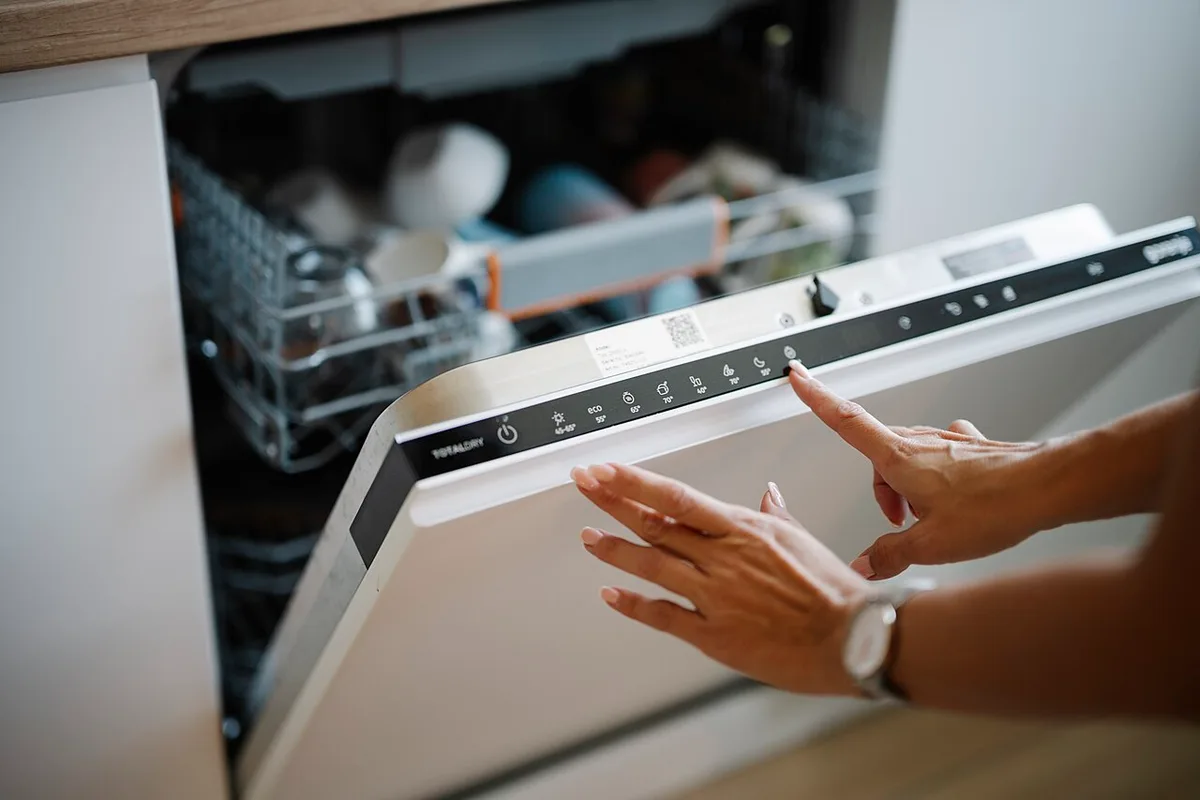
Here’s a breakdown of the most common cycles and when to use each one.
| Cycle | Best For | Water Temp | Duration | Soil Level |
|---|---|---|---|---|
| Normal | Everyday mixed loads | 120-140°F | 2-3 hours | Light to moderate |
| Heavy / Pots & Pans | Baked-on food, greasy cookware | 140-160°F | 3-4 hours | Heavy |
| Quick / Rapid | Lightly soiled dishes, glasses | 110-120°F | 60-90 min | Light |
| Eco | Full loads, moderate soil | 120°F | 2-2.5 hours | Light to moderate |
| Sanitize / High-Temp | Baby bottles, cutting boards | 150-160°F | 1.5-2.5 hours | Any |
| Delicate / Glass | Crystal, fine china, stemware | 100-110°F | 1.5-2 hours | Light |
| Auto / AutoSense | Variable loads, sensor-detected | Varies | Varies | Varies |
Normal Cycle
This is your go-to for everyday dishes. Plates, bowls, cups, and silverware with light to moderate food residue. Manufacturer specs from Whirlpool and KitchenAid indicate Normal cycles run at around 120 to 140°F.
If your load has just a day’s worth of dinner dishes, Normal is your best bet. It balances water usage, energy consumption, and cleaning performance.
Heavy or Pots and Pans Cycle
Use this cycle when food is baked on or stuck hard. Think lasagna pans, roasting trays, and greasy skillets. Water temperatures climb to 140 to 160°F.
The tradeoff is time and energy. Heavy cycles run 3 to 4 hours. Use it when you actually need it, not as a default for every load.
Quick or Rapid Cycle
Short on time? Quick cycles finish in 60 to 90 minutes. They work best for lightly soiled glasses and plates.
Don’t use Quick for a full day’s worth of dishes. The shorter wash time won’t handle heavy residue, and you’ll end up running a second cycle anyway.
Eco Cycle
Eco cycles use less water and energy than Normal. They take a bit longer to compensate for the lower temperatures. Per ENERGY STAR guidelines, Eco modes are among the most efficient settings on modern dishwashers.
If your load is full but not heavily soiled, Eco saves you money without sacrificing results. Check your local utility rates. Running Eco during off-peak hours with a delay start feature saves even more.
Sanitize or High-Temp Cycle
This cycle heats water to 150 to 160°F to kill bacteria. NSF/ANSI 184 is the standard that certifies dishwashers for sanitization performance.
Use Sanitize for baby bottles, cutting boards, and items where hygiene matters most. It’s also useful when someone in your home is ill and you want extra confidence in your dishware.
Auto or AutoSense Cycle
Many modern dishwashers from Bosch, LG, and Samsung include a sensor that detects soil levels. The machine adjusts water temperature and cycle length automatically.
If you’re unsure which cycle to pick, Auto handles the decision for you. It’s a solid default when you don’t want to think about it. As of 2026, most mid-range and premium dishwashers include this feature.
Delicate or Glass Cycle
Crystal stemware, fine china, and delicate glassware need gentler treatment. These cycles use lower water pressure and cooler temperatures to prevent breakage.
If you’ve ever had a wine glass crack in the dishwasher, the Delicate cycle exists for exactly that reason. Use it for anything you’d hesitate to wash by hand.
How to Load a Dishwasher Correctly Before You Start
Loading is where most people go wrong, and it directly affects cleaning results. Even the best cycle won’t save a bad load.
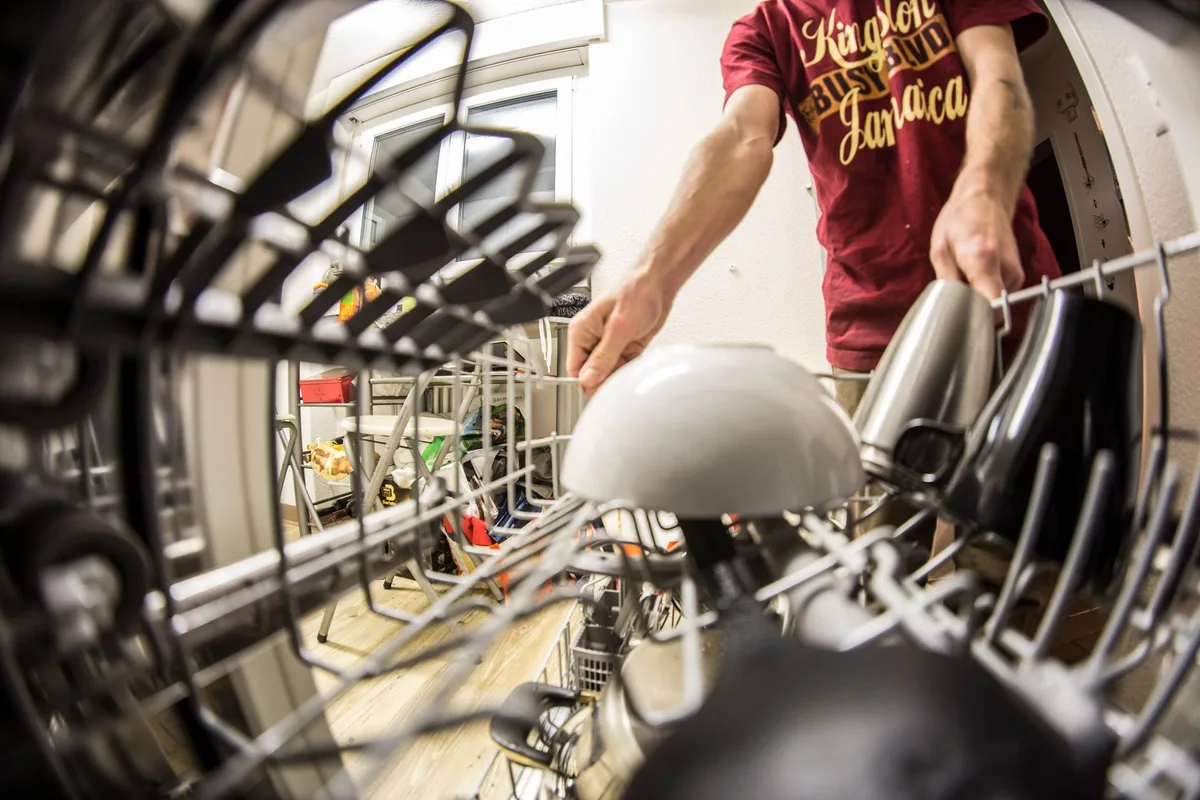
The Golden Rules of Dishwasher Loading
- Angle everything downward. Plates, bowls, and cups should face the spray arms at a downward angle so water runs off instead of pooling.
- Never nest bowls or plates. Stacked items block water flow. Leave space between each piece.
- Keep the center clear. The lower spray arm needs room to spin. Don’t block it with oversized items.
- Place sharp knives blade-down. This protects your hands when unloading and prevents damage to the blade.
- Load silverware by type. Spoons together, forks together, knives together. Mixed types block water flow to each piece.
- Put plastics on the top rack. Heat from the bottom heating element can warp plastic items.
Loading the Bottom Rack
The bottom rack handles your heaviest items. Plates go in the rows with tines, facing the center. Pots and pans go along the sides or back where there’s more height clearance.
Baking sheets and cutting boards should stand vertically along the edges. This maximizes space and ensures water reaches every surface.
Don’t block the filter at the bottom center of the tub. It needs clear access to drain water properly.
Loading the Top Rack
The top rack is for cups, glasses, bowls, and smaller items. Place cups and glasses upside down on the tines. Bowls should tilt slightly so water drains.
Mugs can go in the cup holders along the edges. If your model has a third rack or cutlery tray, use it for utensils and small items that might otherwise fall through.
Loading Silverware
Most dishwashers have a basket or tray for silverware. Load handles up for forks and spoons so the business end gets full water exposure. Knives should go blade-down for safety.
Don’t overload the basket. Crowded silverware won’t clean properly. If you have a lot, use both the basket and the third rack if your model has one.
Common Loading Mistakes
| Mistake | What Happens | Fix |
|---|---|---|
| Nesting bowls | Water can’t reach inner surfaces | Space bowls apart |
| Blocking spray arms | Poor water circulation | Leave center area clear |
| Overloading | Items stay dirty or wet | Remove a few items |
| Plastics on bottom rack | Warping from heat exposure | Move to top rack |
| Cups facing up | Water pools inside after cycle | Flip cups upside down |
Good loading takes 2 minutes and doubles your cleaning results. Bad loading means you’ll run the cycle again, wasting water and energy. If you find yourself rewashing dishes frequently, your loading technique is usually the culprit, not your detergent or cycle choice.
Detergent, Rinse Aid, and Dispensers: What to Use and Where
Your detergent choice and placement make a bigger difference than most people realize. Get this part right, and you’ve solved half the cleaning problems before you even start the cycle.
What Kind of Detergent Should You Use?
There are three main formats, and each has strengths.
| Detergent Type | Best For | Pros | Cons |
|---|---|---|---|
| Pods / Tablets | Convenience, consistent dosing | Pre-measured, easy to store | Can leave residue in dispenser if not fully dissolved |
| Powder | Budget-friendly, tough on grease | Strong cleaning power, cheap per load | Clumps in humid storage, harder to measure |
| Liquid / Gel | Gentle on glassware, good for light loads | Dissolves quickly, easy to pour | Weaker on baked-on food, can over-foam |
Manufacturer specs from companies like Finish and Cascade indicate that pods and tablets deliver the most consistent cleaning across soil levels. If you’ve had trouble with residue, switching from liquid to a tablet is the fastest fix.
One critical rule: never use hand-washing dish soap in a dishwasher. It produces excessive suds that overflow the tub, clog the drain, and can damage internal components. This is a mistake that’s far more common than you’d think, especially in rentals where someone unfamiliar with the machine runs a cycle.
Where Does the Detergent Go?
Almost every dishwasher has a dispenser in the door with two compartments. The larger one is for the main wash. The smaller one, if present, is for a pre-wash dose.
If your dispenser has both, place a small amount of detergent in the pre-wash cup and the full dose in the main wash cup. The pre-wash loosens stuck-on food before the main cycle begins. Many Bosch and Miele models include this feature and recommend using it for heavily soiled loads.
If your dishwasher only has one compartment, put the full dose there. Close the dispenser door firmly. Some users report tablets getting stuck in the dispenser and failing to release.
If that happens, try placing the tablet directly on the floor of the tub near the lower spray arm instead.
How Much Detergent Do You Need?
More detergent does not mean cleaner dishes. It means residue, film, and wasted money.
- For lightly soiled loads, use half a dose or select a detergent labeled for light soil.
- For standard loads, follow the manufacturer’s measurement on the package. Usually one tablet or one tablespoon of powder.
- For hard water areas, you may need slightly more. Check the detergent label for hard water guidance.
- Never fill the dispenser to the brim. Excess detergent creates foam that can overflow and leave white film on dishes.
Rinse Aid: Why It Matters
Rinse aid is one of the most underused features in a dishwasher. It reduces the surface tension of water so it sheets off dishes instead of beading up and leaving spots.
Without rinse aid, you’ll notice water droplets on glasses, white film on plastic containers, and streaks on silverware. Hard water makes all of this worse. The water softener setting on your dishwasher helps, but rinse aid addresses the problem directly.
Most dishwashers have a rinse aid dispenser with a refill indicator. Fill it when the indicator drops to low. A standard bottle lasts about two months with regular use.
Some people use white vinegar as a rinse aid substitute. It works for mild spotting, but it can corrode rubber seals and gaskets over time. Manufacturer manuals from GE and Samsung explicitly warn against putting vinegar in the rinse aid compartment.
If you want an alternative, look for a rinse aid formula designed for sensitive components.
Dispenser Tips Most People Miss
- Open the dispenser after each cycle to make sure detergent fully dissolved. If residue remains, your dispenser latch may need cleaning.
- Clean the dispenser compartment monthly with a damp cloth. Dried detergent builds up and blocks the mechanism.
- If you use a dishwasher cleaner, don’t put it in the detergent dispenser. Place it upside down on the top rack, empty, and run a hot cycle.
Choosing the Right Cycle: A Simple Decision Guide for Any Load
The right cycle depends on three things: how dirty your dishes are, what type of items you’re washing, and how much time and energy you want to spend. Here’s how to decide.
Ask Yourself These Three Questions
Question 1: How soiled is the load?
- If food is barely visible or just dried on lightly, choose Normal or Eco.
- If food is baked on, crusty, or greasy, choose Heavy or Pots and Pans.
- If dishes are mostly clean and you’re just refreshing them, choose Quick.
Question 2: What’s in the load?
- Mixed everyday dishes? Normal is your best choice.
- Heavy cookware and baking sheets? Heavy cycle handles it.
- Crystal, fine china, or delicate glassware? Delicate or Glass cycle.
- Baby bottles, cutting boards, or items needing sanitization? Sanitize cycle.
- A mix of everything and you’re not sure? Auto or AutoSense makes the call for you.
Question 3: What are your priorities?
- Speed matters most? Quick cycle, 60 to 90 minutes.
- Energy savings matter most? Eco cycle with delay start during off-peak hours.
- Cleaning power matters most? Heavy cycle, even if it takes longer.
- Hygiene matters most? Sanitize cycle at 150 to 160°F.
Decision Tree Summary
| If Your Load Is… | Then Choose… | Why |
|---|---|---|
| Lightly soiled everyday dishes | Normal | Balanced performance |
| Full load, moderate soil | Eco | Efficient without sacrificing results |
| Baked-on food, greasy pans | Heavy | Higher temps and longer wash |
| Quickly needs refreshing | Quick | Fastest cycle available |
| Baby items or hygiene-critical | Sanitize | NSF/ANSI 184 high-temp rinse |
| Delicate or fragile items | Delicate / Glass | Gentle water pressure |
| Mixed and unpredictable | Auto / AutoSense | Sensor adjusts automatically |
Can You Use Heavy Cycle for Everything?
You can, but you shouldn’t. Running Heavy on a lightly soiled load wastes 30 to 60 minutes of cycle time and significantly more energy. The heating element runs longer to maintain higher temperatures.
Over months, that adds up on your utility bill.
Save Heavy for when you genuinely need it. Your dishes will be just as clean with Normal on a daily basis.
What About Delay Start?
Most modern dishwashers include a delay start feature. It lets you set the machine to begin the cycle at a specific time, usually in 1 to 12 hour increments.
If your utility company charges more during peak hours (typically 4 PM to 9 PM), delay your cycle to run overnight. Per ENERGY STAR data, running dishwashers during off-peak hours can reduce energy costs by 10 to 20 percent depending on your rate plan.
Delay start also has a practical benefit. Load the dishwasher after dinner, set a 3-hour delay, and the cycle runs after you’ve gone to bed. You wake up to clean dishes without hearing the machine run.
Pre-Rinse or Scrape-and-Load? The Truth About Waste and Water
This is one of the most debated topics in dishwashing, and the answer surprises most people. You do not need to pre-rinse your dishes before loading them into the dishwasher.
What the Research Shows
Manufacturers and water conservation experts agree on this point. Modern dishwashers are designed to handle food residue without a pre-rinse. The wash cycle, spray arm pressure, and detergent chemistry work together to remove stuck-on food.
A full pre-rinse under running water can use 6 to 10 gallons of water before you even start the machine. That completely undermines the efficiency advantage of using a dishwasher in the first place.
Per the EPA’s WaterSense program, the most water-efficient approach is to scrape food into the trash and load directly. No soaking, no rinsing, no standing at the sink for five minutes before every cycle.
What You Should Do Instead
- Scrape large food chunks into the compost or trash. Leave a thin film of residue on the plate. That’s fine.
- Remove bones, large seeds, and anything that could clog the filter. These should never go in the dishwasher.
- For dried-on food that’s been sitting for days, a quick 30-second rinse under running water is reasonable. You don’t need to make every dish sparkling before loading.
- For egg, cheese, or starchy residue, scrape it off but don’t soak. The Normal or Heavy cycle handles these.
When Pre-Rinsing Actually Helps
There are a few edge cases where a quick rinse makes sense:
- You’re not running the dishwasher immediately and dishes sit for hours. Food dries and hardens. A quick rinse prevents this.
- You used a non-stick pan that had a thin layer of oil. A brief rinse keeps grease from transferring to other dishes in the load.
- You’re loading delicate items that trap food in crevices, like reusable straws or baby bottle nipples. A quick rinse ensures nothing gets missed.
The Bottom Line on Pre-Rinsing
Scrape. Don’t rinse. Your dishwasher does the work.
Save the water, save the time, and trust the machine. If dishes come out dirty after a scrape-and-load approach, the problem is usually your cycle choice or loading technique, not the lack of pre-rinsing.
Water Temperature, Hard Water, and Why It Changes Your Results
Water temperature and water quality are two hidden variables that dramatically affect how well your dishwasher cleans. Most people never think about them until something goes wrong.
The Ideal Water Temperature
The U.S. Department of Energy recommends setting your home water heater to 120°F (49°C) for efficient dishwashing. This gives the dishwasher a strong starting point without wasting energy reheating cold water.
If your water heater is set lower than 120°F, the dishwasher’s internal heating element has to work harder to reach cleaning temperatures. That increases energy consumption and extends cycle time.
If your water heater is set higher than 140°F, you risk scalding when you turn on your home faucets. The dishwasher doesn’t need water hotter than 160°F, even on Sanitize cycles.
How to Check Your Water Heater Temperature
Most water heaters have a thermostat dial on the unit. Set it to the “120” or “medium” mark. Wait two hours for the tank to reheat, then run the hot water at your kitchen sink.
It should feel hot but not uncomfortable to the touch. You should be able to hold your hand under the stream for about 3 to 5 seconds without pulling away.
If you have a tankless water heater, check the digital display or consult the manufacturer’s manual for the temperature setting.
Hard Water: The Silent Enemy
Hard water contains high levels of dissolved calcium and magnesium. It causes white spots on glassware, chalky residue on silverware, and mineral buildup inside the dishwasher over time.
The U.S. Geological Survey classifies water hardness on this scale:
| Hardness Level | Grains Per Gallon | What It Means |
|---|---|---|
| Soft | 0 to 3.5 gpg | No issues expected |
| Moderately Hard | 3.5 to 7 gpg | Occasional spotting possible |
| Hard | 7 to 10 gpg | Visible spots, some buildup |
| Very Hard | 10+ gpg | Significant spotting and scale |
Check your local water utility’s annual water quality report for your area’s hardness level. Most municipal utilities publish this online.
Solutions for Hard Water
- Use a dishwasher with a built-in water softener. Many Bosch and Miele models include this feature with a salt reservoir.
- Add dishwasher salt to the softener reservoir if your model has one. This regenerates the softening resin.
- Use rinse aid consistently. It prevents water from beading and leaving mineral spots.
- Choose a detergent formulated for hard water. Look for “hard water” or “max clean” on the label.
- Run a monthly dishwasher cleaner cycle to dissolve mineral buildup on heating elements and spray arms.
What If Your Water Is Too Hot?
Some water heaters are set to 140°F or higher by default. This isn’t dangerous inside the dishwasher, but it can damage delicate items. Crystal, fine china, and some plastics degrade faster at sustained high temperatures.
For everyday loads, 120°F incoming water is ideal. Let the dishwasher’s heating element do the rest of the work during the cycle.
10 Common Mistakes When Running a Dishwasher Cycle
Even experienced dishwasher users fall into these traps. Avoiding them saves water, energy, and frustration.
Mistake 1: Using the Wrong Detergent
Hand-washing soap in a dishwasher creates a foam disaster. Always use detergent specifically labeled for dishwashers. It’s formulated to work with spray arms and drain systems.
Mistake 2: Overloading the Racks
Cramming too many items blocks water flow. Spray arms can’t reach surfaces that are pressed against other dishes. Leave space.
It’s better to run two half-loads than one overloaded cycle that leaves food behind.
Mistake 3: Choosing the Wrong Cycle
Running Quick on a heavily soiled load wastes a cycle. Running Heavy on lightly soiled dishes wastes energy. Match the cycle to the soil level, as covered in the decision guide above.
Mistake 4: Ignoring the Filter
The filter catches food particles. If it’s clogged, those particles recirculate onto clean dishes. Clean it every 1 to 2 weeks.
Most models have a twist-lock filter at the bottom of the tub that pops out in seconds.
Mistake 5: Skipping Rinse Aid
Without rinse aid, you’ll get spots on glassware and film on plastics. It’s one of the cheapest and easiest improvements you can make. Fill the dispenser and forget about it.
Mistake 6: Blocking the Spray Arms
A tall pot or baking sheet placed at the wrong angle can stop the lower spray arm from spinning. This leaves half the load untouched. Always check that the spray arm spins freely before closing the door.
Mistake 7: Running the Dishwasher Half-Empty
Dishwashers are designed for full loads. Running a half-empty cycle wastes 3 to 4 gallons of water and the same amount of energy. Wait until you have a full load, unless you’re in a hurry and okay with the inefficiency.
Mistake 8: Leaving the Door Closed After the Cycle Ends
Moisture trapped inside a closed dishwasher creates mold and mildew. Once the cycle finishes, crack the door open for 15 to 30 minutes. This lets steam escape and keeps the interior fresh.
Mistake 9: Forgetting to Clean the Spray Arms
Over time, spray arm nozzles get clogged with hard water deposits and food debris. Remove the spray arms monthly and rinse them under warm water. Use a toothpick to clear individual nozzles if needed.
Mistake 10: Not Checking the Water Heater
If your incoming water is below 120°F, the dishwasher compensates by running its heating element longer. That’s wasted energy and extended cycle time. Set your water heater to 120°F for optimal performance.
| Mistake | Impact | Easy Fix |
|---|---|---|
| Wrong detergent | Suds overflow, residue | Use dishwasher-specific detergent |
| Overloading | Poor cleaning, rewashing | Leave space between items |
| Wrong cycle | Wasted energy or dirty dishes | Match cycle to soil level |
| Clogged filter | Gritty residue, smells | Clean every 1 to 2 weeks |
| No rinse aid | Spots, film on glasses | Fill rinse aid dispenser |
| Blocked spray arms | Half the load stays dirty | Check arm spins freely before closing |
| Half-empty runs | Wasted water and energy | Wait for a full load |
| Door left closed | Mold and mildew growth | Crack door open after cycle |
| Dirty spray arms | Uneven water distribution | Rinse monthly, clear nozzles |
| Low water heater temp | Longer cycles, more energy use | Set heater to 120°F |
Cycle Times, Water Usage, and Energy Data: What to Expect
Understanding what your dishwasher actually costs you in time, water, and energy helps you make smarter choices about when and how to run it. The numbers vary by cycle and model, but the patterns are consistent.
How Long Does Each Cycle Take?
Cycle duration depends on the setting, water temperature, and how much work the machine needs to do. Here’s what to expect from most modern dishwashers.
| Cycle | Typical Duration | Water Used | Energy Used |
|---|---|---|---|
| Quick | 60 to 90 minutes | 3 to 4 gallons | 0.5 to 0.8 kWh |
| Normal | 2 to 3 hours | 3.5 to 4 gallons | 0.8 to 1.2 kWh |
| Eco | 2 to 2.5 hours | 3 to 3.5 gallons | 0.6 to 0.9 kWh |
| Heavy | 3 to 4 hours | 4 to 5 gallons | 1.2 to 1.8 kWh |
| Sanitize | 1.5 to 2.5 hours | 3.5 to 4.5 gallons | 1.0 to 1.5 kWh |
These figures are based on ENERGY STAR certified models as of 2026. Your specific machine may differ. Check the yellow EnergyGuide label on your dishwasher or the manufacturer’s spec sheet for exact numbers.
How Much Water Does a Dishwasher Use Compared to Hand-Washing?
A standard ENERGY STAR dishwasher uses about 3.5 gallons per cycle. Hand-washing the same load under a running tap can use up to 27 gallons, according to EPA estimates.
That’s a difference of over 20 gallons per load. Over a year of daily dishwashing, you’re looking at thousands of gallons saved by using the machine correctly.
The key is running full loads. A half-empty dishwasher uses nearly the same water as a full one. Batch your dishes and wait for a full rack before starting a cycle.
How Much Does It Cost to Run a Dishwasher?
The average U.S. electricity rate in 2026 is roughly 16 cents per kilowatt-hour. A Normal cycle using 1.0 kWh costs about 16 cents. A Heavy cycle at 1.5 kWh costs about 24 cents.
Water costs add a small amount. At an average municipal rate of about 0.5 cents per gallon, 4 gallons of water costs roughly 2 cents per cycle.
So a single Normal cycle costs around 18 cents total. Running your dishwasher once a day for a year adds up to about $65. That’s a fraction of what hand-washing costs when you factor in the water waste.
When Does Delay Start Save the Most Money?
If your utility company uses time-of-use pricing, running your dishwasher during off-peak hours can reduce your energy bill by 10 to 20 percent. Off-peak typically means after 9 PM or before 7 AM.
Load the dishwasher after dinner, set a delay start for 3 to 5 hours, and let it run while you sleep. You save money and avoid hearing the machine while you’re awake.
Check your utility provider’s website for their specific peak and off-peak windows. Rates vary by region and season.
Does a Longer Cycle Always Mean Better Cleaning?
Not necessarily. A longer cycle at lower temperatures can clean better than a short cycle at high temperatures, depending on the soil level. The spray arm action and detergent chemistry matter more than raw duration.
For example, an Eco cycle running 2.5 hours at 120°F can outperform a Quick cycle running 60 minutes at 110°F on moderately soiled dishes. The extra time gives detergent more opportunity to break down food particles.
Pro Tips for Spotless Dishes and Clear Glassware
Getting truly spotless results goes beyond choosing the right cycle. These tips address the specific problems that most frequently cause dishes to come out less than perfect.
Why Do My Glasses Come Out Cloudy?
Cloudy glassware is almost always caused by one of two things: hard water deposits or detergent residue. Both are preventable.
- If the cloudiness is white and chalky, it’s hard water. Use rinse aid, run the water softener setting if your model has one, and switch to a hard water detergent formula.
- If the cloudiness is a thin film that wipes off with your finger, it’s detergent residue. You’re using too much. Reduce your dose by half.
- If the cloudiness is permanent and can’t be wiped off, it may be etching. This happens over time when dishes are washed at excessively high temperatures with too much detergent. Lower your water heater to 120°F and reduce detergent.
How Do I Get Rid of Water Spots?
Water spots are caused by mineral deposits left behind when water evaporates on dish surfaces. Rinse aid is the primary solution.
Fill your rinse aid dispenser and make sure the refill indicator isn’t on low. Most modern dishwashers dispense rinse aid automatically during the final rinse. If yours doesn’t have a dispenser, you can place a small cup of white vinegar upright on the top rack.
The vinegar releases during the cycle and helps break down mineral deposits.
Vinegar is a short-term fix. It can damage rubber gaskets and seals over time, so don’t use it every cycle. Manufacturer manuals from Samsung and LG warn against regular vinegar use for this reason.
What About Spots on Plastic Containers?
Plastic retains heat longer than glass or ceramic, so water evaporates more slowly. This leaves spots. The fix is simple: select heated dry instead of air dry for loads with lots of plastic.
The extra heat drives off moisture faster.
You can also remove plastics first after the cycle ends. Don’t let them sit in the closed dishwasher. Crack the door open and take out plastics while they’re still warm.
How Do I Remove Stains from Dishwasher Interior?
Over time, the interior of your dishwasher can develop stains from food, grease, and mineral deposits. This is cosmetic, but it’s unsightly.
- Run an empty cycle with a dishwasher cleaner product. Place the cleaner upside down on the top rack and run a hot cycle.
- For stubborn stains, make a paste of baking soda and water. Apply it to the stain, let it sit for 15 minutes, then wipe clean with a damp cloth.
- For rust stains on stainless steel tubs, use a paste of cream of tartar and water. Apply, wait 10 minutes, then scrub gently.
Avoid abrasive scrubbers on stainless steel. They leave scratches that trap more dirt over time.
Can I Wash These Items in the Dishwasher?
Not everything belongs in a dishwasher. Here’s a quick reference.
| Item | Dishwasher Safe? | Why |
|---|---|---|
| Ceramic plates and bowls | Yes | Designed for high heat |
| Stainless steel cookware | Yes | Durable under heat |
| Glass and crystal (labeled) | Usually yes | Check for “dishwasher safe” marking |
| Cast iron | No | Strips seasoning, causes rust |
| Wooden cutting boards | No | Warps and cracks |
| Non-stick pans | Sometimes | High heat degrades coating over time |
| Sharp knives | No | Dulling from spray arm impact |
| Aluminum cookware | No | Discolors and pits |
| Plastic containers (labeled) | Usually yes | Check for dishwasher safe marking |
| Copper cookware | No | Stains and tarnishes |
| Delicate crystal stemware | No | Use Delicate cycle at most, or hand-wash |
| Gold-rimmed dishes | No | Gold washes off over time |
When in doubt, look for the dishwasher safe symbol on the bottom of the item. It’s usually a plate with water droplets above it. If there’s no symbol, hand-wash it.
Dishwasher Maintenance: Filter Cleaning, Spray Arms, and Monthly Upkeep
Regular maintenance keeps your dishwasher running efficiently and prevents the most common problems: bad smells, poor cleaning, and standing water. A little upkeep goes a long way.
How Often Should You Clean the Dishwasher Filter?
Clean the filter every 1 to 2 weeks. It’s the single most important maintenance task.
Most dishwashers have a cylindrical or flat filter at the bottom of the tub. It catches food particles so they don’t recirculate onto clean dishes. When the filter gets clogged, you’ll notice gritty residue on plates and a musty smell.
To clean it:
- Remove the bottom rack to access the filter.
- Twist the filter counterclockwise and lift it out.
- Rinse it under warm running water. Use a soft brush to dislodge stuck particles.
- Check the filter housing for any debris and wipe it clean.
- Reinsert the filter and twist it clockwise to lock it in place.
Some models have a coarse filter and a fine filter. Both need cleaning. If your dishwasher has a self-cleaning filter, you still need to check it periodically.
Self-cleaning filters don’t always catch everything.
How Do You Clean the Spray Arms?
Spray arms get clogged with mineral deposits and food debris over time. This reduces water pressure and leaves some dishes untouched.
Remove the lower spray arm by gently lifting it off its mounting. Most models pop off with no tools. Rinse it under warm water and use a toothpick to clear any blocked nozzles.
Repeat the process for the upper spray arm. Some models have a middle spray arm that also needs attention. Check your user manual for removal instructions specific to your model.
Reattach the spray arms and make sure they spin freely. A blocked or improperly seated spray arm won’t rotate during the cycle.
Monthly Maintenance Checklist
Run through this checklist once a month to keep your dishwasher in top shape.
- Clean the filter. Remove, rinse, and reinstall.
- Wipe the door gasket and seal. Food particles and mold accumulate in the rubber folds.
- Check spray arms for clogs and spin them manually to ensure free movement.
- Run a dishwasher cleaner cycle. Use a commercial product or a cup of white vinegar placed upright on the top rack.
- Inspect the drain area at the bottom of the tub. Remove any visible debris.
- Check the detergent dispenser for residue buildup. Wipe the compartment with a damp cloth.
- Test the door latch. It should click firmly into place without sticking.
Dealing with Bad Smells
A smelly dishwasher is almost always caused by trapped food particles in the filter, spray arms, or drain.
Start by cleaning the filter. Then run a hot empty cycle with a dishwasher cleaner. If the smell persists, check the drain hose for klogs or standing water underneath the machine.
For persistent odors, sprinkle one cup of baking soda on the bottom of the empty tub and run a short hot cycle. Baking soda neutralizes organic odors without harsh chemicals.
When Should You Call a Professional?
Most maintenance tasks are simple enough to handle yourself. Call a qualified appliance technician if you notice:
- Standing water in the bottom of the tub after every cycle.
- The dishwasher won’t drain and the filter and drain area are clear.
- Error codes on the display that don’t resolve after a reset.
- Leaking from the door seal or underneath the machine.
- The machine won’t start even when the door is fully latched.
- Unusual grinding or banging noises during operation.
According to the National Appliance Service Technician Certification program, most dishwasher repairs fall into a few common categories: drain pump failure, door latch issues, heating element problems, and control board errors. Early attention to symptoms often prevents more expensive repairs later.
Frequently Asked Questions
How long does a dishwasher cycle take?
A Normal cycle takes 2 to 3 hours. Quick cycles finish in 60 to 90 minutes. Heavy cycles run 3 to 4 hours.
Eco cycles typically take 2 to 2.5 hours. The exact time depends on your dishwasher model, the water temperature, and the soil level of your load. Check your user manual for cycle-specific timings.
Do you need to pre-rinse dishes before running the dishwasher?
No. Modern dishwashers are designed to handle food residue without pre-rinsing. Scrape large food particles into the trash and load directly.
Pre-rinsing wastes 6 to 10 gallons of water per load. Only rinse items that have been sitting for hours with dried-on food that has hardened significantly.
What temperature should the water be for a dishwasher?
Your home water heater should be set to 120°F (49°C). This is the temperature recommended by the U.S. Department of Energy for efficient dishwashing.
The dishwasher’s internal heating element raises the temperature further during the cycle, reaching 140 to 160°F depending on the setting.
Can you use regular dish soap in a dishwasher?
Never use hand-washing dish soap in a dishwasher. It produces excessive suds that overflow the tub, clog the drain, and can damage internal components. Always use detergent specifically labeled for dishwashers.
It’s formulated to work with spray arms and drain systems without creating foam.
How often should you run a dishwasher cleaner cycle?
Run a dishwasher cleaner cycle once a month. This removes mineral buildup, grease residue, and hidden odors from the interior, filter, and spray arms. You can use a commercial dishwasher cleaner or place a cup of white vinegar upright on the top rack and run a hot cycle.
Why are my dishes coming out wet after the cycle?
Your dishes are wet because the dry phase is set to air dry instead of heated dry. Switch to heated dry for better results. If your model doesn’t have heated dry, crack the door open after the cycle ends and let moisture escape naturally.
Unloading the top rack first also prevents water from dripping onto dry items below.
What is the difference between Normal and Eco cycle?
Normal runs at higher temperatures for 2 to 3 hours. Eco uses less water and energy but takes slightly longer at 2 to 2.5 hours. Both handle everyday loads effectively.
Eco is more efficient and costs less to run. Choose Eco when you have a full load with moderate soil levels.
Can you run the dishwasher with a half-empty load?
You can, but it wastes water and energy. A half-empty dishwasher uses nearly the same resources as a full one. Wait for a full load when possible.
If you need to run a partial load, choose the Quick cycle to minimize waste.
Final Decision Guide: The Best Way to Run Your Dishwasher Every Time
You now have everything you need to run your dishwasher like a pro. Here’s the condensed version you can reference every time.
The 7-Step Cycle Checklist
- Scrape food into the trash. Don’t pre-rinse.
- Load dishes with space between items. Face everything toward the spray arms.
- Add detergent to the dispenser. Use one tablet or one tablespoon of powder.
- Fill the rinse aid dispenser if it’s low.
- Choose the cycle that matches your soil level. Normal for everyday, Heavy for baked-on food, Eco for efficiency.
- Confirm your water heater is at 120°F.
- Start the cycle. Open the door 15 to 30 minutes after it ends to release moisture.
Quick Decision Reference
| Situation | Action |
|---|---|
| Everyday dishes | Normal cycle, full load |
| Baked-on food | Heavy cycle, scrape first |
| In a hurry | Quick cycle, lightly soiled items only |
| Saving energy | Eco cycle, delay start during off-peak |
| Baby bottles or hygiene items | Sanitize cycle |
| Crystal or fine china | Delicate cycle |
| Not sure what to pick | Auto or AutoSense cycle |
| Glassware with spots | Add rinse aid, check water hardness |
| Dishes feel gritty | Clean the filter, check spray arms |
| Bad smell inside | Clean filter, run a maintenance cycle |
| Standing water after cycle | Check drain hose, call a technician |
The Habits That Make the Biggest Difference
A few consistent habits will improve your results more than any single product or setting choice.
- Clean the filter every 1 to 2 weeks. It takes 2 minutes and prevents most cleaning problems.
- Keep rinse aid stocked. Spots and film disappear with consistent use.
- Match the cycle to the load. Don’t default to Heavy for everything.
- Run full loads. Half-empty cycles waste resources.
- Open the door after every cycle. Moisture left inside leads to mold and smells.
- Set your water heater to 120°F. This one setting optimizes every cycle you run.
Follow these steps and your dishwasher will clean better, run more efficiently, and last longer. The machine does the hard work. Your job is just to set it up right.

Table of Contents