Learning how to whisk matcha starts with accepting that text alone cannot teach the motion. The foam tells you everything, bubble size, surface tension, how long it holds. Your wrist learns faster than your eyes read.
Most beginners chase speed when rhythm matters more.
Ceremonial grade matcha measures five to ten microns per particle per Japan Tea Industry Association standards. Water above eighty degrees Celsius burns those particles and releases bitter catechins. A bamboo chasen with eighty prongs lasts two hundred sessions before prong tips fray.
Let us walk through each variable so your next bowl shows fine crema from the first sip.
Quick Answer
Whisk matcha by sifting two grams into a warm bowl. Add seventy milliliters of seventy degree water. Whisk in a rapid W motion for fifteen seconds.
Stop when microfoam covers the surface. Drink immediately.
Why Whisking Matcha Is a Visual Skill
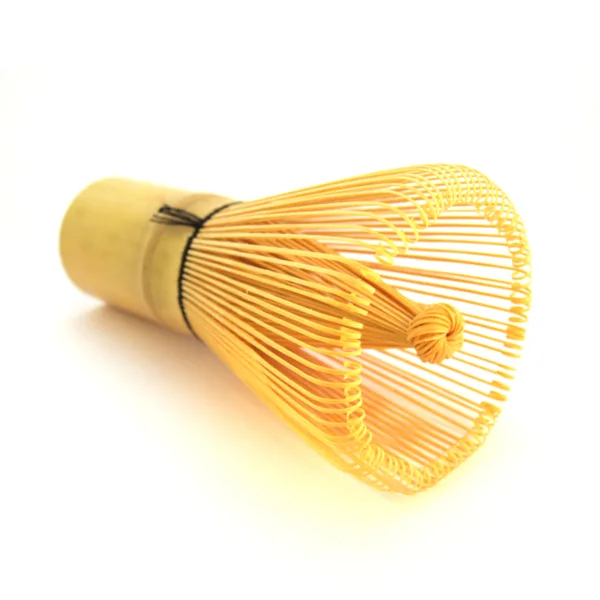
The chasen does not stir. It cuts air into liquid. Each prong acts like a tiny whisk within the whisk.
You cannot feel the foam form through a metal spoon. You must watch the surface change from broken bubbles to uniform crema. That visual feedback loop is the only way to adjust speed and angle in real time.
A proper usucha foam layer reaches two millimeters thick. It holds its shape for ninety seconds before large bubbles appear. If you stop too early the foam collapses.
If you whisk too long the foam turns dry and chalky. The sweet spot lives in a ten second window. Photographs of each stage teach that window better than any paragraph.
Research from the Urasenke school confirms that wrist snap creates finer bubbles than arm motion. The chasen tip speed should approach three meters per second at peak. Most home practitioners achieve half that.
The difference shows in the cup.
Tools That Actually Matter: Chasen, Chawan, and the Rest
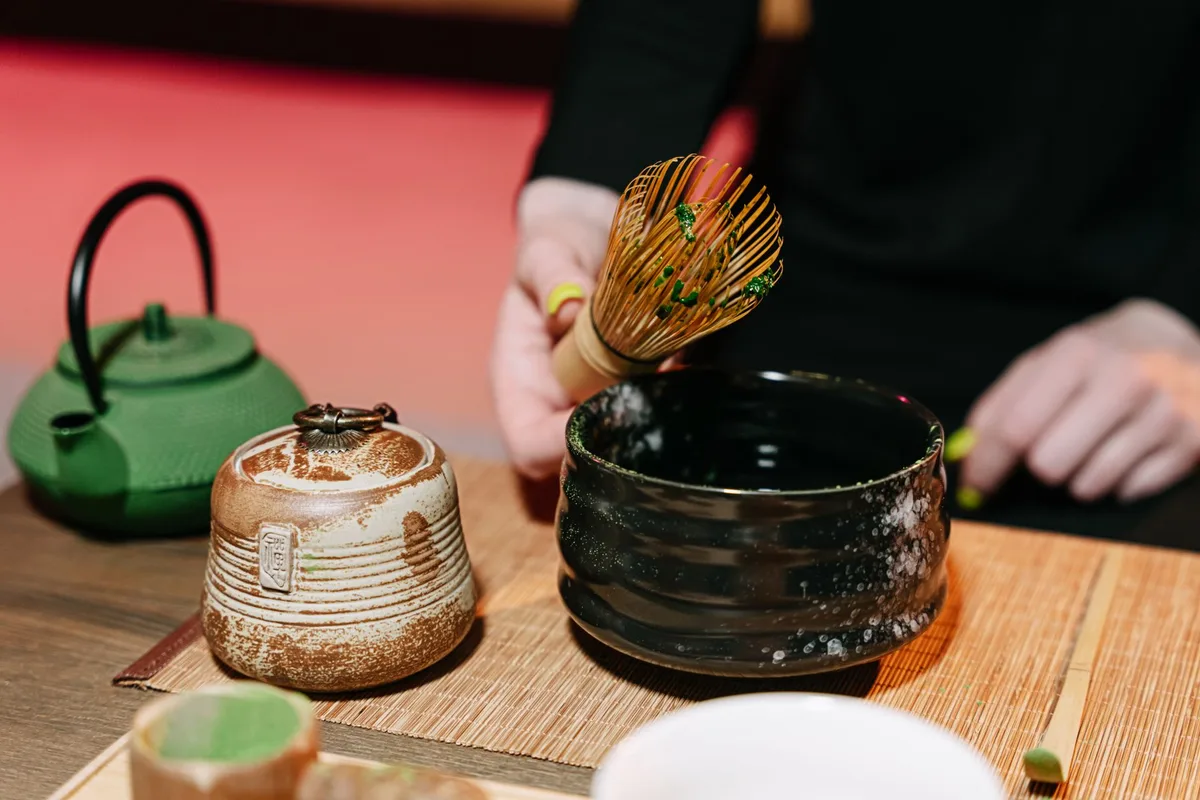
Four tools define the result. The chasen provides the cut. The chawan gives the space.
The chashaku measures the dose. The furui removes clumps before they hit water. Everything else is optional.
| Tool | Japanese Name | Key Spec | Replacement Risk |
|---|---|---|---|
| Bamboo whisk | Chasen | 80 to 120 prongs, cured bamboo | Metal whisk creates coarse foam |
| Wide bowl | Chawan | 12 cm diameter, 7 cm depth | Narrow mug traps foam |
| Bamboo scoop | Chashaku | 1.5 gram capacity | Teaspoon varies by 0.5 gram |
| Fine sifter | Furui | 60 mesh stainless steel | Skipping adds grit |
The chasen prong count changes foam texture. Eighty prong kazuho models forgive slower motion. One hundred twenty prong araho models demand speed but yield silkier crema.
Beginners should start with eighty prongs. The bamboo must be cured at least one year. Green bamboo snaps on first use.
Chawan shape controls the vortex. Wide shallow bowls let the chasen reach the bottom edge. Deep narrow bowls force the whisk vertical which kills the W pattern.
A twelve centimeter diameter gives the ideal turning radius. Glazed interiors reduce friction. Rough raku interiors grab prongs and slow the motion.
Chashaku consistency matters more than precision. Each scoop delivers one point five grams plus or minus point two grams. Two scoops equal three grams for usucha.
Four scoops equal six grams for koicha. Metal spoons vary by brand. The bamboo scoop eliminates that variable.
The furui catches clumps that form during storage. Matcha particles bind through static charge. A sixty mesh screen passes particles under two hundred fifty microns.
Clumps larger than that survive whisking and create grit on the tongue. Sift every session. No exceptions.
Reading Your Matcha: Grade, Particle Size, and Freshness Cues
Ceremonial grade means first flush spring harvest. Leaves shade grown for twenty days before picking. Stems and veins removed.
Stone ground at thirty revolutions per minute. The result tastes sweet with zero astringency when prepared correctly.
Culinary grade uses second or third flush leaves. Grinding speed runs three times faster. Particle size averages fifteen to twenty microns.
The flavor leans bitter and grassy. It works in lattes and baking. It fails as straight usucha.
Freshness shows in color and aroma. Fresh matcha glows jade green. Oxidized matcha dulls to army green.
The nose shifts from sweet vegetal to dry hay. Once opened the powder degrades in four to six weeks at room temperature. Freezing extends life to six months.
Store in an airtight tin with a desiccant packet.
Particle size affects whisking effort. Finer powder suspends faster. Coarser powder demands longer whisking which risks overheating the bowl.
A simple test: rub a pinch between thumb and forefinger. Ceremonial feels like talc. Culinary feels like fine sand.
Water Temperature: The Invisible Variable You Can Feel
Seventy degrees Celsius is the target. Eighty degrees maximum. Sixty degrees minimum.
Ten degrees either way changes the cup more than any other variable.
Water straight from a boiling kettle sits at ninety five degrees. Pour into a yuzamashi cooling vessel. Wait forty five seconds.
Pour into the chawan. Wait fifteen seconds. The bowl absorbs heat.
The water lands at seventy degrees. Skip the yuzamashi and you guess.
Temperature controls catechin extraction. Catechins create bitterness. Amino acids create sweetness.
At seventy degrees amino acids lead. At eighty five degrees catechins dominate. The difference is measurable on a spectrophotometer.
Your tongue detects it instantly.
A digital probe thermometer removes guesswork. Clip it to the chawan rim. Watch the display drop.
Whisk the moment it hits seventy. No probe? Flick a drop onto your inner wrist.
It should feel warm not hot. That tactile cue works within two degrees.
Cold water fails to suspend powder. The foam never forms. The matcha sinks.
You drink water with green sediment. Hot water cooks the powder. The aroma vanishes.
The color yellows. The taste turns sharp. Seventy degrees balances both.
Step-by-Step: Usucha (Thin Tea) Whisking with Visual Checkpoints
Warm the chawan with hot water. Discard. Dry with a linen cloth.
Warm the chasen by dipping prongs in hot water for thirty seconds. Shake off excess. A cold chasen shocks the matcha and kills foam nucleation.
Sift two grams of matcha into the warm bowl. Tap the furui gently. No force.
The powder should fall like snow. Clumps mean the furui mesh is too coarse or the powder is damp.
Pour sixty milliliters of seventy degree water along the bowl wall. Not the center. Wall pour reduces initial agitation.
The powder hydrates evenly. Center pour creates a crater that traps dry powder.
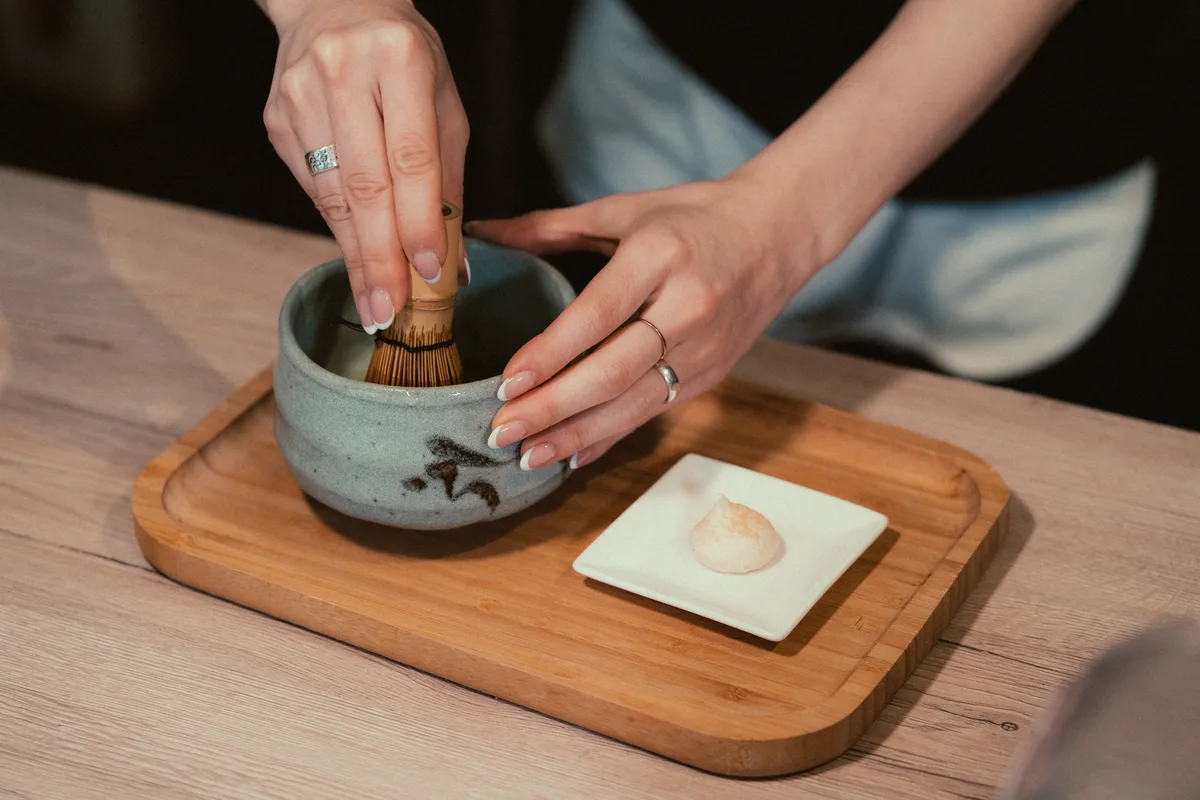
Hold the chasen with thumb index and middle finger. Wrist loose. Elbow close to ribs.
Start slow. Draw a W shape across the bowl diameter. Ten centimeters wide.
Two strokes per second. Increase speed every three seconds.
Watch the surface. Large bubbles appear first. They look like fish eyes.
Keep whisking. The W pattern breaks them down. At ten seconds the foam turns uniform.
Microbubbles pack tight. The surface reflects light like wet paint.
Stop at fifteen seconds. Lift the chasen straight up. A clean peak should rise and hold for three seconds.
That peak proves the foam structure. If it collapses instantly you under whisked. If the foam looks dry you over whisked.
Drink in three sips. The first sip carries the crema. The second balances liquid and foam.
The third finishes the bowl. Do not let it sit. Foam half life is two minutes.
After that the flavor flattens.
Step-by-Step: Koicha (Thick Tea) Kneading — No Foam, All Body
Koicha uses four grams of matcha and forty milliliters of water. The ratio is one to ten. No foam forms.
The texture resembles melted chocolate. The motion is slow kneading not rapid whisking.
Warm the chawan and chasen as for usucha. Sift four grams into the bowl. Pour forty milliliters of seventy degree water along the wall.
Let the powder hydrate for five seconds before moving the chasen.
Hold the chasen vertical. Press the prongs into the powder. Move in a slow figure eight.
One stroke every two seconds. The paste thickens under the prongs. No splashing occurs.
The surface stays mirror smooth.
Knead for thirty to forty seconds. The paste pulls away from the bowl wall cleanly. A subtle sheen appears.
That sheen signals full hydration. Stop. Lift the chasen straight up.
No peak forms. The surface holds a gentle dome.
Koicha demands ceremonial grade matcha. Culinary grade turns harsh at this concentration. The sweetness must carry the weight.
Share the bowl in a ceremony setting. Each guest takes three sips. The bowl rotates between hands.
What Good Foam Looks Like: Crema, Bubble Size, and Stability
Ideal usucha foam measures one to two millimeters thick. Bubbles are invisible to the naked eye. The surface reflects light like wet paint.
Tilt the bowl forty five degrees. The foam clings without sliding.
Large bubbles signal trouble. Fish eyes larger than one millimeter mean the chasen speed was too low or the angle too steep. They burst fast and leave craters.
The foam collapses in thirty seconds.
Dry foam looks matte and cracked. It means you whisked past the sweet spot. The structure fractured.
The flavor turns hollow. Stop when the surface turns glossy.
Foam half life is two minutes. After ninety seconds large bubbles nucleate at the rim. They migrate inward.
The crema thins. Drink before this cascade starts. Cold bowls accelerate collapse.
Warm bowls extend it by thirty seconds.
A simple test: blow gently across the surface. Good foam ripples like fabric. Bad foam craters instantly.
The ripple test reveals elasticity. Elastic foam holds aroma. Brittle foam releases it.
Common Visual Mistakes and What They Tell You
Clumps floating on top mean the furui was skipped or the mesh too coarse. Fix: sift every session. Use a sixty mesh screen.
Tap gently. No pressure.
Pale green liquid with no foam means water was too cold or matcha too old. Fix: hit seventy degrees. Use powder opened within six weeks.
Store in freezer for longer life.
Yellow green color with sharp aroma means water exceeded eighty degrees. Fix: use a yuzamashi. Wait forty five seconds after boil.
Verify with probe or wrist test.
Thin foam that vanishes in ten seconds means the chawan was cold or the chasen dry. Fix: warm both with hot water first. Dry the bowl.
Dampen the prongs. Shake excess.
Splatter up the bowl walls means the W motion started too fast. Fix: begin slow. Two strokes per second.
Accelerate gradually. The vortex must form before speed increases.
Grit on the tongue means matcha particles larger than two hundred fifty microns survived. Fix: sift. Check furui mesh.
Replace if mesh stretched. Ceremonial grade reduces this risk.
Chasen Care: Soaking, Drying, and Knowing When to Replace It
Soak new chasen in warm water for two minutes before first use. The prongs unfurl. The bamboo relaxes.
Skip this and tips snap on day one.
After each use rinse under cold running water. No soap. No scrub.
Shake once hard. Pat the handle dry. Place prongs down on a kuse naoshi whisk holder.
The holder maintains the curve. Air dry twenty four hours.
Never store a damp chasen in a sealed container. Mold spores bloom in twelve hours. Aspergillus appears as black dots at the base.
Discard immediately. Mold transfers to matcha.
Prong tips fray after two hundred sessions. Tips turn white and split. The cut action dulls.
Foam quality drops. Replace the chasen. A fresh eighty prong kazuho costs fifteen dollars.
The cup quality justifies it.
Bamboo darkens with age. That patina is normal. Cracks at the handle base are not.
They signal structural fatigue. Retire the chasen before it fails mid whisk.
Quick Alternatives When You Don’t Have a Bamboo Whisk
An electric milk frother works in a pinch. Use the whisk attachment. Submerge fully.
Run ten seconds. The foam forms but tastes flat. Metal contact dulls the sweet notes.
Acceptable for lattes. Not for straight usucha.
A metal balloon whisk creates coarse bubbles. The wires are too thick. They cannot cut microbubbles.
The foam collapses in twenty seconds. Better than nothing for culinary grade matcha in baking.
A sealed jar shaken hard produces foam. Large bubbles dominate. Oxidation accelerates.
The matcha tastes metallic within five minutes. Use only for iced matcha where dilution masks flaws.
A handheld bamboo whisk with fewer than sixty prongs fails. The prong density cannot sustain the vortex. Foam forms then dies.
Invest in a proper chasen. The difference is immediate.
No tool replaces the chasen for koicha. The kneading motion requires flexible prongs that press not cut. Metal whisks scrape the bowl.
They cannot develop the paste texture.
Matcha-to-Water Ratios Cheat Sheet
| Style | Matcha | Water | Ratio | Whisk Time | Foam Target |
|---|---|---|---|---|---|
| Usucha (thin) | 2 g | 60–70 ml | 1:30–35 | 15–25 s | 1–2 mm microfoam |
| Koicha (thick) | 4 g | 40 ml | 1:10 | 30–40 s knead | none, mirror sheen |
| Café latte | 3 g | 30 ml shot + 180 ml milk | 1:10 base | 10 s froth | 5 mm macrofoam |
| Cold brew | 5 g | 200 ml cold | 1:40 | shake 30 s | light head |
Usucha scales linearly. Double the dose to 4 g with 120 ml water for a larger bowl. Keep temperature at 70 °C.
Koicha does not scale. The paste texture breaks above 4 g per 40 ml. Ceremonial grade is mandatory for koicha.
Culinary grade works for latte and cold brew.
A digital scale accurate to 0.1 g removes guesswork. The chashaku delivers 1.5 g ±0.2 g. Two scoops equal 3 g.
Adjust by weight for precision. Water volume measured in a graduated pitcher beats eyeballing.
Frequently Asked Questions
Can I whisk matcha without a sifter?
No. Clumps larger than 250 microns survive whisking and create grit. A 60 mesh furui costs five dollars and lasts years.
Sift every session.
Why does my foam collapse in 30 seconds?
Large bubbles indicate low whisk speed or cold bowl. Warm the chawan and chasen first. Accelerate the W motion gradually.
Stop when the surface turns glossy.
Is metal whisk okay for daily use?
Metal creates coarse bubbles that burst fast. It also imparts a metallic note. Acceptable for culinary grade in lattes.
Not for ceremonial usucha or koicha.
How long does opened matcha stay fresh?
Four to six weeks at room temperature. Six months in the freezer in an airtight tin with a desiccant packet. Color dulls to army green when oxidized.
Can I use boiling water if I cool it in the bowl?
Pouring boiling water directly into the chawan shocks the powder and cracks the bowl. Use a yuzamashi or wait 45 seconds off boil. Target 70 °C at the powder.
When should I replace my chasen?
After 200, 300 sessions or when prong tips turn white and split. A fresh 80 prong kazuho costs $15. Mold at the base means immediate replacement.

Table of Contents