You don’t need a big kitchen to enjoy a dishwasher. But how to choose a dishwasher for a small kitchen isn’t about picking the shiniest model. It’s about measuring your space, checking your hookups, and knowing what type fits your life.
A standard built-in dishwasher is 24 inches wide and typically needs a 24-inch cabinet cutout. Most small kitchens don’t have that. In fact, many apartments offer only 18 inches of space or a countertop spot.
So your first move is measuring, and that’s where we’ll start.
How to Choose a Dishwasher for a Small Kitchen
Measure your kitchen gap. Check that you have water and drain access. Pick a countertop, portable, compact built-in, or drawer model.
Match the unit to your space and budget. You should also consider noise and capacity. The best dishwashers for small kitchens fit without major renovations.
Why a Standard Dishwasher Won’t Fit Your Small Kitchen
Most full-size dishwashers are built to one spec: 24 inches wide, 24 inches deep, and 35 inches tall. That’s the standard. Manufacturer specs also call for a minimum cutout of 24 inches wide and 22.5 inches deep.
But the average small kitchen doesn’t have that. You might have 18 inches, or just 15, or none at all.
Even if you do have 24 inches of width, depth can still ruin the plan. A 24-inch deep unit needs a 24-inch deep cutout. If your cabinets are only 20 inches deep, the dishwasher will stick out.
That blocks walkways and makes opening drawers a pain. Door swing is another surprise. A standard dishwasher door needs to open fully to pull out the bottom rack.
If you have a fridge or cabinet next to it, you might not be able to open the door all the way. That makes loading and unloading miserable.
The other problem is hookups. Built-in dishwashers need three things: a water supply line, a drain line, and a 120-volt electrical connection. If those aren’t within a few feet of your cutout, you’re facing major plumbing work.
Not a small project. That’s a remodel.
So before you even look at models, ask yourself these three questions:
- Is there a 24-inch wide cabinet gap?
- Are there existing water and drain lines under the sink?
- Is there a dedicated electrical circuit or a plug nearby?
If the answer is no to any of these, a standard dishwasher won’t work. You’ll need a compact built-in, a countertop unit, or a portable model. Each of those comes with its own space and hookup demands.
We’ll walk through them step by step.
Step 1: Measure Your Space, Hookups, and Electrical Access
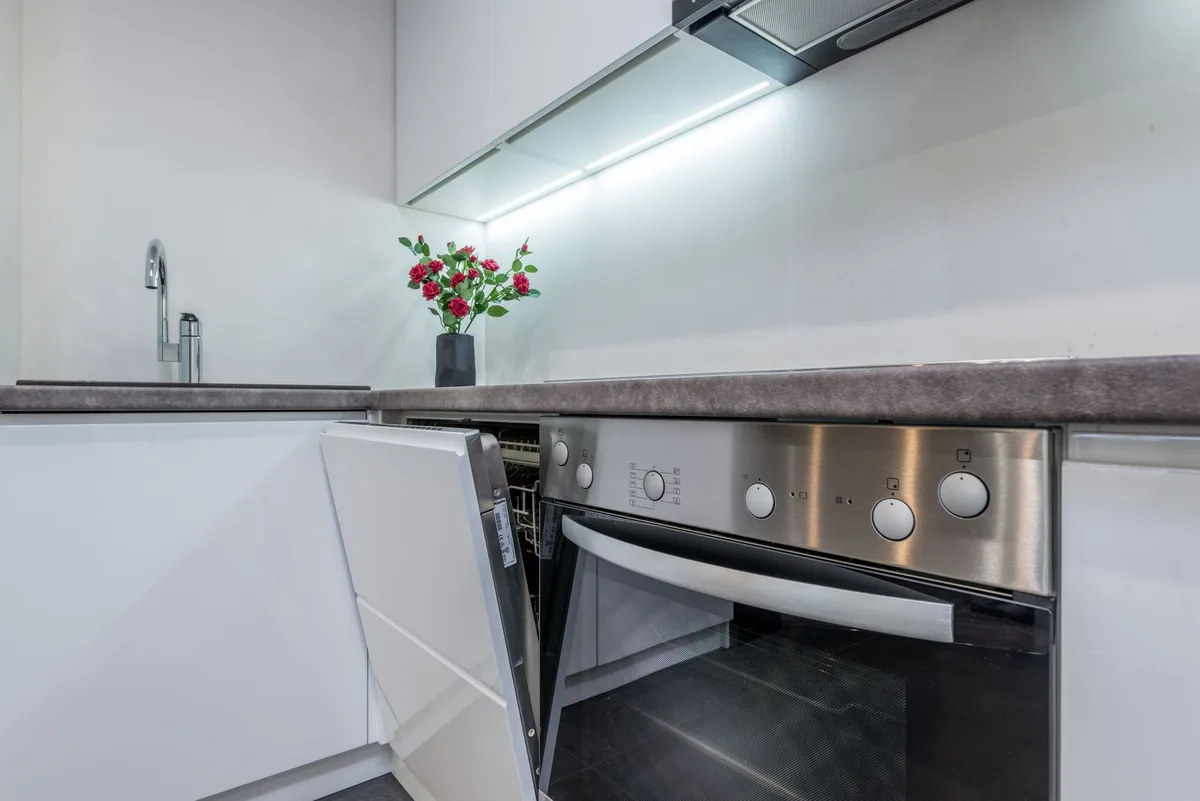
Grab a tape measure and a notepad. This step takes ten minutes, and it tells you exactly which dishwasher types are possible. Don’t skip it.
A 1-inch difference in width decides whether you need a compact unit, a portable, or nothing at all.
Cabinet Cutout Width, Depth, and Height
Measure the width of the cabinet space. Do it at the front, not the back, because cabinets often narrow behind the doors. Write down the clear inside width between the sidewalls.
If it’s 24 inches, a standard built-in fits. If it’s 18 inches, that’s what compact models are made for. If it’s less than 17 inches, you’re looking at countertop or portable units.
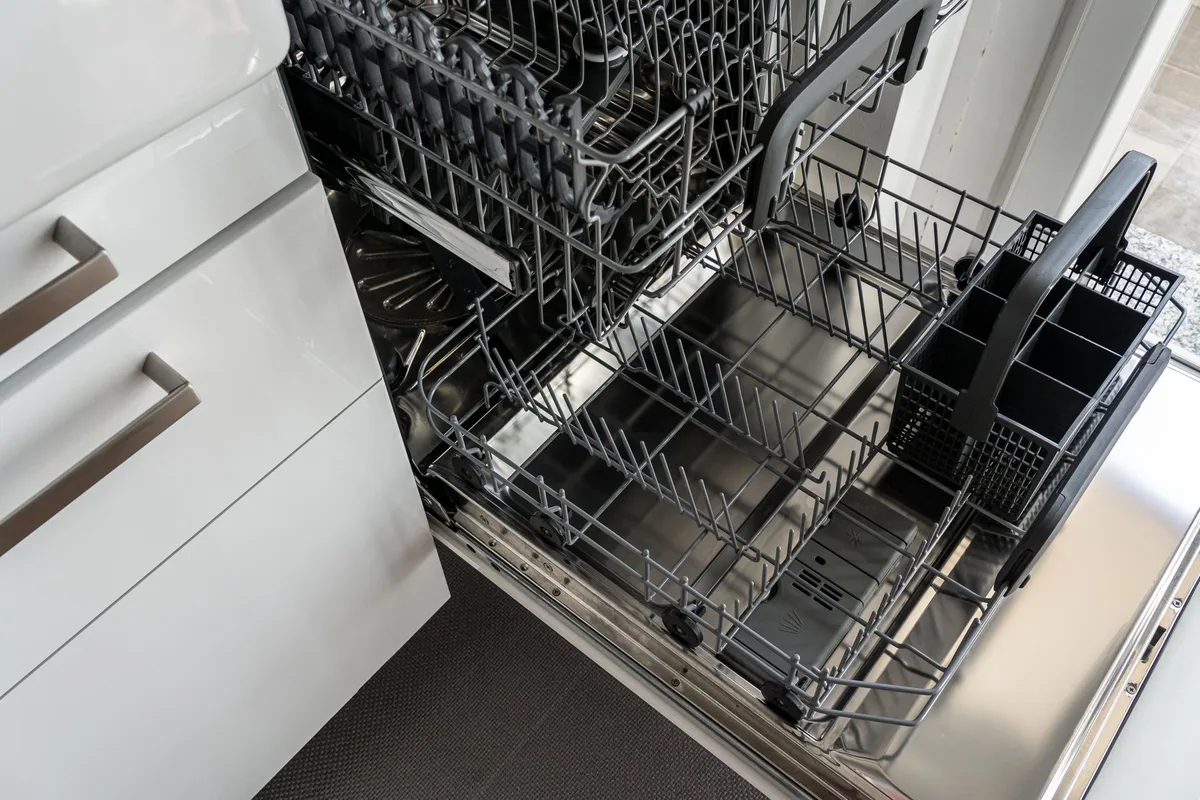
Then measure the depth. Run your tape from the back wall to the front edge of the cabinets. Most built-ins need a cutout that’s at least 22.5 inches deep.
You also need room for the door to swing open. Add a few inches for that. Finally, measure the height from the floor to the underside of the countertop.
A typical built-in fits under a 35-inch tall opening. Compact models are often slightly shorter, which helps in older homes.
Water Supply and Drain Connections
Look under your sink. Find the hot water supply line. Built-in dishwashers need either a shut-off valve or a T-adapter on that line.
Most homes have a 3/8-inch compression fitting under there. If you don’t, a plumber can add one in about an hour.
The drain side matters just as much. Your drain hose needs to connect to the sink drain tailpiece, a garbage disposal inlet, or a dedicated standpipe. If you see a plastic cap on the tailpiece, you’re ready.
But if there’s no way to attach the hose, a portable dishwasher gets around this problem completely. It hooks straight to your kitchen faucet and uses the sink for drainage.
Electrical Circuit and Outlet Access
Built-in dishwashers need a 120-volt outlet under the counter or a hardwired connection. Just as important, they need their own circuit. If your unit shares a circuit with a microwave or space heater, you’ll trip breakers.
Countertop and portable dishwashers don’t need that. They plug into any standard wall outlet with a three-prong cord.
One more thing: modern electrical codes now call for a GFCI-protected outlet near the sink. As of 2026, many local jurisdictions require it for dishwashers. That’s a safety upgrade, not a style choice.
If your outlet is old, budget for a quick electrician visit.
Once you have these measurements and hookup notes, you can filter your options instantly. If you have an 18-inch gap with water and a plug, a compact built-in fits. If you have no gap at all, but you have a counter and an outlet, a countertop unit works.
If you have floor space and a faucet, a portable is your friend.
Step 2: Know Your Four Dishwasher Options
Small-kitchen dishwashers come in four different styles. Each one exists to solve a different spatial problem. Don’t pick one because it’s cute.
Pick the one that matches the measurements you just wrote down.
Countertop dishwashers sit directly on the counter. They measure roughly 18 inches wide by 18 inches deep, and they hold around six place settings. You connect them to your faucet with a special adapter.
No permanent plumbing required. These are best for renters, dorm rooms, or kitchens with zero cabinet gaps.
Portable dishwashers are full-sized machines on wheels. They usually measure 24 inches wide and stand about 36 inches tall. You roll them to the sink, hook the hose to the faucet, run a cycle, then roll them into a closet or a corner.
They hold up to ten place settings and offer a real dishwasher capacity without any built-in installation.
Compact built-in dishwashers are permanent units made for 18-inch cutouts. They fit under the counter just like standard dishwashers, but they’re about 6 inches narrower. They need a water line, a drain, and an electrical connection.
They’re the best choice for apartments with a pre-made 18-inch cabinet gap.
Drawer dishwashers pull out like a drawer rather than swinging a door. They’re usually 24 inches wide but slightly shorter than standard units. You can get a single drawer or two stackable drawers.
They let you wash small loads without using water for a full-size rack. They require the same plumbing as a built-in, so installation costs tend to be higher.
Here’s a quick way to think about it. No counter space? Portable.
No floor space? Countertop. No cabinet gap but wet and wired?
Compact built-in. Want flexibility and don’t mind the cost? Drawer model.
Countertop vs. Portable vs. Built-In: The Side-by-Side Reality Check
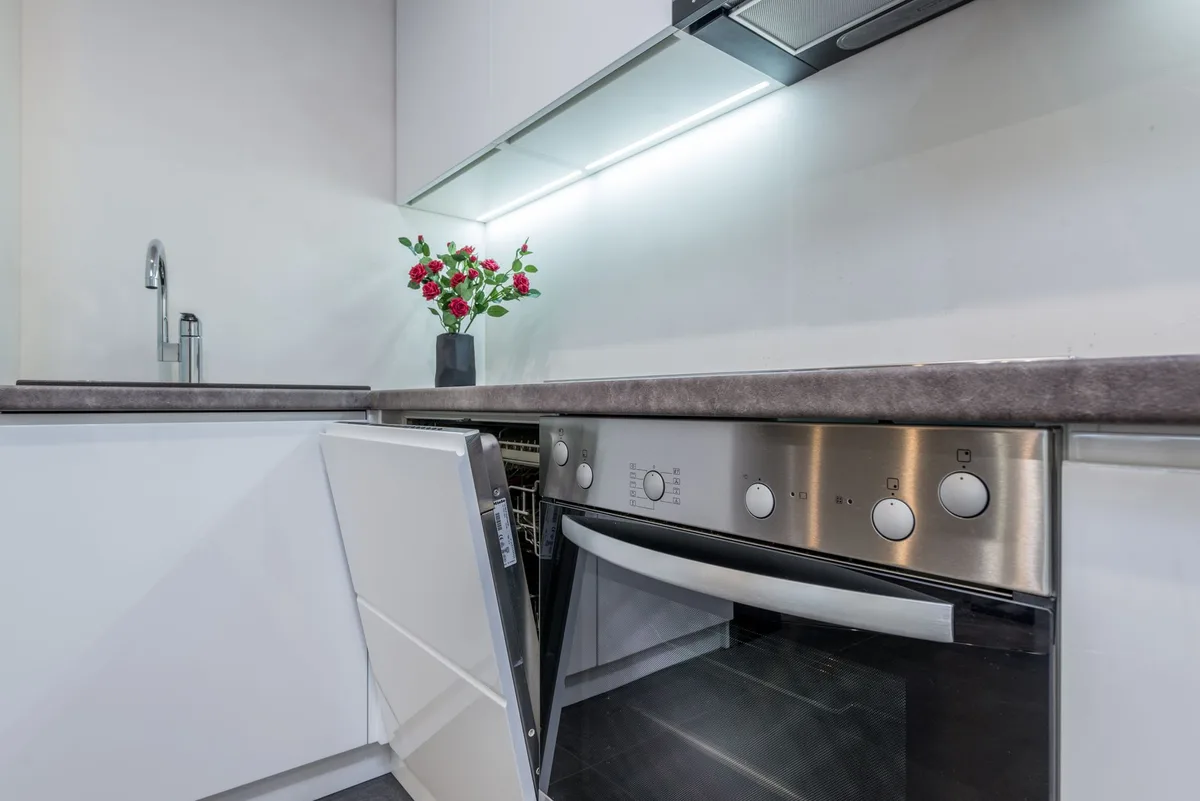
Now, let’s put them side by side. This table shows what you’re really trading when you pick one configuration over another. The right choice depends entirely on the numbers you measured earlier.
| Type | Width | Installation | Capacity | Typical Noise | Best For |
|---|---|---|---|---|---|
| Countertop | 18″ | Plug into faucet adapter | 6-8 place settings | 50-60 dBa | Renters, tiny kitchens, no floor space |
| Portable | 24″ | Wheels, hook to faucet | 8-10 place settings | 55-65 dBa | Small kitchens with floor space |
| Compact built-in | 18″ | Permanent under-counter | 6-8 place settings | 44-55 dBa | Apartments with an 18″ cabinet gap |
| Drawer model | 24″ | Permanent under-counter | 6-10 place settings | 45-50 dBa | Remodels, flexibility, premium kitchens |
The countertop model wins on simplicity. You don’t need tools. You don’t need a plumber.
You just connect it to the faucet and press start. The tradeoff is capacity and noise. These units are louder, vibrate a bit on wood counters, and can’t handle a big dinner party’s worth of plates.
The portable model wins on capacity without renovation. It washes like a standard dishwasher because it basically is one, just on wheels. You do have to clear floor space when you use it, and the hose takes a few minutes to connect.
That’s annoying if you cook every day, but it’s a fair trade for renters.
The compact built-in wins on permanent convenience. It lives under your counter, so it’s out of sight. It’s also quieter than countertop and portable models.
The catch is that it needs that 18-inch cabinet space and permanent connections. If you don’t have both, this option doesn’t exist for you.
The drawer model wins on flexibility and looks. You can run one drawer while waiting for the other to fill. But it’s the most expensive route per inch, and installation sometimes requires custom cabinetry work.
Only choose this if your budget and your layout both cooperate.
Keep in mind that noise ratings come from manufacturer specs. In real kitchens, countertop and portable models get louder if they’re not on a solid, level surface. Built-in units are always secured to the cabinet, which keeps vibration down.
That’s a huge advantage in a small, open-plan apartment.
Features That Matter When Space Is Tight
Once you narrow down the type, start looking at features. In a small kitchen, every feature affects how often you actually use the machine. Here’s what deserves your attention and what’s just marketing.
Noise level. This might be the most important spec for a small kitchen. There’s no separate laundry room or utility closet to hide in. If a dishwasher runs at 55 decibels, you’ll hear it while you’re cooking, while you’re eating, and while you’re watching TV in the next room.
Look for models rated at or below 50 dBa. A 44-dBa model is quieter than a normal conversation. That’s worth the extra cost.
Cleaning capacity and rack flexibility. Compact units don’t have room for careless rack design. Look inside before you buy, if you can. Are the tines adjustable?
Is there a flat or folding rack for wine glasses? Does the top rack slide smoothly? A good rack system can fit an entire week of dishes for one person in a unit that claims only six place settings.
A bad one will leave you hand-washing the awkward stuff anyway.
Drying systems. Condensation drying is the gold standard for small kitchens. It uses the residual heat of the final rinse to dry dishes without a heating element. It’s energy-efficient and safe for plastics.
Some models also have a fan-assisted dry or a zeolith mineral chamber that absorbs moisture. Either way, look for a dedicated drying cycle instead of relying on “open the door and air dry.”
Cycle options. You don’t need twelve programs. You need four that work in real life. A quick wash for lightly soiled dishes, a heavy cycle for baked-on gunk, an eco cycle for daily use, and a sanitize option for baby bottles or cutting boards.
Half-load is also a smart feature. In a small household, you don’t want to wait three days to fill the machine.
Filter system. Many compact models use a manual filter you pull out and rinse once a month. That’s fine. More advanced units have a self-cleaning filter that grinds food particles away.
The self-cleaning version costs more and is worth it if you hate maintenance. Just know that neither filter makes the dishwasher a garbage disposal. Scrape large food scraps first.
Installation accessories. For countertop and portable units, check the faucet adapter kit. Some work with standard threaded faucets only. If you have a pull-out sprayer or a touchless faucet, you might need an adapter.
That’s a $20 add-on, but it can mean the difference between a four-minute setup and an afternoon of frustration.
One more advantage of compact units that gets overlooked: they use significantly less water and energy than hand washing a full sink. A compact dishwasher averages about 2.7 gallons per cycle, while a standard unit uses around 4.5 gallons. If you’re in an apartment with a utility charge, those numbers add up.
What a Compact Dishwasher Really Costs (Including Installation)
Countertop models run $200 to $450. Portable units sit between $400 and $700. Compact built-ins range from $500 to $900.
Drawer models start near $1,200 and climb quickly from there.
The real cost is installation. Countertop units cost $20 extra for a faucet adapter and nothing else. Portable units also skip permanent hookups entirely.
A compact built-in, though, adds $150 to $400 on top of its sticker price.
Electrical work pushes that number higher. If you need a new GFCI outlet or a dedicated circuit, budget another $200 to $350. Permits run $50 to $150 in most cities.
As of 2026, budget countertop units still start under $200, but the models that dry properly start closer to $300.
| Type | Unit Price | Installation | Real-World Total |
|---|---|---|---|
| Countertop | $200 to $450 | $20 to $40 | $220 to $490 |
| Portable | $400 to $700 | $0 to $30 | $400 to $730 |
| Compact built-in | $500 to $900 | $150 to $400 | $650 to $1,300 |
| Drawer model | $1,200 to $2,000 | $300 to $600 | $1,500 to $2,600 |
Running costs are where small units shine. Energy Star rated models draw about $30 to $40 of electricity per year. A standard 10-year-old unit can cost two or three times that.
Water use drops to roughly 2.7 gallons a cycle, per Energy Star testing. Hand washing the same few place settings uses 10 to 20 gallons.
Most compact units come with a one-year parts and labor warranty. Extended coverage rarely pays for itself on a sub-$1,000 appliance. Spend that money on a quieter model instead.
Seven Mistakes That Turn a Space-Saver into a Headache
Skipping the depth measurement. You can wedge an 18-inch unit into an 18-inch gap and still have it stick out 3 inches. Cabinet depth varies between 20 and 24 inches. Measure front to back, not just side to side.
Ignoring the door swing. Compact built-ins need their door to open fully so the racks slide out. A wall or refrigerator next to the unit can block that arc. Leave at least 24 inches of clearance in front.
Buying before checking faucet compatibility. Countertop and portable units connect directly to your faucet. Pull-out sprayers, touchless sensors, and brushed fixtures often need a special adapter. Check the model’s compatibility sheet before ordering anything.
Forgetting about water pressure. Countertop dishwashers need 20 to 120 psi for proper spray cleaning. Low pressure produces weak washes and longer cycles. If you’re in an old building, test your pressure first.
Overloading a compact unit. Six place settings means six plates, six bowls, and six cups. It doesn’t mean a casserole dish parked on top of a skillet. Run smaller loads more often instead of cramming everything in at once.
Assuming any outlet works. Countertop and portable units draw 10 to 12 amps. Plugging one into a circuit that also carries a microwave will trip the breaker. Give it its own outlet or a short, heavy-duty extension cord.
Choosing price over noise. A $250 countertop model that sounds like a blender makes you delay running it. That defeats the entire purpose. Spend the extra $100 for a quieter unit you’ll actually use.
Maintenance: Keeping It Running for a Decade
Clean the filter monthly. Most compact units have a removable filter cartridge in the bottom of the tub. Twist it out, rinse it under hot water, and brush away any food grime. This two-minute habit is the #1 way to prevent drain clogs.
Clear the spray arms. Food bits and hard water minerals settle in the nozzle holes. Run a wooden toothpick through each hole every few months. Make sure the arms spin freely by hand.
Use rinse aid every month. Rinse aid helps water sheet off dishes, which speeds up drying and prevents hard-water spots. If you skip it, you’ll see cloudy film on glassware. Refill the reservoir every three to four weeks.
Descale every few months. A compact machine has less water to flush away scale. Add a few tablespoons of citric acid to the tub and run an empty hot cycle. This keeps the heating element efficient and the drain path clear.
Wipe the door seal. The rubber gasket around the tub catches crumbs and grease. Left alone, it can warp and leak water onto your floor. Wipe it down whenever you clean the filter.
Most dishwashers run 10 to 15 years before major repairs. With regular cleaning, compact models hit that range easily. Without it, they tend to fail around year seven, usually from a clogged pump or corroded seal.
Quick FAQs for Small-Kitchen Dishwasher Shoppers
Can a countertop dishwasher really clean dishes?
Yes, for normal daily loads. It uses the same wash and rinse principles as a full-size dishwasher. Baked-on food and oversized platters will disappoint you, though.
Scrape plates before loading and run a rinse cycle on heavy messes. That keeps results consistent.
Do portable dishwashers need special faucets?
Most standard threaded faucets work with a simple adapter. Aerators screw off, and the adapter threads on in seconds. Pull-out spray heads and touchless designs usually need a manufacturer-specific kit.
Check the compatibility list before you order a portable unit. Some kits cost $20 to $40 extra.
Are 18-inch dishwashers worth it?
Only if you truly lack a standard 24-inch cutout. They cost more per place setting than full-size models. If you have an 18-inch gap with hookups, they’re the only built-in option.
They preserve counter space and handle small households well.
Can I install a compact dishwasher myself?
Yes for countertop and portable models, which take about 15 minutes. Built-in models are a different story. They need water lines, a drain, and secure electrical connections.
If you’re not comfortable with plumbing, hire a professional. A small leak is not a cheap repair.
How long does installation take?
Countertop units take 15 minutes, start to finish. Portables take about the same. Built-in models run 1 to 3 hours for a confident DIYer.
A plumber will be faster with the hookups but won’t help with cabinet fitting.
Do small dishwashers use less water than hand washing?
Yes, consistently. Compact models use 2.7 to 4.5 gallons per cycle, according to Energy Star standards. Hand washing the same load takes 10 to 20 gallons.
That makes the compact unit better for your bills and the planet.
The Final Decision Flow: Match Your Kitchen to the Right Unit
Start with a tape measure and a simple checklist. Answer these questions in order, and the right type picks itself.
Do you have a standard 24-inch gap with hookups? Go with a standard built-in. If not, keep moving.
Do you have an 18-inch gap with water and power? Pick a compact built-in. It’s the best way to get permanent convenience without tearing out cabinets.
Do you have clean floor space near the sink? Choose a portable dishwasher. Full-size capacity plus zero renovation.
Do you have counter space and a nearby outlet? A countertop dishwasher is the cheapest and easiest route. Perfect for renters.
Still torn? Let noise and budget decide. Quieter built-ins win on daily comfort. Cheaper countertop units win on upfront price.
If you have an 18-inch gap but no power nearby, don’t run an extension cord. Hire an electrician to add a dedicated outlet. That’s the safest call.
And always read the installation manual before ordering parts. The manual lists exact clearance and connection specs for your model. Most installation failures come from skipping that document.

Table of Contents