If you’re here to figure out how to choose a quiet dishwasher, you already know the problem. The current machine shakes the walls, or the budget model hums all through dinner. That grinding churn and water splash can turn a cozy night into a headache.
We’re going to walk through the specs that actually matter.
Our research starts with the math of noise. Decibels are measured on a logarithmic scale, so a difference of just three decibels is roughly double the acoustic energy. As of 2026, the quietest residential models on the market claim ratings around 38 dBA.
The real trick is understanding what that number means in a regular kitchen, not a soundproof test lab.
How to Choose a Quiet Dishwasher
Look for a dishwasher with a dBA rating of 44 or lower. Use 50 dBA as your hard maximum. Compare models using the same cycle type.
Remember that insulation and installation quality matter just as much as the number.
Why Dishwasher Noise Matters More Than You Think
Open-concept kitchens make the dishwasher part of every gathering. When the machine runs, everyone hears it. The hum, the spray, and the clinking dishes all become part of the background noise.
That matters more than a lot of shoppers realize.
The stakes go up at night. Families with babies, light sleepers, or anyone on a late work schedule all need a dishwasher that can run without waking the house. In apartments, shared walls pass sound straight through.
A loud machine becomes a source of tension with neighbors.
Noise complaints appear constantly in consumer feedback across every major brand. People don’t replace a dishwasher because it failed to clean. They replace it because they can’t stand the sound.
The cost of picking wrong is not just financial. It’s a daily annoyance you can’t easily fix.
Put the dBA number at the top of your requirement list. Then look at build quality. A cheaper machine with a plastic tub and limited insulation will be louder even if the spec sheet tries to look good.
The quietest options pair a strong motor with real sound-dampening material.
There is a standardized way to measure all this. In North America, the Association of Home Appliance Manufacturers works with the IEC 60704 test, which places the dishwasher in a controlled chamber. This gives you a comparable number across brands.
The test uses a fixed cycle, a loaded machine, and a microphone at a standard distance.
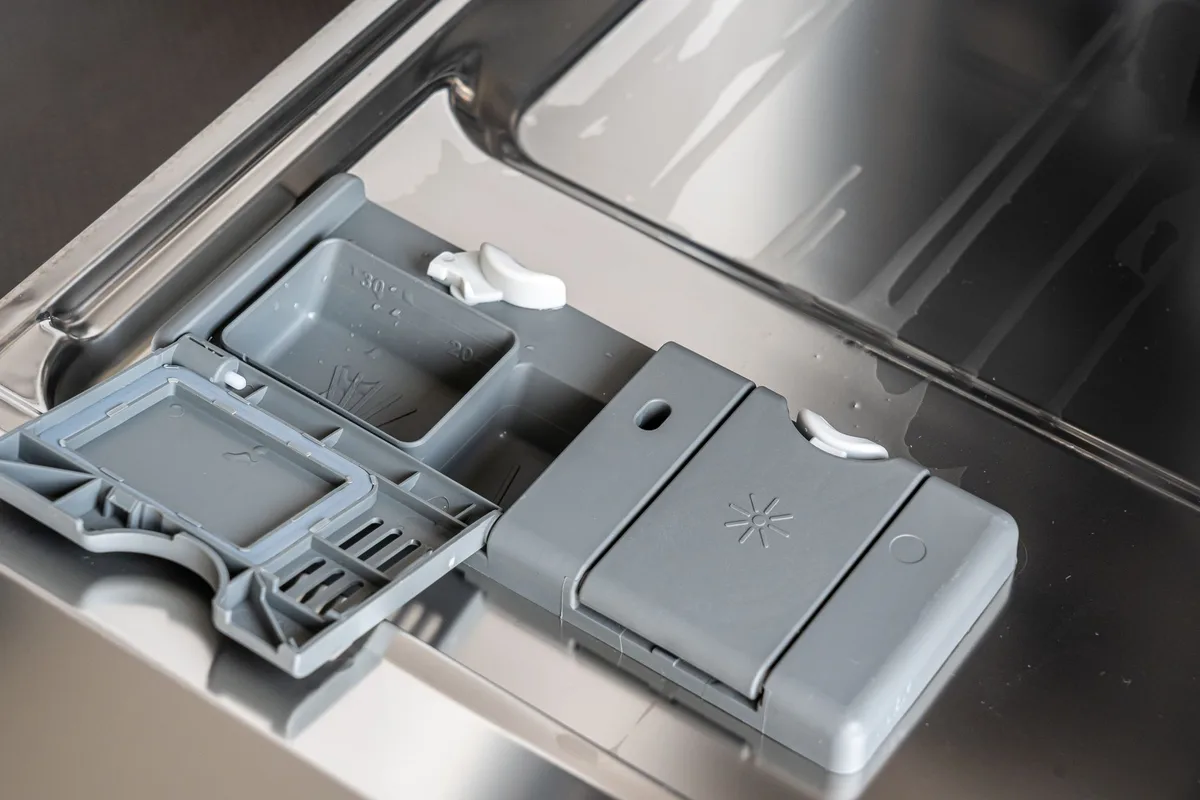
The catch is that your kitchen is not a test lab. Tile floors, high ceilings, and wood cabinetry change how sound behaves. Glassware in the racks adds its own voice.
That’s why you should treat the dBA rating as a starting point, not a guarantee.
Add a few installation habits to lower real-world noise:
- Fill the gap between the unit and the cabinet with sound-dampening foam strips.
- Make sure the door panel is tight and not rattling.
- Level the dishwasher so the spray arm doesn’t knock against dishes.
- Use a normal cycle for routine loads instead of the heaviest wash setting.
If you set your expectations around 44 dBA or lower, quiet becomes a reality. At that level, a dishwasher can run during a family dinner without derailing the table talk. For many buyers, that’s the difference between an appliance and an amenity.
There’s also the resale angle. A kitchen with a silent dishwasher reads as modern and thoughtful. Homebuyers who have lived with noise instantly get the appeal.
Open layouts dominate new construction, so nobody wants an appliance that competes with conversation. Silence, in this case, is genuinely valuable.
Decibel Ratings Explained: What 38, 44, and 50 dBA Really Sound Like
dBA is the unit used to measure sound pressure, and the “A” means the reading is weighted toward human hearing. The scale is logarithmic, which trips up a lot of buyers. A 44 dBA machine isn’t just slightly louder than a 40 dBA one.
The energy jumps in big steps.
Here’s a rapid guide to what the numbers feel like:
| dBA Rating | You’d hear it as | Use in a home |
|---|---|---|
| 38-40 dBA | Soft whisper or quiet library | Barely noticeable; you might double-check it’s on |
| 42-44 dBA | Quiet office hum | Runs in the background without spoiling conversation |
| 46-48 dBA | Light rain or gentle fan | Clearly present; can interrupt music or TV |
| 50-52 dBA | Normal conversation | Unmistakable; quiet movie scenes get harder to follow |
| 54+ dBA | Loud speech or nearby vacuum | You’ll likely raise your voice to talk over it |
The most important takeaway: every three dBA represents a doubling of sound pressure. That’s why a 47 dBA machine can feel dramatically louder than a 44 dBA one, even though the numbers look close on paper.
Manufacturers test these numbers using a standard wash cycle in a lab. The microphone sits at a fixed distance, and the machine is fully loaded. That’s fine for comparing models side by side.
It just doesn’t tell you exactly how the machine will sound under your counters and inside your cabinets.
Some brands publish multiple dBA ratings for different cycles. A normal cycle might be rated 44 dBA while the heavy or sanitize cycle is 50 dBA or higher. Always compare like for like.
If one spec sheet advertises its quietest cycle and another advertises its normal cycle, the comparison falls apart.
Don’t confuse dBA with plain dB. The “A” weighting filters out low-frequency sounds that humans don’t perceive as loudly. Since dishwasher noise contains both motor hums and higher-pitched spray sounds, dBA is the more useful number.
Look for dBA on the spec sheet, not just dB.
A few rules for reading spec sheets:
- Look for the normal or automatic cycle dBA.
- Ignore marketing names like “Silent Wash” or “Whisper Quiet.”
- Find the dBA of the cycle you’ll actually run.
- Check reviews to see if real owners report noise levels matching the rating.
In our research, models rated at 44 dBA or lower tend to satisfy the majority of buyers. At 50 dBA, opinions start to split. Some people find it acceptable; others regret the purchase.
If you’re sensitive to sound, aim for the lower end of that range.
The installation also feeds into what you hear. A loose panel can rattle, a drain hose can knock against the floor, and a poorly leveled machine can add vibration. So even the same 44 dBA dishwasher can be experienced differently in two identical kitchens.
The Quiet Dishwasher Landscape: Built-In, Panel-Ready, Drawer, and Portable
Before you compare individual models, you need to pick the format. Different dishwasher types have different noise profiles. The quietest options on the market are built-in, full-size units with heavy insulation.
But that doesn’t mean they’re the right choice for every home.
Built-in dishwashers are the standard in most kitchens. They slip under the counter, connect to the plumbing, and offer the most room for insulation. If quiet is your top priority, a built-in is the easiest path.
You get the thickest tub walls and the most sound-dampening material.
Panel-ready built-ins work the same way but accept a custom cabinet front. That extra layer of wood or laminate adds mass, which can reduce perceived noise. They’re common in high-end kitchens and remodels.
The custom panel also hides the machine visually, which many buyers love.
Drawer dishwashers are compact and fit smaller spaces. Two separate drawers let you run a small load in one side while the other stays off. They’re clever for small households, but the construction tends to be lighter.
As a result, they’re often noisier than full-size counterparts.
Portable dishwashers sit on wheels and connect to the kitchen faucet. Renters love them for obvious reasons. But the connection kit and drain hose can rattle, and the pump works harder to move water through a temporary setup.
Portables rarely compete with built-ins on quietness.
A useful way to think about it:
| Dishwasher type | Best fit | Noise outlook |
|---|---|---|
| Built-in | Most households | Quietest options available |
| Panel-ready | Custom kitchens | Quieter due to added panel mass |
| Drawer | One or two people | Compact but generally louder |
| Portable | Renters | Convenient but hardest to quiet down |
If your kitchen has a standard 24-inch opening, stick with a built-in. It gives you the most room for insulation, which is exactly what reduces sound. Compact 18-inch models exist for tight spaces, but they trade quietness for size.
There’s just less cavity to pack with insulation.
Location also matters. A dishwasher placed next to a main living area will feel noisier than one tucked behind a pantry. If your kitchen opens directly into the family room, steer toward models with premium soundproofing features like extra-thick mats and quiet motors.
Built-in models let you add aftermarket insulation around the sides and top. With a portable unit, you don’t have that option. The machine is exposed on all sides, so motor noise radiates into the room.
That’s why portables can feel louder even when the dBA rating looks similar.
If you’re installing in a rental or temporary home, a portable could make sense. Just set your noise expectations accordingly. For permanent homes, a built-in with stainless steel tub and robust insulation is the standard to beat.
Side-by-Side Spec Comparison: The Quietest Models at a Glance
Not every model in a brand’s lineup is equally quiet. Price points map directly onto insulation, motor quality, and tub materials. Based on current manufacturer specifications, here’s how the quietest sides of major lineups stack up.
Prices are approximate street prices in U.S. dollars and vary by region and retailer.
| Model family | Best for | Rated dBA | Approx. price | Key feature |
|---|---|---|---|---|
| Bosch 800 Series | Anyone who hates noise | 40-42 dBA | $1,100-$1,500 | Crystal tub, flexible racking, excellent insulation |
| Miele G 5000/6000 | Long-term buyers | 42-46 dBA | $1,300-$2,200 | Perfect glass drying, robust stainless internals |
| KitchenAid Quiet Wash | Everyday family loads | 44-46 dBA | $800-$1,200 | Tall tub, adjustable racks |
| LG QuadWash | Tech-focused buyers | 42-45 dBA | $700-$1,000 | Quiet motor, thin door insulation |
| Samsung Storm Wash | Budget-minded buyers | 43-46 dBA | $600-$900 | Multiple wash arms, smart app |
| Frigidaire Gallery | Tight budgets | 48 dBA | $500-$700 | Insulated front, reliable cleaning |
Don’t treat this table as a ranking. It’s a reference point. All these models are designed to be quiet compared with older machines.
The dBA spread between 41 and 48 is notable, but your decision should also factor warranty, drying performance, tub material, and rack layout.
Beyond dBA, look at the tub height and interior configuration. A tall tub gives you more space to position pots and pans away from the spray arm. That matters for noise because rattling contact is one of the loudest parts of a cycle.
Stainless steel tubs absorb vibration better than plastic tubs. They also hold heat, which helps drying without relying on an exposed heating element.
When you compare two models, use identical criteria. Look at the dBA for the normal cycle, not a dedicated quiet mode that runs double the time. Check the decibel rating at the front center, one meter away.
That is the industry standard. Anything else is marketing.
A few extra features worth considering:
- A third rack offers space for utensils without clumping them together.
- A hidden heating element cuts down on a common source of sound.
- A soil sensor adjusts the cycle length and water pressure, often avoiding the heaviest, noisiest wash phase.
In our research, the biggest regrets come from buyers who focused only on dBA and ignored capacity. A too-small dishwasher means more loads and more time spent running the machine. A cramped interior means dishes touch and rattle.
The quietest motor in the world can’t fix a load that’s packed in wrong.
Also, keep an eye on incentives. Energy Star certification doesn’t directly measure noise, but it gives you confidence in the motor’s energy use. Inverter motors tend to be quieter and more efficient.
They cost a bit more up front but pay off in lower utility bills and less noise over time.
Check user reviews for the specific model you’re eyeing. Some manufacturers advertise a low dBA number for an eco cycle that takes hours. Real owners will usually report what the machine sounds like on a nightly basis.
Weigh those reports heavily.
Inside a Quiet Dishwasher: Tub Material, Motor Type, Insulation, and Drying
Quietness is engineered, not accidental. Four components matter most: the tub material, the motor, the insulation, and the drying system. Understanding these four things helps you see past marketing gimmicks and focus on actual design.
Stainless steel tubs are the gold standard for quiet machines. The metal is denser than plastic and absorbs vibration well. It also conducts heat, so the interior dries better.
Plastic tubs are lighter and cheaper, but they transmit more motor sound and tend to flex under heavy loads. If you want quiet, choose stainless steel.
The motor matters just as much. Inverter motors use electronics to control speed smoothly. They don’t jolt on and off like older motors.
That makes them quieter and more efficient. Direct-drive designs connect the motor directly to the spray arms without a noisy belt or gear. Any spec sheet that mentions an inverter motor or digital inverter is talking about this kind of build.
Insulation is the third piece of the puzzle. Extra sound-dampening layers wrap the tub and reduce radiated noise. Look for heavy insulation mats on the sides, top, and door.
A front panel with insulation does double duty by blocking the drain pump sound, which is often the loudest part of a cycle.

Drying technology might not seem related to noise, but it is. Older dishwashers used an exposed heating element at the bottom. That element gets hot, rattles on its mounts, and encourages the machine to run longer.
Modern designs use condensation drying, where the hot wash water heats the stainless steel tub and cooler surfaces finish the cycle. The result is quieter operation and better drying.
Some premium models add a heat exchanger while maintaining a quiet profile. That extra complexity adds cost, but it can improve both filtration and drying. If your budget allows, a model with a stainless tub and condensation drying is a safer bet for quietness than one with a plastic tub and an exposed heater.
Here’s a quick checklist for evaluating a quiet dishwasher:
- Stainless steel tub? Yes.
- Inverter or direct-drive motor? Yes.
- Insulation mats on all sides? Good.
- Door insulation? Even better.
- Condensation drying instead of exposed heater? Prefer it.
- Height and accessible loading? Don’t ignore capacity.
There’s no single feature that makes a dishwasher quiet. Instead, it’s a combination of dense materials, smooth motor control, and sound barriers. Premium brands do all three.
Budget models cut corners in at least one place, usually the tub material or insulation.
If you can’t see the tub material on a spec sheet, check the manufacturer’s website. You want at least 19-gauge or 20-gauge stainless steel. Thinner sheet steel can resonate.
The heavier the steel, the more damped the whole machine feels.
One last tip: look at the door gasket. A thick, flexible seal keeps water inside and contains sound. A loose or worn gasket turns the front of the dishwasher into something closer to a speaker port.
If you install yourself, inspect the gasket carefully before you lock the machine into the opening.
Maintenance also plays a role. A clogged filter makes the pump work harder, which adds noise. Clean the filter every month or two.
Check the spray arms for hard water buildup. Keeping the machine free of debris means the pump operates at the exact performance level the engineers intended.

Table of Contents