When it comes to kitchen prep, speed and efficiency are king. We’re all looking for ways to shave minutes off our cooking tasks. Two of the most common tools we grab for peeling fruits and vegetables are the Y peeler and the swivel peeler.
They might look similar, but they offer subtly different experiences and excel in different situations. Understanding the distinctions between a Y peeler and a swivel peeler can seriously upgrade your peeling game.
This isn’t just about aesthetics; it’s about ergonomics, efficiency, and the type of produce you’re tackling. Let’s break down these kitchen staples and figure out which one deserves a prime spot in your utensil drawer.
What Exactly Is a Y Peeler?
The Y peeler, also known as a horizontal peeler or a standard peeler, gets its name from its distinctive T-shape. The blade is set perpendicular to the handle, forming a Y. This design means you grip the handle more like you would a knife, and the blade pivots to follow the contours of your food.
You’ll typically find Y peelers with either a straight or a serrated blade. The straight blade is your go-to for most smooth-skinned items. The serrated version, however, is a secret weapon for softer fruits and vegetables that might otherwise get bruised by a straight edge.
Think ripe peaches, tomatoes, or even kiwis.
And What About a Swivel Peeler?
The swivel peeler, sometimes called a straight peeler or an inline peeler, features a blade that rotates or “swivels” independently of the handle. The blade head is usually mounted on a pivot, allowing it to adjust to the shape of the produce as you move the peeler. The blade is often parallel to the handle, meaning you push the peeler away from you, or pull it towards you, with the blade gliding across the surface.
This design lends itself well to a more linear motion. You hold the peeler in a more vertical grip, allowing your wrist to do more of the work as the blade adjusts. This can be incredibly comfortable for prolonged peeling tasks.
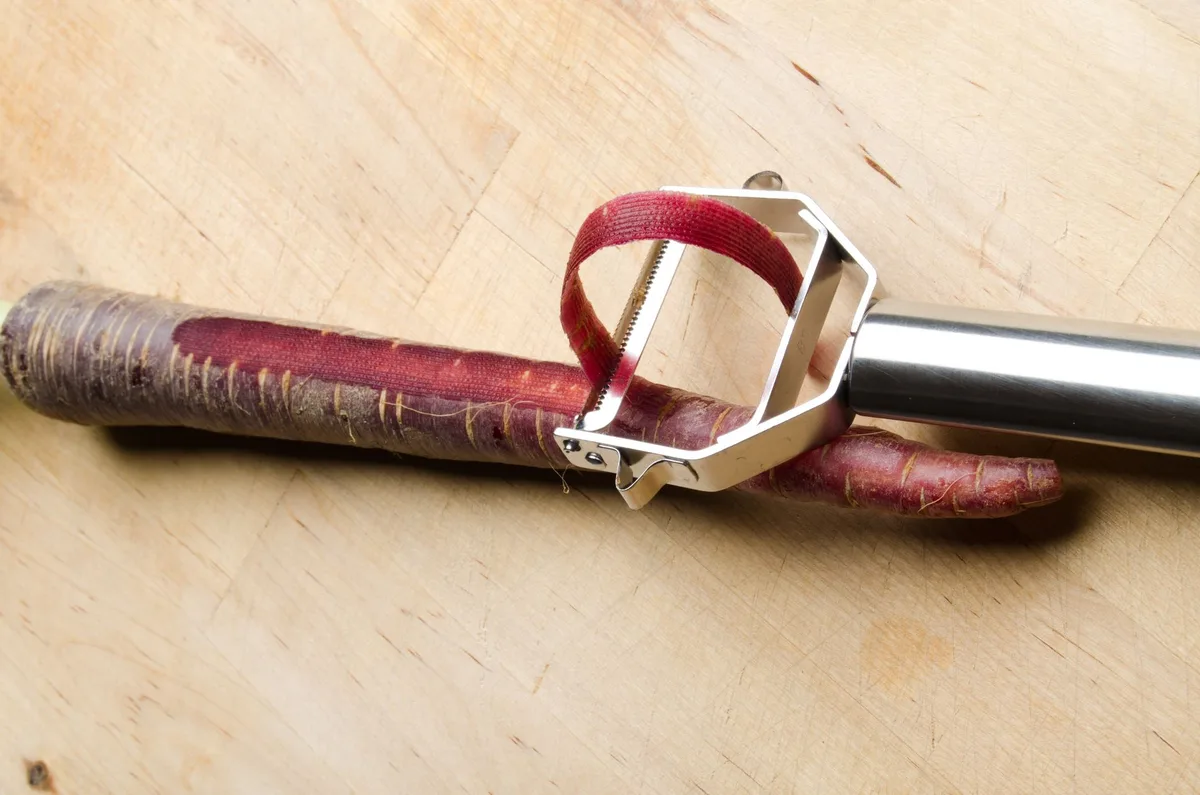
Image source: Pexels / Jason Deines (Pexels License)
The Core Differences: Design and How You Use Them
The most obvious difference lies in their design and how that translates to usage.
Blade Orientation
- Y Peeler: The blade is fixed and oriented horizontally or at a slight angle to the handle. This allows for a pulling or pushing motion from the side, following the curve of the food.
- Swivel Peeler: The blade is mounted on a pivot and can rotate. This lets the blade angle itself freely as you move the peeler in a more straight-ahead or back-and-forth motion, parallel to the handle.
Grip and Motion
- Y Peeler: You generally hold a Y peeler with a grip similar to a knife, allowing for more control and a “pulling” action. You can bring the peeler towards you, or push it away, with the blade cutting at an angle. This often feels more intuitive for peeling round objects.
- Swivel Peeler: The grip is usually more upright, almost like holding a pen or a small hammer. The swivel action means you often push the peeler away from you with a more consistent, linear stroke. This can be very comfortable for a long session.
Ergonomics and Comfort
This is where personal preference really comes into play.
- Y Peeler: For some, the knife-like grip offers superior control, especially when working with irregularly shaped vegetables like potatoes or carrots with many nooks and crannies. It allows for a more nuanced approach to peeling.
- Swivel Peeler: The upright grip of a swivel peeler can be a lifesaver for those with wrist or hand issues. It often requires less wrist articulation, relying more on arm and shoulder movement. Many people find it less fatiguing for large batches.
Precision and Control
- Y Peeler: The fixed blade and more controlled grip can offer greater precision. You have a clear line of sight to the blade and can make very fine adjustments, essential for delicate fruits or when you need to be particularly careful not to remove too much flesh.
- Swivel Peeler: While the swivel action is fantastic for adapting, it can sometimes lead to the blade digging in a bit too much if you’re not paying close attention, especially on softer items. However, for long, straight vegetables, the consistent angle can be incredibly efficient.
When to Reach for Your Y Peeler
The Y peeler is a fantastic all-rounder, but it truly shines in certain scenarios.
Peeling Round and Irregular Shapes
Think of potatoes, apples, or sweet potatoes. The Y peeler’s design allows you to easily maneuver around curves and bumps. You can peel in short strokes, rotating the produce as you go, ensuring you don’t miss any spots and remove only the skin.
It feels like you’re whittling away at the produce, which gives a lot of control.
Navigating Eyes and Blemishes
The precision offered by the Y peeler makes it ideal for “eyeing” potatoes or removing specific blemishes. You can use the tip of the blade to scoop out those small potato eyes or gouge out a soft spot without wasting much of the vegetable. This level of detail is harder to achieve with a swivel peeler.
Working with Firmer Produce
For hardy root vegetables like carrots, parsnips, or rutabagas, the Y peeler provides the necessary leverage and control. You can apply firm pressure without worrying about the blade digging in too deeply or losing its angle. It’s a straightforward, no-nonsense tool for tough skins.
Fine Control for Delicate Tasks
If you’re someone who likes to zest citrus or create thin ribbons of vegetables for garnishes, the Y peeler offers a level of control that’s hard to beat. You can get right up to the edge of your desired cut, ensuring minimal waste. This precision is also why some chefs prefer them for preparing ingredients for dishes, ensuring every piece is prepped perfectly.
For example, when preparing vegetables for a vibrant vegetable smoothie, precise peeling ensures you’re getting all the goodness without any tough skin.
When a Swivel Peeler Takes Center Stage
The swivel peeler isn’t just a variation; it’s a workhorse with its own strengths. It’s often the preferred tool for speed and comfort.
Speed and Efficiency for Bulk Prep
If you’re peeling pounds of carrots for a stew, a large batch of apples for pies, or potatoes for mash, the swivel peeler can significantly speed up the process. The linear motion and self-adjusting blade mean you can cover more surface area with each stroke. This makes it a real time-saver when you have a lot to get through.
It’s like using a small, efficient scraper.
Comfort for Extended Use
For home cooks who spend a lot of time in the kitchen or those with conditions like arthritis, the swivel peeler’s ergonomic design can be a game-changer. The upright grip and reduced need for wrist rotation mean less strain and fatigue. You can peel more food for longer periods without your hand aching.
This aligns with general kitchen efficiency, like using easy-to-clean appliances to cut down on post-meal chores.
Straightforward Peeling of Long Produce
Vegetables like cucumbers, zucchini, or even long varieties of carrots are perfectly suited for the swivel peeler. You can run the peeler down the length of the vegetable in a continuous motion, stripping away the peel cleanly and efficiently. It’s a smooth, satisfying action.
Gentle on Softer Produce (with care)
While I cautioned about softer produce with swivel peelers earlier, it’s worth noting that with a light touch, they can work well on items like bell peppers when you’re preparing them for roasting or stuffing. You can quickly run the peeler around to de-skin them for a smoother texture, a task that can be a bit fiddly with other tools.
Key Features to Look For in Either Peeler
Regardless of whether you’re leaning towards a Y or a swivel design, a good peeler has some universal qualities you should seek out.
Blade Material
- Stainless Steel: This is the standard for a reason. Good quality stainless steel blades are durable, resist rust, and hold their edge well. Look for blades that feel sharp right out of the packaging. A sharp blade is crucial for safe and efficient peeling. A dull blade forces you to apply more pressure, increasing the risk of slipping and injury. For maintaining your kitchen tools, consider learning how to care for your blades, such as with sharp stone sharpening.
- Ceramic: Ceramic blades are incredibly sharp and stay sharp for a very long time. They won’t rust and are resistant to corrosion. However, they can be brittle and may chip or break if dropped or used on hard surfaces.
Handle Design and Material
- Ergonomics: Whether it’s a Y or swivel peeler, the handle should fit comfortably in your hand. It shouldn’t be too thin or too thick. Look for non-slip grips, especially if you tend to have wet hands in the kitchen. Materials like silicone or rubberized plastic can provide extra security.
- Durability: The handle should be sturdy and well-attached to the blade assembly. You don’t want a handle that feels flimsy or like it might snap off. When choosing kitchen essentials, like pots and pans, durability is always a key factor.
The Peeling Edge
- Sharpness: This is paramount. A truly sharp peeler glides through the skin effortlessly. If you have to saw at it, it’s not sharp enough.
- Serrated vs. Straight: As mentioned, serrated blades are phenomenal for soft produce like tomatoes or ripe peaches. Straight blades are best for most firm fruits and vegetables. Some peelers offer both, one on each side, or a reversible blade.
Added Features
- Swivel Head: For swivel peelers, ensure the head pivots smoothly without being too loose.
- Eye Remover: Many peelers, both Y and swivel, come with a small, pointed “eye remover” tool integrated into the design. This is a handy addition for dealing with potato eyes and other blemishes.
Y Peeler vs. Swivel Peeler: A Direct Comparison
Let’s put them head-to-head for a quick recap:
| Feature | Y Peeler | Swivel Peeler |
|---|---|---|
| Blade Orientation | Perpendicular to handle (horizontal) | Pivoting, parallel to handle |
| Grip Style | Knife-like, more controlled | Upright, more linear motion |
| Primary Motion | Pulling/pushing at an angle | Pushing/pulling in a straight line |
| Best For | Irregular shapes, precision tasks, firm produce | Speed, bulk prep, long produce, comfort for extended use |
| Control | High precision, detailed work | Efficient coverage, consistent angle |
| Ergonomics | Can be more demanding on the wrist for long tasks | Less wrist strain, good for prolonged use |
| Soft Produce | Good with serrated edge, requires precision | Can work with light touch, risk of digging in |
| Hard Produce | Excellent control and leverage | Efficient, but less nuanced for deep imperfections |
| Eye Removal | Excellent for detailed scooping | Can be awkward unless specifically designed for it |
Do You Need Both?
Honestly, if you cook often, the answer is probably yes. These aren’t mutually exclusive tools. They are companions, each excelling in different areas.
Think about it this way: You wouldn’t use a chef’s knife for all your slicing tasks, would you? You’d use a serrated knife for bread and a paring knife for small, detailed work. Peelers are no different.
- For everyday peeling of apples, carrots, and potatoes, a good Y peeler is usually my first choice. I like the control it offers. When I need to peel a big bag of potatoes for a party, however, I’ll switch to my swivel peeler because it’s just faster and kinder to my wrist.
- If you often find yourself peeling soft fruits or need to get into tight spots, a Y peeler with a serrated blade is invaluable. For those who have hand fatigue or are prepping large quantities of vegetables regularly, a well-designed swivel peeler might become your daily driver. Using the right tool can even impact the quality of your final dish, just like using the right cutting board or having perfectly blended sauces.
Verdict: It’s Not About One Being “Better”
Ultimately, the debate between Y peeler and swivel peeler isn’t about finding a single “winner.” It’s about understanding their strengths and choosing the right tool for the job at hand.
- For maximum control, precision, and tackling irregular shapes, the Y peeler is often the champion. It gives you that intimate connection with your produce.
- For speed, efficiency, and sustained comfort, especially with bulk prep, the swivel peeler often takes the lead. It’s designed for smooth, consistent action.
Many culinary experts and home cooks alike will own and use both. They each bring something unique to the kitchen arsenal. My personal recommendation?
Get a quality Y peeler for its versatility and precision, and consider adding a comfortable swivel peeler if you do a lot of large-scale prep or want to reduce strain. Your hands and your cooking will thank you.

Table of Contents