Flickering lights do more damage than most people realize. Even when the strobe is too fast to see consciously, your eyes still register it — and after a few hours, the result is headaches, tired eyes, and a general sense of fatigue that’s hard to trace back to its source. The fix is straightforward: replace problem bulbs with quality flicker-free LEDs.
The best flicker-free LED bulbs use high-frequency driver technology that keeps light output rock-steady, even during dimming. We evaluated dozens of options, cross-referencing verified buyer feedback with manufacturer specs, to bring you six bulbs that genuinely deliver on the flicker-free promise — without asking you to spend a fortune.
Quick Comparison: Best Flicker-Free LED Bulbs



The 6 Best Flicker-Free LED Bulbs — Full Reviews
Each bulb on this list was selected based on a clear standard: consistent flicker-free performance, adequate brightness for real-world use, and reliable feedback from verified purchasers. Here is what you need to know about each one.
1. Philips LED Flicker-Free Frosted A19 Light
If you want warm, comfortable light that stays rock-steady even when dimmed, this Philips frosted A19 is the benchmark. It uses a Warm Glow effect — meaning color temperature shifts from 2700K down to 2200K as you dim it, closely mimicking how incandescent bulbs behave. The result is lighting that feels natural and genuinely soothing, not sterile. Buyers who replaced standard LED bulbs with this model frequently describe the difference as immediate and dramatic.
1. Philips LED Flicker-Free Frosted A19 Light
The frosted glass finish scatters light in every direction, eliminating hot spots and harsh shadows. This makes it an excellent choice for table lamps, ceiling pendants, and bedroom fixtures — anywhere you want soft, even coverage rather than a focused beam. The E26 base is a standard fit for virtually all North American fixtures, and the dimmable driver has been tested with a wide range of compatible switches.
Why we picked it
Very few bulbs handle dimming as gracefully as this one. The shift to warmer tones at lower brightness levels is a thoughtful design touch that sets it apart from competitors simply marketing themselves as “dimmable.” For bedrooms and living rooms, it’s hard to beat.
Key specs
- Brightness: 800 lumens
- Color Temperature: 2700K–2200K (Warm Glow Effect)
- Power Draw: 8.8W (replaces 60W incandescent)
- Base: E26
- Dimmable: Yes
- Finish: Frosted
What buyers are saying
Reviewers consistently highlight the smooth dimming curve and the absence of the buzzing or flickering that plagued their previous bulbs. Several note that headaches they attributed to screen fatigue actually cleared up after switching. The warm glow effect earns specific praise in dining room and bedroom settings.
Things to consider
At 800 lumens, this bulb is optimized for ambiance rather than raw brightness. It’s not the right pick for a utility room or kitchen where you need strong, task-grade illumination. The frosted finish, while flattering, does reduce output slightly compared to a clear equivalent.
2. PHILIPS LED Flicker-Free Frosted Dimmable A19 with EyeComfort Technology
This is Philips’ more advanced flicker-free offering, built around what the company calls EyeComfort Technology. The LED driver inside operates at a much higher frequency than budget LEDs, which keeps light output perceptibly steady under virtually all conditions. For anyone who spends long hours reading, working at a desk, or studying under artificial light, this is one of the most thoughtfully engineered options available.
2. PHILIPS LED Flicker-Free Frosted Dimmable A19
The 2700K soft white color temperature is consistent across the bulb’s dimming range, making it reliable for spaces where you need predictable, calm illumination. Unlike some LEDs that shift color when dimmed (not always in a pleasant way), this model holds its tone steady. It fits standard E26 sockets and is compatible with most LED-rated dimmers on the market.
Why we picked it
The EyeComfort branding isn’t just marketing. Multiple buyers with documented light sensitivity — including those who experience migraines triggered by fluorescent or low-quality LED lighting — report genuine relief after switching to this bulb. That level of real-world impact earns it a firm spot on this list.
Key specs
- Brightness: 800 lumens
- Color Temperature: 2700K (Soft White)
- Power Draw: 8.8W (replaces 60W incandescent)
- Base: E26
- Dimmable: Yes
- Finish: Frosted
What buyers are saying
Home office users are the most vocal fans of this bulb. Reviews frequently mention using it in desk lamps for four to six hours daily without any eye fatigue. Several compare it directly to other Philips models and rank this one as noticeably better for extended use. Consistent light output and reliable dimming are the most commonly praised traits.
Things to consider
This bulb is best suited for smaller to mid-sized rooms. If you’re lighting a large open-plan area, 800 lumens may fall short. Also, the product listing references an older version designation — worth confirming on the product page that you’re getting the current formulation.
3. Yochoice LED Light Bulbs 100W Equivalent — Best Budget Pick
Not every room needs warm, dimmable ambiance. Garages, workshops, laundry rooms, and home offices often call for strong, clear light — and that’s exactly where the Yochoice 100W-equivalent LEDs shine. At 1100 lumens and 5000K daylight white, these bulbs make detail work easier and reduce the kind of visual strain caused by dim or inadequate lighting. The 12-pack format makes them practical for outfitting an entire level of a home.
3. Yochoice LED Light Bulbs 100W Equivalent
The 5000K color temperature is close to natural midday sunlight, which most people find energizing and easy on the eyes during active tasks. Buyers who’ve used these in workshops report that the steady, shadow-free light makes a real difference for precision work. The flicker-free operation is consistently confirmed in user feedback, with several reviewers running the smartphone camera test and reporting a clean result.
Why we picked it
Value per lumen is hard to beat here. For anyone furnishing a rental property, setting up a workshop, or simply needing to replace bulbs across a large home without spending a lot, this 12-pack makes strong financial and practical sense.
Key specs
- Brightness: 1100 lumens (replaces 100W incandescent)
- Color Temperature: 5000K (Daylight)
- Power Draw: 11W
- Base: E26
- Dimmable: No
- Finish: Standard A19
What buyers are saying
Workshop and garage users dominate the positive reviews, praising the clean, bright output that eliminates shadows in tight spaces. Home office users also respond well, noting that the daylight tone helps them stay alert. Buyers appreciate that the color stays consistent across the pack — no mismatched hues between bulbs.
Things to consider
These bulbs are not dimmable. If your fixture requires dimming capability — for instance, a living room with a slider switch — these will not work correctly and should not be used. Stick to non-dimming circuits for the best results.
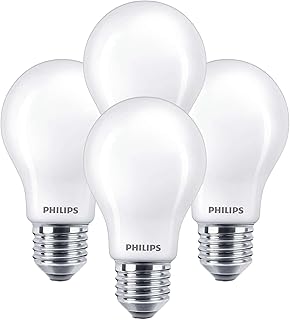
4. PHILIPS LED 60W A19 4-Pack Basic
Sometimes you just need a reliable, no-fuss bulb that works everywhere without any surprises. The Philips A19 4-Pack Basic fills that role well. It delivers 800 lumens of soft white light at 2700K, consuming 10W in the process — an honest, efficient replacement for the traditional 60W incandescent. The frosted finish minimizes glare, and the dimmable design makes it flexible enough for most standard fixtures.
4. PHILIPS LED 60W A19 4-Pack Basic
What makes this pack worth considering is the Philips reliability factor. The brand’s commitment to consistent build quality means you’re unlikely to get one dud bulb in the pack. Buyers replacing aging fixtures throughout a home — hallways, guest rooms, closets — find this a practical and cost-effective solution. The four-pack format keeps per-unit cost reasonable.
Why we picked it
This is the go-to option when you want a solid, trusted brand in a multi-pack without overthinking specifications. It handles everyday lighting in most rooms without drama, and the flicker-free performance holds up under prolonged evening use.
Key specs
- Brightness: 800 lumens (replaces 60W incandescent)
- Color Temperature: 2700K (Soft White)
- Power Draw: 10W
- Base: E26
- Dimmable: Yes (standard dimming)
- Finish: Frosted
What buyers are saying
Buyers praise these for steady, warm light that doesn’t trigger the eye discomfort they experienced with cheaper LED alternatives. The consistent output across fixtures — ceiling fans, table lamps, recessed cans — is a recurring positive. Several reviewers note using them in children’s rooms because of the gentle, non-irritating light quality.
Things to consider
The dimming range is standard rather than premium. If you use a high-end smart dimmer and want ultra-smooth, low-level dimming, you may find the lower end of the range cuts off earlier than expected. This is a functional, not a boutique, bulb — priced and designed accordingly.
5. Neporal Full Spectrum Light Bulb 15W
The Neporal full spectrum bulb occupies a distinct niche: it’s built for people who want their indoor lighting to replicate natural sunlight as closely as possible, without UV exposure. With a high Color Rendering Index (CRI), colors under this bulb look accurate and vivid. Artists, crafters, makeup enthusiasts, and houseplant growers will all find it genuinely useful — and the flicker-free operation ensures that even prolonged use doesn’t become uncomfortable.
5. Neporal Full Spectrum Light Bulb 15W
At 1100 lumens from 15W, the efficiency is solid, and the rated lifespan of 30,000 hours means you’re unlikely to need to replace it for years. The 2700K warm tone is unusual for a full-spectrum bulb — most emit a cooler, bluer light — which makes it more versatile for living spaces where you also want accurate color reproduction without feeling like you’re working under a laboratory lamp.
Why we picked it
The combination of high CRI, full-spectrum output, and flicker-free technology in a single E26 bulb is genuinely rare at this price point. If you care about color accuracy or you spend time under artificial light doing creative work, this bulb delivers something the standard Philips options simply don’t.
Key specs
- Brightness: 1100 lumens (replaces 100W incandescent)
- Color Temperature: 2700K (Warm)
- Power Draw: 15W
- Base: E26 / E27
- Lifespan: 30,000 hours
- Features: Full Spectrum, UV-Free, High CRI, Flicker-Free
What buyers are saying
Art studio and craft room users consistently praise the color rendering quality, noting that fabric, paint, and plant colors appear far more accurate than under standard LEDs. Houseplant enthusiasts also report healthy growth under this bulb. The absence of flicker earns repeated mention alongside the general improvement in eye comfort during long creative sessions.
Things to consider
This bulb is not dimmable, which limits its flexibility in multi-purpose rooms. Also, at 2700K it skews warm — buyers who want a crisp, neutral white for detailed work may prefer the Yochoice option at 5000K instead.
6. Philips LED 75W A19 Light Bulbs with Selectable White
The standout feature here is simple but genuinely useful: you can select the color temperature by toggling the light switch in a specific sequence. The bulb cycles between different white tones — typically from warm white to cool white — letting you adapt one fixture to different times of day or activities. Morning coffee and late-evening reading can call for very different light, and this bulb handles both without requiring a smart home setup.
6. Philips LED 75W A19 Light Bulbs
At 1100 lumens from 11W, the output comfortably covers medium to large rooms. The four-pack format and Philips’ long LED lifespan make it a cost-effective investment. Flicker-free performance is maintained across all color temperature settings, which is a detail worth noting — some multi-mode bulbs introduce instability when switching modes, and this one doesn’t.
Why we picked it
The selectable white feature gives this bulb genuine versatility without requiring any smart home investment. For a multi-use room like a living room or home office, the ability to shift between warm and cool light on demand is a practical advantage that buyers clearly appreciate.
Key specs
- Brightness: 1100 lumens (replaces 75W incandescent)
- Color Temperature: Selectable White (Multi-CCT)
- Power Draw: 11W
- Base: E26
- Dimmable: Yes
- Finish: Frosted
What buyers are saying
Users love the ability to adapt the light to their needs without touching an app or a hub. Living room reviews frequently mention using warmer tones for evening relaxation and switching to cooler tones for reading or work calls. The flicker-free performance across modes is specifically praised — a concern that apparently led some buyers to test the bulb carefully before committing to the full four-pack.
Things to consider
The color temperature switching is a physical process — you cycle through modes using your wall switch — rather than remote or app-based. This works fine in most situations but may feel clunky in a home with smart switches or complex wiring. The dimming range is also standard rather than deep, which may matter to buyers with precise low-light preferences.
How We Selected These Bulbs
Our selection process was built around one core question: does this bulb actually eliminate flicker in real-world conditions, not just on a spec sheet?
We started with verified buyer reviews, filtering specifically for language around flicker, eye strain, headaches, and visual fatigue. Bulbs with a strong, consistent pattern of positive feedback on those specific issues moved to the top of our shortlist. Bulbs with scattered or contradictory reports were excluded regardless of marketing claims.
From there, we cross-referenced buyer feedback with manufacturer specifications. We looked for driver technology details, CRI ratings, color temperature accuracy, and any independent certifications or testing references. Bulbs that made vague claims without supporting technical details received less weight.
We also considered practical factors: base type compatibility, multi-pack value, dimming capability, and lumen output relative to stated watt equivalence. A bulb that performs beautifully but only fits unusual fixtures or requires rare dimmers doesn’t serve most buyers well.
Every pick on this list is one we’d recommend to a friend asking the same question — not because of marketing, but because real buyers have consistently confirmed the core benefit: lights that simply don’t flicker.
Buying Guide: What to Look for in a Flicker-Free LED Bulb
Understanding a few key specifications will save you from buying the wrong bulb. Here is what actually matters.
Color Temperature — Kelvin (K)
Color temperature determines whether your light looks warm and cozy or cool and crisp. It’s measured in Kelvin. Around 2700K to 3000K produces a warm, amber-toned light similar to traditional incandescent bulbs — well suited for bedrooms, living rooms, and dining spaces. Between 4000K and 5000K produces a cleaner, more neutral daylight white that works well in kitchens, offices, and workspaces where you need to stay alert and see clearly.
Choosing the right Kelvin for each room is one of the easiest ways to reduce ambient eye strain, because mismatched light — too warm for task work, too cool for relaxation — creates subtle visual tension over time.
Brightness — Think Lumens, Not Watts
Watts measure energy consumption, not light output. Lumens measure actual brightness. A traditional 60W incandescent produces approximately 800 lumens; a 75W equivalent produces around 1100 lumens. When shopping for LEDs, match lumens to your existing setup rather than watt equivalence, since LED wattages vary between manufacturers for similar output levels.
Flicker-Free Technology — What the Term Actually Means
LED flicker is caused by the driver electronics converting AC current to DC for the LED chips. Cheap drivers pulse the current rapidly, creating a strobing effect. High-quality flicker-free drivers operate at much higher frequencies — or use DC conversion techniques — that eliminate visible and near-visible pulsing entirely.
When a manufacturer uses terms like “EyeComfort Technology” or explicitly states flicker-free performance, it signals that the driver has been engineered with this in mind. Buyers can verify this independently with a smartphone camera test: if recording under the bulb shows no dark banding or rolling interference in the footage, the bulb passes.
Dimmability — Check Before You Buy
Not all LED bulbs work with dimmer switches, and not all dimmable LEDs work with all dimmers. If you have dimmer-controlled fixtures, confirm the bulb is explicitly rated as dimmable, and ideally check the manufacturer’s dimmer compatibility list. Using a non-dimmable LED with a dimmer switch can cause buzzing, flickering at low levels, or early driver failure.
If you need smooth, deep dimming — especially for bedrooms or home theaters — look for bulbs specifically designed for wide dimming ranges rather than standard dimmable models.
Lifespan and Efficiency — The Long-Term Math
Most quality LED bulbs are rated for 15,000 to 30,000 hours of use. At three hours of daily use, a 15,000-hour bulb lasts approximately 13 years. At 10 hours daily, a 30,000-hour bulb lasts about eight years. Factor this into per-unit cost when comparing options — a slightly more expensive bulb that lasts twice as long is often the better value.
Base Type and Bulb Shape
The E26 base is the standard in North America — it’s the screw-in base found in virtually all household lamps and ceiling fixtures. The A19 shape (roughly egg-shaped, about 2.4 inches in diameter) is the standard household form factor. Before purchasing, verify both the base type and bulb shape to confirm they match your fixture. Most bulbs on this list use E26 / A19, making them compatible with the vast majority of American home fixtures.
Frequently Asked Questions
Is a flicker-free LED bulb worth buying?
For most people, yes — especially if you spend several hours a day under artificial light. Even flicker that isn’t consciously visible can contribute to eye fatigue and headaches over time. Buyers who switch to flicker-free LEDs frequently report noticeable improvements in comfort within days. The price difference between standard LEDs and quality flicker-free models has also narrowed considerably, making the upgrade an easy decision for most households.
How do I test whether my current LED bulbs flicker?
The simplest method is the smartphone camera test. Open your camera app, point it at the lit bulb, and look at the live feed rather than the bulb directly. Visible dark bands scrolling through the image, or rhythmic brightness fluctuations in the footage, indicate flicker. A truly flicker-free bulb will show a steady, uniform glow on screen. You can also wave your hand quickly in front of the light — if you see a strobe-like multiple-image effect, the bulb is flickering.
Will a flicker-free LED work with my current dimmer switch?
It depends on the dimmer. Older dimmer switches designed for incandescent bulbs often perform poorly with LEDs, producing buzzing, flickering at low settings, or limited dimming range. For best results, pair your flicker-free LED with a dimmer specifically rated for LED loads. Most bulb manufacturers publish compatibility lists; checking these before purchasing saves trial-and-error frustration.
Are full-spectrum LED bulbs better for reducing eye strain?
They can be, particularly for extended close-up work. Full-spectrum bulbs render colors more accurately and have a more balanced light profile that mimics natural daylight. This reduces the visual effort required to distinguish colors and details under artificial light. Combined with flicker-free technology, a high-CRI full-spectrum bulb like the Neporal is one of the more complete solutions available for anyone who experiences lighting-related eye discomfort.
What is the difference between A19 and A60 bulbs?
The A19 designation is used in North America and refers to a bulb approximately 2.375 inches (60mm) in diameter at its widest point. The A60 designation is used in Europe and most other markets for the same physical shape and size. The two are effectively interchangeable in most fixtures. Base types differ slightly — A19 typically uses E26 (26mm diameter) while A60 uses E27 (27mm diameter) — but these are close enough that many fixtures accept both.
What does “800 lumens, 8.8W = 60W” mean?
The labeling tells you three things. First, the bulb produces 800 lumens of actual light output. Second, it draws 8.8 watts of power to do so. Third, it produces an equivalent amount of light to a traditional 60-watt incandescent bulb, which burned far more electricity for the same result. This comparison is there to help buyers understand the brightness level when shopping without a reference point. The real number that matters for brightness is lumens; the watt equivalence is just a familiar anchor.
Final Verdict
For most homes, the Philips LED Flicker-Free Frosted A19 is the best starting point. Its warm glow effect, smooth dimming, and dependable flicker-free performance make it an ideal choice for bedrooms, living rooms, and dining spaces. It’s the bulb that consistently gets recommended by people who’ve actually noticed a difference.
If you work long hours under desk lighting, the PHILIPS LED Flicker-Free Frosted Dimmable A19 with EyeComfort Technology is the smarter choice. The higher-frequency driver design makes a tangible difference for light-sensitive users.
For utility spaces, the Yochoice 100W Equivalent 12-Pack offers the best combination of brightness, flicker-free performance, and price. And if color accuracy matters in your space, the Neporal Full Spectrum 15W is in a category of its own.
Whatever your priority — comfort, brightness, versatility, or value — there is a solid flicker-free LED on this list built for it.
Affiliate disclosure: This post contains affiliate links. If you purchase through one of these links, we may earn a small commission at no additional cost to you. This never influences our recommendations — we only include products we would genuinely consider buying ourselves.

Table of Contents