Learning how to make butter with a whisk turns a carton of cream into fresh butter and real buttermilk in about ten minutes. No churn, no mixer, no electricity needed. You control the salt, the tang, and the fat percentage.
The result spreads cleaner and tastes brighter than anything in the dairy case.
Research from Cornell Food Science Extension confirms that cream at 55°F with 36, 40% fat breaks most reliably. Ultra-pasteurized cream often fails because heat damages the fat globule membrane. As of 2026, most national organic brands use HTST pasteurization, which works fine.
Let’s look at why the whisk still earns a spot in a modern kitchen.
Quick Answer
Whisk cold heavy cream in a chilled bowl until the emulsion inverts. Fat clumps separate from buttermilk in 5, 8 minutes. Drain, wash the butter under ice water until runoff clears, knead in salt, and store.
One quart yields roughly one pound butter plus two cups buttermilk.
Why Whisk Butter When Machines Exist
A stand mixer does the job in three minutes. A food processor takes ninety seconds. So why bother with a whisk?
The answer comes down to texture, control, and byproduct quality.
Whisking incorporates air differently than a paddle or blade. The fat crystals stay larger. That gives the finished butter a distinct mouthfeel, firmer at room temperature, cleaner on the palate.
You also get true buttermilk, not the cultured skim milk sold in cartons. That liquid is thin, slightly sweet, and perfect for biscuits.
There’s no heat buildup. Machines can warm the cream past 65°F, where butter greases instead of separating. Your arm is the thermostat.
If the bowl feels warm, you pause. That tactile feedback prevents the most common failure mode.
Cost is near zero. A decent balloon whisk costs twelve dollars. A stainless bowl, fifteen.
No motor to burn out, no gasket to replace, no cabinet space lost. For batches under two quarts, the whisk wins on cleanup too.
What You Need: Cream, Tools, and the Right Conditions
Success hinges on three variables: cream quality, temperature, and vessel geometry. Miss one and the emulsion won’t invert cleanly.
Cream Specifications
| Factor | Target | Why It Matters |
|---|---|---|
| Fat content | 36–40% (US heavy cream) | Below 35% won’t break reliably |
| Pasteurization | HTST or vat (161°F/15s) | UHT (280°F/2s) damages membrane |
| Age | 2–7 days post-pasteurization | Fresh cream churns slower |
| Temperature | 50–60°F (ideal 55°F) | Cold fat won’t clump; warm fat greases |
Avoid ultra-pasteurized cream. The label usually says “ultra-pasteurized” or “UHT.” Organic Valley, Horizon, and most store brands use HTST. Straus, Kalona, and many local dairies use vat pasteurization, both work.
Tool Checklist
- Balloon whisk (12, 14 wires, 10, 12 inch handle)
- Stainless or glass bowl, 4, 6 quart capacity
- Fine-mesh sieve
- Spatula or bench scraper
- Ice water bath (large bowl, ice, cold water)
- Parchment or wax paper for storage
Chill the bowl and whisk for fifteen minutes. It buys you time before the cream warms past 60°F. Fill the bowl no more than two-thirds full.
Cream expands dramatically at the foam stage.
The 10-Minute Timeline: From Cream to Butter
The process moves through four distinct phases. Each has a clear visual cue. Stop whisking the moment you see the break.
Phase 1: Foam (0–2 minutes)
Large bubbles form. Volume doubles. Cream looks like bubble bath.
Keep whisking vertically, push-pull strokes aerate faster than circles.
Phase 2: Soft Peaks (2–3 minutes)
Bubbles tighten. Peaks curl over when you lift the whisk. This is whipped cream territory.
Stop here if that’s your goal.
Phase 3: Stiff Peaks (3–4 minutes)
Peaks stand straight. Texture turns dense and glossy. The whisk drags heavier.
You’re close.
Phase 4: The Break (5–8 minutes)
Color shifts from white to pale yellow. The mixture suddenly looks grainy, like cottage cheese. Thin liquid sloshes at the bottom.
That’s buttermilk. Fat has coalesced. Stop immediately.
Total active time: 5, 10 minutes depending on fitness and cream temperature. Colder cream breaks faster but tires your arm sooner.
What the Numbers Tell Us: Yield, Fat Loss, and Texture
One quart (32 oz) of 40% cream yields approximately 16 oz butter and 16 oz buttermilk. That’s a 50/50 split by weight. Fat recovery runs 85, 90%.
The rest stays in the buttermilk or rinses away during washing.
Double cream (UK, 48% fat) breaks in 3, 4 minutes and yields 18, 19 oz butter per quart. Higher fat means less water to separate.
Washing removes residual buttermilk. Each wash cycle recovers ~0.5% more fat but loses ~1% yield to the water. Three to four changes until runoff runs clear is the sweet spot.
Unsalted, washed butter keeps 7, 10 days refrigerated. Salted extends to 2, 3 weeks. Frozen, vacuum-sealed: six months.
Texture varies with kneading. Light folding preserves large crystals, flaky, crisp mouthfeel. Aggressive working makes it dense and waxy.
For laminating dough, you want the former.
Where It Goes Wrong: Real Mistakes From Real Batches
Most failures trace to five root causes. All are preventable.
Ultra-Pasteurized Cream
The proteins are denatured. Fat globules won’t coalesce. You’ll whisk for twenty minutes and get only stiff peaks.
Fix: Read the label. Choose HTST or vat-pasteurized.
Wrong Temperature
Cream straight from a 38°F fridge won’t break. Fat stays solid. Let it sit twenty minutes to hit 50, 55°F.
Conversely, cream above 65°F turns to grease. You’ll see oil slicks, not granules. Fix: Use an instant-read thermometer.
Bowl Too Small
Foam overflows. The break splatters buttermilk everywhere. Fix: Use a 4-quart bowl for 1 quart cream. 6-quart for 2 quarts.
Skipping the Wash
Residual buttermilk sours in 48 hours. Butter turns rancid. Fix: Knead under 40°F water until runoff is clear.
Three to four changes.
Salting Before Washing
Salt traps buttermilk pockets. Creates salty, sour spots. Fix: Wash first.
Fold in salt after final knead.
Overworking
Butter warms in your hands. Fat smears. Texture turns pasty.
Fix: Work fast. Chill hands in ice water. Use a spatula, not palms.
Pro Adjustments That Change the Result
Small tweaks shift flavor, texture, and shelf life. Each is optional. Pick what fits your goal.
Cultured Butter
Add 1 tablespoon live-culture buttermilk or yogurt per quart of cream. Cover and hold at 70°F for 12, 18 hours until thickened and tangy. Chill to 55°F before whisking.
The culture produces diacetyl, buttery aroma, and drops pH to 4.5. Butter keeps longer. Flavor deepens.
European-Style (82–85% Fat)
Start with 40% cream. After the break, knead longer under cold water. Press out more moisture.
Target 83% fat. Texture turns pliable, not crumbly. Best for croissants and laminated dough.
Herb or Garlic Compound Butter
Softened butter folds cleanly. Ratio: 4 oz butter to 1 tablespoon finely minced fresh herbs or 1 teaspoon roasted garlic paste. Add lemon zest for brightness.
Roll in parchment. Slice coins for steak, fish, or bread.
Honey or Maple Butter
Warm honey or maple syrup to 100°F. Whip into softened butter at 2:1 ratio. Emulsion holds if both are same temperature.
Refrigerate. Spread on biscuits or pancakes.
Salt Timing and Type
Flaky sea salt (Maldon, Jacobsen) dissolves on the tongue. Kosher salt distributes evenly. Table salt tastes harsh.
Fold in ½ teaspoon per pound after final wash. Taste. Add more if needed.
How It Stacks Up: Whisk vs. Mixer vs. Jar vs. Churn
Each method hits different constraints. Choose by batch size, frequency, and physical tolerance.
| Method | Time (1 qt) | Effort | Texture | Cleanup | Best For |
|---|---|---|---|---|---|
| Balloon whisk | 5–8 min | High | Large crystals, flaky | Bowl + whisk | Small batches, control, no gear |
| Stand mixer (paddle) | 3 min | Zero | Uniform, slightly dense | Bowl + paddle | Frequent batches, hands-free |
| Food processor | 90 sec | Zero | Fine grain, warm risk | Bowl + blade + lid | Speed, very small batches |
| Mason jar shake | 15–20 min | Medium | Inconsistent | Jar + lid | Kids, camping, no tools |
| Hand-crank churn | 10–15 min | Medium | Traditional, variable | Churn parts | Authenticity, larger batches |
| Electric churn | 5 min | Zero | Commercial uniform | Machine parts | Volume production |
The whisk wins on texture control and zero heat. The mixer wins on repeat convenience. The jar wins on entertainment value.
The churn wins on nostalgia. For most home bakers making 1, 2 quarts weekly, the whisk stays in the drawer.
Storing, Salting, and Using Your Butter and Buttermilk
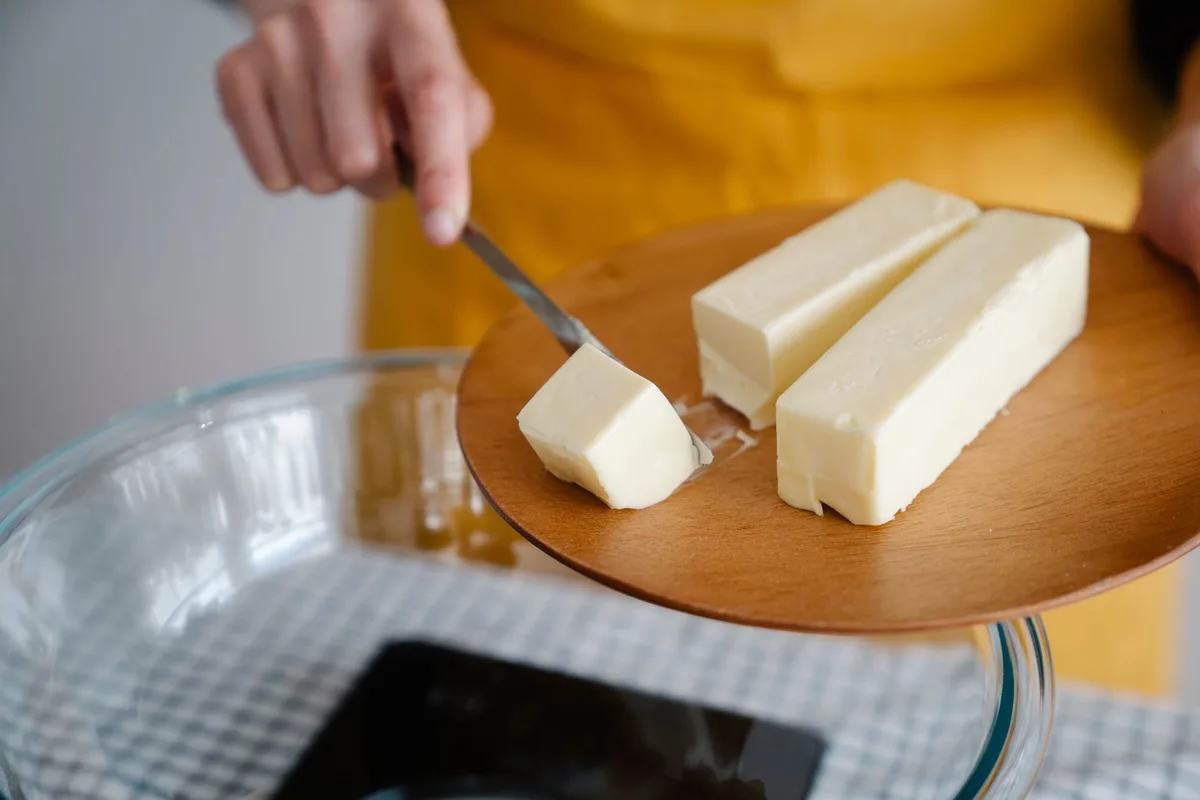
Washing is non-negotiable for shelf life. The photo below shows the motion.
Washing Protocol
Transfer butter grains to a clean bowl. Pour 40°F water over them. Press and fold with a spatula.
Water clouds white. Drain. Repeat until water runs clear.
Three to four changes. Pat dry with paper towels or cheesecloth.
Salting
Weigh butter. Add 0.5, 0.75% salt by weight. For 16 oz butter, that’s 2.3, 3.4 g salt (½, ¾ tsp kosher).
Fold quickly. Overworking warms the fat.
Storage Containers
Parchment paper wraps breathe. Wax paper seals tighter. Butter bells (French crocks) keep butter spreadable at room temperature for 3, 5 days using water seal.
Mason jars work for freezer. Vacuum bags prevent freezer burn past three months.
Buttermilk Uses
True buttermilk is thin, pH 4.5, 4.8, with residual fat and phospholipids. It tenderizes gluten. Use in:
- Biscuits and scones (sub 1:1 for milk)
- Pancake batter (adds lift)
- Fried chicken brine (enzymes tenderize)
- Smoothies (probiotic if cultured)
- Soups (finish cold soups with a splash)
Freeze in ice cube trays. Transfer cubes to zip bag. Keeps three months.
FAQs: Raw Cream, Ultra-Pasteurized, Cultured, and More
Can I use raw cream?
Yes, where legal. Raw cream carries native lipase and bacteria. It cultures fast, often 6, 8 hours at room temperature.
Churns quicker. Flavor is complex. Check your state regulations via the FDA raw milk map.
Always source from a licensed, tested dairy.
Why did my ultra-pasteurized cream fail?
UHT heating (280°F for 2 seconds) denatures whey proteins that stabilize the fat globule membrane. Without that membrane rupture, fat won’t coalesce. You get stiff peaks forever.
No fix. Buy HTST or vat-pasteurized cream.
How do I make cultured butter without starter?
Leave pasteurized cream at 65, 70°F for 24 hours. Wild lactic acid bacteria will culture it. Unpredictable.
Risk of off-flavors or spoilage. A pinch of commercial mesophilic starter (Flora Danica, MM100) guarantees clean acidification.
My butter is crumbly not pliable. Why?
Over-washed or over-worked. Too much water removed. Or fat crystals shattered by aggressive kneading.
Next batch: wash until water just clears. Fold gently. Chill 30 minutes before use.
Can I whip the buttermilk into butter too?
Residual buttermilk has 0.5, 1% fat. Not worth the effort. Use it for baking.
The yield math doesn’t support a second pass.
How long does homemade butter last?
Salted, washed, refrigerated: 2, 3 weeks. Unsalted: 7, 10 days. Frozen (vacuum sealed): 6 months.
Rancidity shows as yellowed surface, stale nutty smell. Trust your nose.

Table of Contents