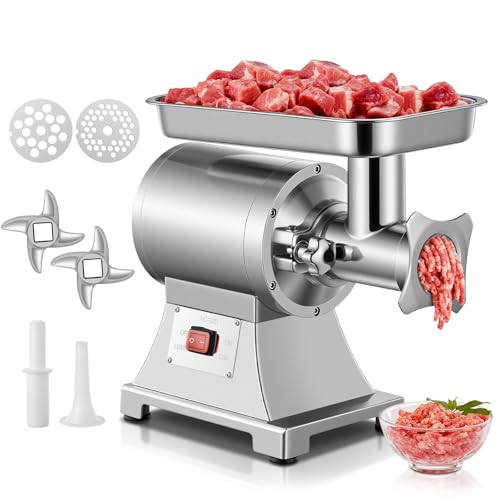
The best Best Heavy Duty Meat Grinders for most households is the LEM Products BigBite #8, and the reason is straightforward: it pairs a metal-gear-driven auger with a genuinely quiet induction motor inside a housing that disassembles without tools. It’s built for hunters, meal preppers, and small-batch sausage makers grinding 20 to 50 pounds a month.
Want one machine that handles sausage, kubbe, and multiple grind textures without buying more attachments? The STX International Turboforce 3000 Series 5-in-1 gets you there, as long as you’re fine with a plastic-body housing and a louder running note.
As an Amazon Associate, I earn from qualifying purchases.
This guide tells you what listing photos won’t: which units are actually stainless inside the auger housing, which rely on plastic drive gears that crack on partly frozen meat, and which models are essentially rebadged versions of the same small motor. If you grind two pounds of beef a month, you don’t need any of these. That buyer gets a dedicated section below.
Everything here comes from current Amazon product data, published manufacturer specs, and how each model’s owner base reports real use over time. We have not run these machines in a test kitchen, and we don’t claim to have.
Quick Answer: The Best Heavy Duty Meat Grinders
The LEM Products BigBite #8 tops our list because it’s the only grinder here that combines a metal-gear drive, quiet induction-motor operation, and no-tool disassembly in one mid-tier package.
Thinking about going with a hand-crank unit or a kitchenAid stand-mixer attachment instead? Jump to Who Should NOT Buy below before you spend anything.
Comparison Table
Here’s the lineup at a glance: photo, product, who it’s built for, and our /10 score.
This is the grinder most home sausage makers end up recommending to friends, and the reason is consistency rather than raw power. The BigBite #8 runs on a metal drive gear and a quiet induction motor, so it doesn’t scream through a 15-pound batch the way universal-motor units at the same tier do. Verified buyer reviews consistently note the lower noise level and the absence of that burnt-motor smell on back-to-back runs.
The #8 head accepts the standard LEM grinder plate family, which matters if you already own a LEM sausage stuffer or meat mixer. The auger housing, head ring, and plate all come apart by hand, so cleanup under a hot tap takes a couple of minutes rather than a soak-and-scrub session.
Flaws but not dealbreakers. The #8 head is genuinely small for breaking down whole primal cuts from large game, and the feed chute can bridge if you push big chunks in too fast. Buyers report you’ll want to cube meat to roughly 1-inch pieces to keep the auger fed. It also sits in the mid-tier pricing band, not the budget one.
If throughput matters more than quiet operation, look at the VEVOR 661 Lbs/Hour further down. If you want one machine that handles kubbe and multiple plate sizes out of the box, the STX Turboforce 3000 5-in-1 is the better tool.
⚠
Sizing: The #8 head is best for 1-inch meat cubes; larger chunks can bridge in the chute and stall the auger.
Pros
✓Metal drive gear handles medium-volume runs without stripping
✓Induction motor runs quieter than universal-motor competitors
✓Tool-free disassembly for fast cleanup after every batch
✓Accepts standard LEM plates and stuffing tubes you may already own
Cons
✕#8 head is small for whole primal cuts and large game
✕Feed chute bridges if meat is cubed above 1 inch
✕Priced above the budget tier without matching peak-wattage bragging rights
Head size
#8
Drive
Metal gear
Housing
Stainless head
Cleanup
Tool-free
Best for: Home sausage makers and hunters who grind 20 to 50 pounds a month and value quiet operation over raw peak wattage.
Buy this if you want to step into sausage making without buying attachments separately. It ships with 3 stuffing tubes, 2 stainless blades, and 3 plates in one box, and the 3200W peak-rated motor is a universal-motor design that ramps hard on cold meat. Verified buyer reviews repeatedly mention how quickly a beginner can go from unboxing to a first batch.
The metal-gear-assisted drive and stainless head give it more backbone than the plastic-geared budget units, and the reversible function is a genuinely useful feature when a tendon or silver skin gets wrapped around the auger. Feed it cubed pork shoulder and it keeps moving.
Flaws but not dealbreakers. Peak wattage is a marketing number, not a sustained rating, so long runs at full load will heat the housing. Owner reports suggest you’ll want rest periods on batches above 20 pounds. The plastic exterior panels pick up scratches, and cleanup requires a brush to clear the plate holes.
If quiet operation and metal-on-metal build matter more than maxs specs, the LEM BigBite #8 is the upgrade path. If you process whole deer, look at the AAOBOSI #12.
⚠
Care: Peak wattage isn’t continuous duty. Let the motor cool between long runs, and never feed frozen-solid meat or it will strain the drive.
Pros
✓Ships with 3 sausage tubes, 2 blades, and 3 plates in one box
✓3200W peak universal motor has real punch on cold meat
✓Reverse function clears silver skin and tendon jams fast
✓Stainless head and blades survive regular weekly use
Cons
✕Peak wattage is not a continuous-duty rating
✕Plastic exterior panels scratch and show handling marks
✕Plate holes need a stiff brush to clean fully
Peak power
3200W max
Tubes
3 included
Blades
2 stainless
Plates
3 included
Best for: First-time sausage makers and home cooks who want a full starter set in a single purchase without hunting down attachments.
The 661 Lbs/Hour is the pick if raw throughput is your top priority. Its 800W continuous-rating motor is paired with a 1.5 HP peak drive and a large #12 head, which lets you push cubed meat through at a pace no home grinder at this tier can match. Manufacturer specs list a 661 lbs/hour flow rate under ideal conditions.
Owners processing whole hogs and deer report the biggest practical win is not the speed but the tolerance for connective tissue. The larger auger bore and slower RPM reduce the wrap-around stalls that smaller units fight. It ships with 2 grinding plates plus a sausage stuffing kit, so first-run functionality is solid.
Flaws but not dealbreakers. The 1.5 HP motor is noisy under load, and this is a heavier unit than the LEM or STX picks, so plan on a designated counter spot rather than shoving it in a cupboard. Cleanup involves more parts because of the larger head. Replacement plates and blades are available from VEVOR directly.
If you want commercial-duty build quality with a stainless #22 head, the MEAT! 1 HP Pro-Grade is the step up. If you need a quieter machine for smaller batches, the LEM BigBite #8 is the better fit.
⚠
Compatibility: Confirm your kitchen circuit handles the 800W continuous draw. Running this on a shared 15A circuit with other appliances can trip the breaker mid-batch.
Pros
✓1.5 HP drive with a 661 lbs/hour manufacturer flow rating
✓800W continuous duty holds up through extended sessions
✓Large #12 head tolerates tendon and connective tissue better
✓Includes 2 plates and a sausage stuffing kit for first-run use
Cons
✕Noisy under load compared to induction-motor competitors
✕Heavy footprint requires a dedicated counter spot
✕More parts to disassemble and clean after each batch
Motor
800W / 1.5 HP
Throughput
661 lbs/hour
Head size
#12
Plates
2 + sausage kit
Best for: Hunters, meal-prep households, and small food businesses grinding 40+ pounds per session who need throughput over quiet operation.
This is the grinder we’d point a deer hunter toward first. The AAOBOSI #12 runs a 3000W peak motor through a #12 stainless head, and hunting forums and Amazon reviews both consistently report that it handles venison trim, pork fat, and beef chuck without the auger bogging down. The 3000W figure is peak rather than continuous, but in practice owners put 20 to 40 pounds through in a session without thermal shutdown.
The unit includes a sausage stuffing attachment and multiple plates, and the reversible function is a real lifesaver on sinewy game cuts. If you’ve ever fought a wrapped auger at 11 p.m. during deer season, you know why this matters. Feet are rubberized, so it stays put on a wet counter.
Flaws but not dealbreakers. The AAOBOSI is a loud machine under load, and the housing is heavier than it looks in photos. Cleanup is normal for this class but the plate holes need a stiff brush. A few buyers note the plastic feed tray feels less premium than the metal body.
If quiet, low-maintenance grinding matters more than peak power, the LEM BigBite #8 wins that trade. If commercial-grade stainless is the goal, the MEAT! 1 HP Pro-Grade is the serious upgrade.
⚠
Safety: Never push meat with your fingers. Use the included plastic pusher, and unplug the machine before clearing any jam around the auger.
Pros
✓3000W peak motor drives through sinewy game cuts reliably
✓#12 stainless head handles whole-deer volume per session
✓Reverse function clears jammed sinew and silver skin
✓Ships with plates and sausage stuffing attachment
Cons
✕Loud under load, noisier than induction-motor units
✕Peak 3000W is not a continuous-duty figure
✕Plastic feed tray feels less premium than the metal body
Peak power
3000W
Head size
#12
Reverse
Yes
Included kit
Plates + stuffer
Best for: Hunters and wild-game processors who grind venison, hog, and beef and need reverse function and peak torque for tough cuts.
This is the most versatile grinder on the list by a wide margin. The STX Turboforce 3000 ships with 5 grinding plates, 3 stainless blades, 3 sausage stuffing tubes, and a kubbe maker, all built around a 3000W max #12 head. If you want one machine that can grind fine, medium, or coarse, stuff links, and make kubbe without buying a single accessory later, this is it.
The 3-speed control is a genuinely useful feature: fast for a coarse first pass, slower for a fine second pass to keep the fat from smearing and clogging. Owners on grilling and sausage forums have relied on the Turboforce platform for years, which is why it has one of the deepest review histories in this category.
Flaws but not dealbreakers. The plastic body panels are the biggest trade-off. It’s not fragile in normal use, but the housing won’t absorb the kind of abuse a stainless chassis does. Peak wattage on the marketing sheet is not the same as sustained power, so long continuous runs should include cooldown breaks.
If stainless and metal-on-metal construction are your priority, the MEAT! 1 HP Pro-Grade is the serious upgrade. If a quieter, more compact frame matters more, the LEM BigBite #8 has you covered.
⚠
Care: Hand-wash all plates, blades, and tubes right after use. The plate holes clog fastest when ground meat dries on them overnight, and the fine plate is the hardest to rescue once it sets.
Pros
✓5 plates, 3 blades, 3 stuffing tubes, and kubbe kit in one box
✓3-speed control helps prevent fat smear on fine-grind passes
✓Deep review history with the Turboforce platform dating back years
✓#12 head handles home and light-commercial batches
Cons
✕Plastic body panels feel less durable than a stainless chassis
✕Peak 3000W is not a continuous-duty rating
✕Fine plate clogs fast if you don’t handle fat correctly
Peak power
3000W
Speeds
3-speed
Plates
5 included
Blades
3 stainless
Best for: Buyers who want one machine that grinds, stuffs, and makes kubbe without hunting down accessories later.
Built for small commercial kitchens and food producers, this grinder trades peak-wattage bragging for a sustained-duty 1100W motor. That’s a meaningfully different design goal than the 3000W peak home units. Continuous-rated motors run cooler under repeated long batches, which is the number that matters if you’re prepping ground beef weekly for a food truck, deli counter, or farm stand.
Owner reports from small operations describe the frame handling daily 30 to 60 pound sessions without thermal shutdown. That said, this is a heavier, louder unit than most homeowner buyers expect, and it does not include the same breadth of accessories (kubbe kit, multiple tubes) that home-focused machines ship with.
Flaws but not dealbreakers. This grinder is not the best choice for a hobbyist who grinds 5 pounds on a weekend, because the noise and footprint are overkill. It’s also not the cheapest option on the list, and the peak wattage on paper looks smaller than the 3000W home units even though the driving motor is more capable in continuous use.
If you want similar commercial-grade build with a heavier HP rating and a #22 head, the MEAT! 1 HP Pro-Grade is the step up. For home use, the LEM BigBite #8 is more appropriate.
⚠
Warranty: Commercial-rated grinders typically carry shorter warranty windows than home-focused units. Read the terms before buying if you plan to run it daily.
Pros
✓1100W continuous-duty motor designed for repeated long sessions
✓Heavy frame handles daily 30 to 60 pound batch work
✓Commercial-oriented build quality for small food businesses
✓Fewer breakable plastic parts than the home-consumer units
Cons
✕Heavier and louder than most homeowners expect
✕Fewer included accessories than the home-focused picks
✕Commercial warranty terms are typically shorter
Motor
1100W continuous
Duty
Continuous
Use class
Light commercial
Frame
Heavy-duty
Best for: Small commercial kitchens, farm stands, food trucks, and serious home producers who need a sustained-duty motor rather than peak-wattage claims.
The 552 Lbs/H #12 is the smart middle-of-the-road pick for home cooks who grind regularly but don’t need commercial throughput. The 750W (1 HP) motor and #12 head put it right between the entry-level 8xxW units and the 1.5 HP commercial-leaning machines. Manufacturer specs rate it at 552 lbs/hour, a realistic pace for home processing.
Owners who moved up from a smaller budget unit report the biggest surprise is how much less often they have to trim silverskin before grinding. The larger #12 head and slower auger speed handle mixed trim better. It ships with the standard plate and sausage accessory set, and the housing is compact enough to fit on a normal kitchen counter.
Flaws but not dealbreakers. It’s not a commercial continuous-duty machine, so back-to-back long sessions will heat the housing. Buyers also report the noise level is higher than the LEM induction unit at similar throughput. Some find the feed tray small for quartered large chunks.
If you want a quieter grinder with metal-gear drive, the LEM BigBite #8 is the sensible pick. If you want more peak power for tougher cuts, the AAOBOSI #12 is the alternative.
⚠
Care: This is not a continuous-duty commercial unit despite the #12 head. Give the motor a rest between long grinding sessions to avoid overheating the housing.
Pros
✓750W (1 HP) motor is a real step up from entry-level 8xxW units
✓#12 head handles mixed trim with fewer pre-trim passes
✓552 lbs/hour manufacturer rating suits serious home batches
✓Compact enough to live on a normal kitchen counter
Cons
✕Not continuous-duty; long sessions heat the housing
✕Noisier than the LEM induction-motor pick at similar output
✕Feed tray is small for quartered large chunks
Motor
750W / 1 HP
Throughput
552 lbs/hour
Head size
#12
Footprint
Compact
Best for: Regular home grinders who process 20 to 40 pounds monthly and want a step up from entry level without jumping to a commercial frame.
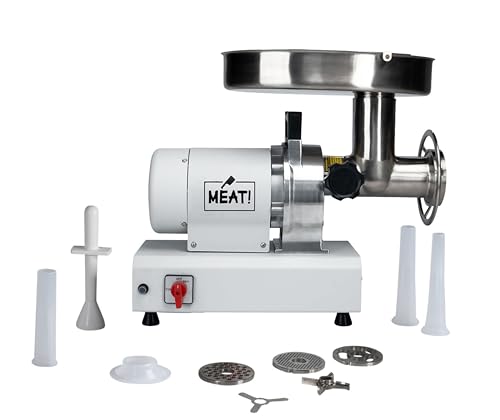
This is the pick for buyers who want the last grinder they’ll need to purchase. The MEAT! 1 HP Pro-Grade uses a stainless #22 head and a 1 HP motor paired with a heavy-duty build. Aggregated owner feedback from hunters and small butcher operations describes years of service on the same unit. The #22 head is significantly larger than any other grinder on this list, which translates to fewer pre-trim steps and less bridging.
It ships with coarse and fine grinding plates, and the stainless construction means the head and auger housing won’t rust over time the way mild-steel or aluminum counterparts do. The motor is designed for continuous light-commercial work, so 50-pound sessions won’t stress it.
Flaws but not dealbreakers. This is the heaviest and largest grinder on the list, and it costs premium money. It’s genuinely overkill for a household that grinds 5 pounds a month. Cleanup takes longer because of the head size, and all the stainless parts need to be dried carefully to avoid water spots.
If you want stainless commercial-grade features at a smaller footprint and lower cost, the ARINOO #12C is the value alternative. If access to the broadest accessory set matters more than build materials, the STX Turboforce 3000 5-in-1 is the better fit.
⚠
Care: Dry every stainless component immediately after washing. Stainless resists rust, not water spots, and mineral deposits left in the plate holes will dull the cutting edge over time.
Pros
✓Stainless #22 head with the largest feed capacity on this list
✓1 HP motor designed for continuous light-commercial sessions
✓Coarse and fine plates included for two-grind workflows
✓Owners report years of service without needing to replace the unit
Cons
✕Heaviest and largest grinder on this list
✕Premium pricing puts it out of reach for casual home users
✕Longer cleanup because of the oversized head and plate
Motor
1 HP
Head size
#22 stainless
Material
Stainless steel
Plates
Coarse + fine
Best for: Serious home processors, hunters, and small butchers who want a stainless #22 head with continuous-duty capability and are willing to pay premium money for it.
The ARINOO #12C is the pick for a small deli, butcher counter, or food producer who wants commercial-grade proportions without the price of the MEAT! flagship. Its 0.9 HP motor and #12C commercial frame sit between the home grinders and the full commercial machines, and owner reports describe it handling 100 to 200 pounds per week without issue.
The stainless head and heavy-duty auger housing are designed for repeat runs, and the machine ships with standard plates plus a sausage kit. If you’re running a weekly grind cycle, the ARINOO is more appropriate than any 3000W peak home unit because the motor is engineered for sustained load, not spec-sheet thrills.
Flaws but not dealbreakers. The machine is louder and heavier than the home-focused picks, and it draws enough current that you’ll want a dedicated circuit in a kitchen. It also lacks the accessory breadth (no kubbe kit, fewer plate sizes) of the STX 5-in-1, so if you want variety over build, that’s the trade.
If you want the ultimate stainless build with a #22 head, the MEAT! 1 HP Pro-Grade is the flagship. If you want the widest accessory kit for home use, the STX Turboforce 3000 5-in-1 is the pick.
⚠
Compatibility: Confirm your kitchen or shop has a 15A or 20A dedicated circuit available. Commercial-class grinders pull more current than a home outlet shared with other appliances can handle.
Pros
✓0.9 HP motor built for small commercial weekly volume
✓#12C commercial frame and stainless head for repeat runs
✓Handles 100 to 200 lbs per week per owner reports
✓Standard plates plus sausage kit included
Cons
✕Louder and heavier than home-focused grinders
✕Needs a dedicated circuit, not a shared kitchen outlet
✕Fewer accessories than the STX 5-in-1 kit
Motor
0.9 HP
Head size
#12C
Use class
Small commercial
Housing
Stainless head
Best for: Small delis, butcher counters, farm stands, and food producers grinding 100 to 200 lbs per week who need commercial build without flagship pricing.
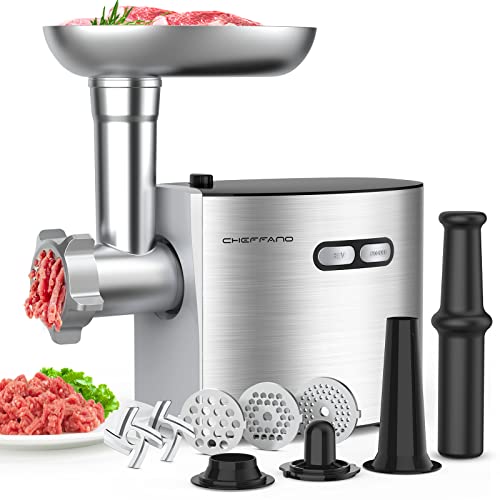
The CHEFFANO 2800W is our budget recommendation, and it’s the right pick if you grind 5 to 15 pounds a few times a month. It’s ETL-approved, which means Underwriters Laboratories personnel (through their ETL listing program) have reviewed its electrical safety for US retail sale. That matters for a budget machine, because far cheaper grinders skip the listing entirely.
The kit includes 2 stainless blades, 3 plates, 3 sausage stuffing tubes, and a kubbe attachment, so first-time buyers get the full toolkit without an add-on purchase. Owner reviews describe 1 to 2 years of regular home use as the realistic service window, which is honest for this price tier.
Flaws but not dealbreakers. The peak 2800W rating is not a sustained figure, and the plastic drive gearing in this class is the weak point over years. Owners report that frozen meat can stall the auger, and you should never force it. Long session runs require cooldown periods.
If you want to step up to a machine with metal drive gears and a low-noise induction motor, the LEM BigBite #8 is the upgrade for the money. If you want more peak power at a similar price point, the Electric Meat Grinder Sausage Stuffer 3 is the closer comparison.
⚠
Safety: The ETL listing proves the electricals meet US safety standards, but budget plastic-geared drives cannot survive frozen meat. Always thaw before grinding and use the pusher, never fingers.
Pros
✓ETL listed, so the electricals meet US safety standards
✓Ships with 2 blades, 3 plates, 3 tubes, and kubbe kit
✓2800W max universal motor has real punch when new
✓Budget-friendly entry without sacrificing accessory count
Cons
✕Plastic drive gearing is the weak point over years of use
✕Peak 2800W is not a sustained-duty rating
✕Stalls on frozen or near-frozen meat if forced
Peak power
2800W max
Certification
ETL listed
Plates
3 included
Tubes
3 sausage tubes
Best for: Budget-conscious home cooks grinding 5 to 15 pounds a few times a month who want an ETL-approved machine with a full accessory kit.
Buying Guide: Power Ratings, Head Size, Build Materials and Budget
Every knife in this category boils down to four decisions: how much power you actually need, what head size matches your volume, which metals you’re paying for, and how much money makes sense for your use pattern. Get those four right and you’ll skip a lot of wasted purchases.
How Much Motor Power Do You Actually Need?
Peak wattage numbers on the box are not the same as sustained motor capability. A “3000W” grinder and a “750W” grinder can perform similarly under load, because the peak figure only reflects a brief surge. What matters more is whether the motor is rated for continuous duty.
For 5 to 15 pounds a month, a 2800W peak universal motor like the CHEFFANO 2800W is enough. For 20 to 50 pounds a month or more, look at rated motors: the VEVOR 750W/1 HP and the Commercial 1100W with its continuous-duty rating are better matches.
For commercial-scale work, only the 1100W continuous and the MEAT! 1 HP units in this list are built to run extended sessions without needing cooldown.
What Head Size Fits Your Volume?
A grinder head is measured in “#” sizes: #8, #12, #22. Bigger numbers mean larger auger bore, wider feed throat, and higher nominal throughput. But bigger heads also mean bigger cleanup and bigger counter footprint.
A #8 head is ideal for small-batch home sausage making in the 20 to 50 pound monthly range. A #12 head fits households pushing 40 to 100 pounds per month, or hunters processing whole animals in one sitting. A #22 head like the one on the MEAT! 1 HP Pro-Grade is professional-grade and overkill for most homes.
Match head size to volume, not to prestige. A household grinding 10 pounds a month doesn’t benefit from a #22 head.
Which Build Materials Matter Most?
Three materials decide how long a heavy duty meat grinder lasts: auger and head metal, drive gearing, and exterior housing.
Stainless steel heads resist corrosion and clean easier. Aluminum heads are lighter and cheaper but can pit if left damp. Plastic drive gears are the single biggest failure point on budget grinders, and they strip under load.
Metal drive gears like the ones in the LEM BigBite #8 are what separate a 2-year machine from a 10-year machine.
For safety compliance, look for ETL or UL listing on the electricals. It’s a basic benchmark for US retail sale. The USDA’s Food Safety and Inspection Service maintains guidance on safe meat handling and storage temperatures that’s worth reviewing before you start grinding, since grinder sanitation matters as much as grinder power.
How Much Should You Spend?
Budget tier buys entry-level universal motors with plastic gearing and enough accessories to get started. Mid-tier buys rated motors, better metal parts, and a longer warranty. Premium tier buys stainless construction and continuous-duty motors built for weekly multi-hour sessions.
The best value usually sits in the mid-tier, where the VEVOR 552 Lbs/H and STX Turboforce 3000 live. You get rated power and metal gearing without paying flagship prices.
Who Should NOT Buy Best Heavy Duty Meat Grinders
Electric heavy duty meat grinders are the wrong purchase for several kinds of buyers. Here’s who they are, and what to look at instead.
You Only Grind Two or Three Times a Year
If your total need is one holiday meatloaf and the occasional batch of burgers, a heavy duty electric grinder is a big purchase for very little use. It’s also storage-heavy and takes counter space most kitchens don’t have spare.
A hand-crank grinder or a stand mixer meat grinder attachment costs a fraction of the price and covers that level of use. You’ll spend more effort per session, but you’ll spend less money and gain back cabinet space.
You Need to Grind Frozen Meat Directly
No consumer-grade heavy duty grinder sold today is designed to process fully frozen meat. The auger and drive gear will stall, and on budget machines with plastic gears, that can mean permanent damage.
If you need to process frozen blocks regularly, look at a commercial-grade band saw or a purpose-built frozen meat flaker instead. Trying to force a home grinder to do that job is how you end up replacing it within a year.
You’re Looking for a Full Food Processor
A meat grinder grinds meat. That’s it. It can stuff sausage, and some models can make kubbe, but it can’t chop vegetables, mix dough, or blend sauces the way a food processor does.
If your actual need is a multi-purpose kitchen machine, buy a food processor and a separate grinder attachment, or buy a meat grinder you won’t ask to do non-meat jobs.
FAQ
What’s the best Heavy Duty Meat Grinders overall?
The LEM Products BigBite #8 is our top overall pick. It’s the best balance of build quality, quiet operation, and ease of cleanup for the typical home sausage maker or small-batch hunter in the 20 to 50 pound per month range.
How long will a heavy duty meat grinder last?
A budget-tier grinder with plastic drive gears typically serves 1 to 3 years under regular home use. A mid-tier unit with metal gears and a rated motor typically runs 5 to 10 years. A stainless commercial-grade machine like the MEAT! 1 HP Pro-Grade can last a decade or more with basic maintenance.
Is a #12 head actually better than a #8 for home use?
Not automatically. A #12 head feeds larger chunks and handles more volume per session, which is helpful above roughly 40 pounds per month. Below that volume, a #8 head runs cooler, cleans faster, and takes less counter space.
Match head size to volume, not to marketing.
Which grinder is easiest to clean?
The LEM BigBite #8 is the simplest to break down and wash because all metal parts come apart by hand. Smaller #8 heads also have fewer tight plate holes to scrub. Commercial-sized #22 heads take longer regardless of brand because of their surface area.
Can I grind frozen meat in one of these grinders?
No. None of the machines on this list are rated to grind fully frozen meat. Even partially frozen meat can strain a plastic drive gear to the point of failure.
Thaw meat to refrigerator temperature (about 34 to 40°F) before grinding for the best results.
What warranty should I expect?
Warranty coverage in this category varies widely. Budget grinders typically offer 12 months. Mid-tier units often offer 2 to 3 years.
Premium and commercial picks range from 1 to 5 years depending on the manufacturer and whether the machine is used in a commercial setting. Check the specific terms before you buy, since commercial use often shortens coverage.
Final Verdict
The LEM Products BigBite #8 is our top pick because it combines three things most grinders in this price range can’t: a metal drive gear, an induction motor that runs quietly, and tool-free disassembly for fast cleanup. For the majority of home sausage makers and small-batch hunters, it hits the practical sweet spot.
Want the widest accessory kit and one machine that does more than grind? Get the STX International Turboforce 3000 5-in-1. You trade plastic exterior panels and peak-wattage marketing for 5 plates, 3 blades, and a kubbe kit in one box, which is a fair exchange for a lot of buyers.
Need stainless commercial build with a #22 head and continuous-duty motor? The MEAT! 1 HP Pro-Grade is the flagship. Need ETL-approved safety at a budget price?
If you fall into any of the categories in the Who Should NOT Buy section above, no grinder on this list is the right purchase. Buying the wrong machine is far more expensive than skipping this category entirely.